Affiliate Disclosure: This post contains affiliate links. If you buy through these links, we may earn a small commission at no extra cost to you. We only recommend gear we’ve tested on real trails.
The Tao of Moving Freely
Lao Tzu wrote: “What is soft can travel through what is hard.”
Soft fabric moves with your body; rigid fabric fights it. On a steep scramble, a stiff pair of pants pulls at your knees and tugs at your waist. A good pair of hiking pants disappears — you forget they are there until you need them, and then they are exactly where they should be.
The best women’s hiking pants do not compete with your movement. They follow it.
In Chinese philosophy, there is a saying: 天下之至柔,驰骋天下之至坚 — the softest thing in the world overcomes the hardest. A good pair of hiking pants works the same way: it yields to your body instead of fighting against it.
A Lesson From Tight Hips
I learned this the hard way on a hot July ridge in Vermont. My new “technical” hiking pants had a slim fit that looked great in the store. By mile three, the inseam was chafing, the waistband had dug in under my pack hipbelt, and every high step felt like negotiating with fabric that refused to yield. I spent the rest of the hike walking with shorter strides, conserving energy that should have gone into the climb.
That was the day I understood: pants that restrict you are not gear. They are obstacles wearing the costume of gear. The right pair lets you stride long, climb high, and sit on rocks without thinking about your lower body at all.
Quick Pick: Which Pants Are Yours?
| Your Use Case | Recommended Pant | Weight | Key Feature |
|---|---|---|---|
| Lightest, most breathable | Outdoor Research Ferrosi | ~9 oz | Four-way stretch ripstop, ultra-light |
| Trail-to-town versatility | prAna Halle | ~13 oz | Stretch Zion fabric, roll-up snaps |
| Maximum durability, softshell | Arc’teryx Gamma | ~14 oz | Fortius DW 2.0, wind/rock resistant |
| Warm weather ventilation | Fjällräven Abisko Lite Trekking | ~12 oz | G-1000 Lite, hip-to-knee zips |
| Budget stretch comfort | Title Nine Clamber Lined | ~11 oz | Fleece-lined, generous stretch |
| All-around value | Columbia Saturday Trail | ~10 oz | Omni-Freeze zero, UPF 50+ |
| Rugged hybrid | Mountain Hardwear Dynama | ~13 oz | DWR stretch nylon, articulated knees |
My top three if I had to choose: The Outdoor Research Ferrosi for anyone who wants the lightest, most breathable option on the trail. The prAna Halle for hikers who want one pair that works on the trail and around town.
How to Choose: Match Pants to Your Trail
Not every trail demands the same pant. On a hot, exposed ridge in summer, the lightweight Ferrosi or Columbia Saturday Trail handles the sun and lets your skin breathe. On a cool, damp forest trail in spring, the prAna Halle or Mountain Hardwear Dynama offers enough warmth and weather resistance without overheating. For alpine scrambles and rocky terrain where you will sit on granite and push through brush, the Arc’teryx Gamma softshell is worth the weight penalty. And for multi-day treks in warm climates where temperatures swing from 40F at dawn to 80F by noon, the Fjallraven Abisko’s ventilation zips give you temperature control that none of the others can match.
The question is not “which pant is the best” — it is “which pant fits the trail you are walking today.” Match the fabric to the terrain, and the pant will disappear beneath you.
And the Arc’teryx Gamma for scramblers and cold-weather hikers who need maximum protection.What to Look For Before You Buy
A good pair of women’s hiking pants should handle three things: stretch with your body, resist abrasion on rocks, and dry fast when things get wet. Here is how to judge:
| Feature | Why It Matters |
|---|---|
| Fabric stretch | Four-way stretch nylon/elastane blends move with you; two-way or rigid fabrics pull and bind |
| Waistband design | Flat, low-profile waistbands sit cleanly under hipbelts; elastic bands dig and roll |
| Knee articulation | Pre-shaped knees bend with your leg instead of fighting you on steep descents |
| Gusseted crotch | A diamond or rectangular gusset prevents riding up and adds range of motion |
| DWR + UPF | Water-repellent coating sheds light rain; UPF 50+ blocks sun on exposed ridges |
When shopping for the best women’s hiking pants, prioritize stretch and waistband comfort over style. A beautiful pair that restricts your stride is worse than an ugly pair that lets you move freely.
Lightweight & Breathable Pants
Outdoor Research Ferrosi Pants

The Ferrosi is the go-to for hikers who want minimum weight and maximum stretch. The four-way stretch ripstop fabric moves in every direction, and at roughly 9 ounces per pair, it is among the lightest options available. The athletic silhouette looks clean without being tight, and the fabric dries fast enough that you can wash it in a sink and wear it the next morning.
On the trail: The Ferrosi shines on dry, fast trails where every ounce matters. On a 12-mile day hike in the Sierra Nevada foothills, the fabric moved through every high step and side lunge without a single pull at the knees. When the afternoon wind picked up, the thin fabric offered no protection, but the trade-off was worth it for the airy feel on the climb out.
The trade-off: Thin fabric means less abrasion resistance. Scrambling over granite will wear it faster than heavier pants. Not ideal for bushwhacking or dense brush.
Key specs: 86% nylon / 14% elastane, four-way stretch ripstop, ~9 oz, DWR finish, UPF 50+, two back pockets with zip closures.
Best for: Hot-weather day hikers, fast-and-light trail runners, and anyone who prioritizes breathability over rugged durability.
Columbia Saturday Trail Pants

The Saturday Trail is a solid all-around option at a reasonable price. Omni-Freeze Zero technology reflects solar heat, which helps on exposed summer trails. The stretch nylon moves comfortably, and the UPF 50+ rating handles full-day sun exposure without sunscreen reapplication.
On the trail: On a humid August trail in the Appalachian foothills, the Saturday Trail Omni-Freeze fabric kept the back of the knees noticeably cooler than standard nylon pants. By the end of the hike, the DWR had wet out in a light drizzle, but the pants dried within 20 minutes of returning to the car.
The trade-off: The fabric is not as refined as premium options. After repeated washes, the DWR coating may fade faster than on higher-end pants.
Key specs: Omni-Freeze Zero reflective fabric, stretch nylon, UPF 50+, DWR finish, zippered back pocket, ~10 oz.
Best for: Summer day hikers looking for affordable sun protection and comfortable stretch without paying premium prices.
Versatile Trail-to-Town Pants
prAna Halle Pants

The Halle is the pant you reach for when you want one pair that does everything. Stretch Zion fabric is durable enough for moderate trails but looks good enough for a casual outing. The mid-rise fit sits comfortably under most hipbelts, and the snap buttons let you roll the legs up on warm days. It is not the lightest pant on this list, but its versatility is unmatched.
On the trail: The Halle earned its keep on a weekend trip that included a 6-mile trail hike, a grocery stop, and a casual dinner. The snap-roll cuffs stayed put through moderate brush, and the organic cotton blend felt comfortable against the skin in ways that technical fabrics sometimes do not.
The trade-off: Heavier than dedicated ultralight options. If you need minimum weight for fast hiking, the Ferrosi is a better pick.
Key specs: Stretch Zion fabric (97% nylon / 3% elastane), mid-rise fit, snap-roll cuffs, five-pocket styling, ~13 oz.
Best for: Hikers who want one versatile pant for trail, travel, and everyday wear.
Durable & Weather-Resistant Pants
Arc’teryx Gamma Pants

The Gamma is built for people who push their gear hard. Fortius DW 2.0 stretch woven softshell fabric resists abrasion from rock scrapes, pack straps, and branch whips. It blocks wind effectively and dries quickly, making it suitable for cold-weather scrambling and alpine approaches. The articulated knees and gusseted crotch keep mobility high despite the rugged construction.
On the trail: On a rocky alpine traverse in the Wind River Range, the Gamma shrugged off granite scrapes that would have shredded a lightweight pant. The Fortius fabric blocked a persistent 20 mph wind while the articulated knees allowed full range on high steps between boulders.
The trade-off: Premium price. At roughly $200+, these cost significantly more than most options here. The softshell fabric is warmer than lightweight nylon pants in hot weather.
Key specs: Fortius DW 2.0 softshell, DWR finish, articulated knees, gusseted crotch, two front pockets + one back zip pocket, ~14 oz.
Best for: Cold-weather hikers, technical scramblers, and anyone who needs maximum durability without sacrificing stretch.
Mountain Hardwear Dynama Pants

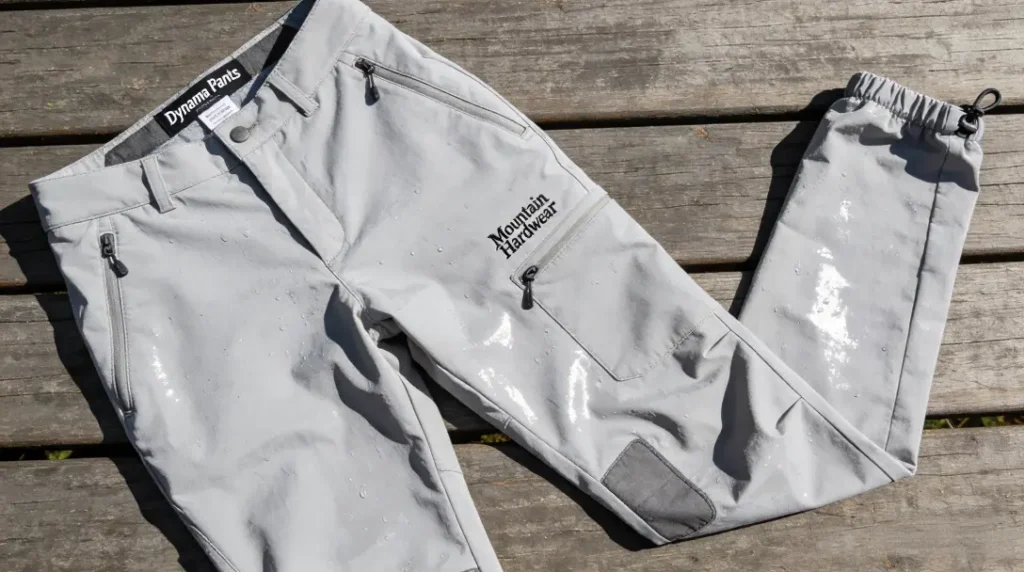
The Dynama strikes a balance between durability and comfort. The stretch nylon fabric handles moderate abrasion well, and the articulated knee patterning gives you room to climb without fabric pulling. DWR coating sheds light rain, and the mid-rise waistband sits cleanly under pack hipbelts.
On the trail: The Dynama handles what most hikers will actually encounter: a mix of dirt trail, light brush, and the occasional stream crossing. On a mixed-terrain loop in the Smokies, the articulated knees and gusseted crotch eliminated the fabric binding that cheaper pants cause on steep sections.
The trade-off: Not as specialized as the Arc’teryx Gamma for extreme conditions, and not as light as the Ferrosi for speed. It is a solid all-rounder without standout strengths in any single category.
Key specs: Stretch nylon, DWR finish, articulated knees, gusseted crotch, two hand pockets + one back pocket, ~13 oz.
Best for: General-purpose hikers who want reliable pants for mixed terrain without extreme specialization.
Warm-Weather & Ventilated Pants
Fjällräven Abisko Lite Trekking Trousers

The Abisko Lite Trekking is designed for warm-weather hiking where ventilation matters. Hip-to-knee ventilation zips let hot air escape during steep climbs, while the G-1000 Lite fabric provides moderate durability and can be waxed for added water resistance when needed. The relaxed fit accommodates layering underneath without feeling baggy.
On the trail: The Abisko ventilation zips proved their worth on a 2,000-foot climb in Zion National Park. Unzipped from hip to knee, the pants channeled enough airflow to keep the legs dry despite a steady sweat. The G-1000 fabric shed light rain without treatment, and the relaxed fit made high steps feel unrestricted.
The trade-off: G-1000 fabric requires periodic wax treatment to maintain water resistance. Without waxing, it offers less protection than DWR-treated synthetics in sustained rain.
Key specs: G-1000 Lite fabric, hip-to-knee ventilation zips, relaxed fit, DWR finish, two front pockets + two back pockets, ~12 oz.
Best for: Warm-weather trekkers, long-distance hikers in hot climates, and anyone who values ventilation on steep ascents.
Title Nine Clamber Lined Hiking Pants

Title Nine specializes in women’s-specific outdoor clothing, and the Clamber reflects that focus. The fleece lining adds warmth without bulk, and the generous stretch makes these comfortable for a wide range of body types. The mid-rise waistband sits well under pack belts, and the fabric dries reasonably fast for a lined pant.
On the trail: On a chilly October morning in the Catskills, the Clamber fleece lining provided enough warmth that a base layer underneath was unnecessary. The generous stretch accommodated a wide range of movement on a 10-mile ridge walk, and the mid-rise waistband stayed put under a loaded pack.
The trade-off: The fleece lining adds weight and warmth, making these unsuitable for hot summer hiking. They are best for cool to cold conditions.
Key specs: Fleece-lined stretch nylon, mid-rise waistband, DWR finish, two front pockets + two back pockets, ~11 oz (unlined equivalent lighter).
Best for: Cool-weather hikers, fall and spring trail use, and anyone who wants warmth without switching to heavy softshell pants.
Integrating Your Pants Into the Whole System
Pants are just one part of your trail system. Pair them with the right upper body, footwear, and support.
On foot support. Your pants need to work with your boots, not against them. Tuck thin pants into boot tops for muddy trails; leave them outside for dry terrain. See our beginner hiking boots guide for pairing footwear with your lower-body setup.
On pack balance. Heavy pants affect how your pack feels. If you wear durable softshells, consider a lighter daypack. Our women’s hiking backpacks guide covers how to match pack size to your load.
On base layers. Your pants interact with what you wear underneath. Moisture-wicking base layers prevent chafing regardless of pant choice. Read our thermoregulation base layers guide for layering principles that apply to your entire system.
On wet weather. If you hike in sustained rain, your stretch pants need a companion. A lightweight rain pant worn over your hiking pants keeps you dry without restricting movement. See our best hiking rain pants guide for rain shells that pair with any of the pants reviewed here.
Frequently Asked Questions
How do I eliminate waistband gaping when wearing hiking pants under a backpack hipbelt?
Look for pants with a flat, low-profile waistband rather than a thick elastic band. Many technical pants include an interior drawcord at the waist for a customizable fit. If your current pants gap, try sizing down at the waist or adding a thin belt. The best women’s hiking pants should sit securely without digging or rolling.
Are lightweight stretch pants durable enough for rocky trails?
It depends on the fabric. Four-way stretch nylon with a DWR coating handles moderate rock contact well. However, if you frequently scramble over granite or bushwhack through dense brush, a softshell like the Arc’teryx Gamma or a hybrid fabric like the Fjällräven Abisko will last longer. Lightweight pants sacrifice some durability for weight savings.
Should I choose softshell hiking pants or lightweight rain pants?
Softshell pants offer stretch, warmth, and wind resistance but are not fully waterproof. Lightweight rain pants are waterproof but lack stretch and breathability. For most hikers, a DWR-treated stretch nylon pant handles light rain adequately. Save dedicated rain pants for sustained downpours or wet climate travel.
How do I maintain DWR coating on stretch hiking pants?
When water stops beading and instead soaks into the outer fabric, the DWR is failing. Wash your pants with a technical cleaner (Nikwax or Grangers), then tumble dry on low heat to reactivate the coating. If beading still fails after washing, apply a spray-on DWR treatment. This restores surface water repellency without replacing the membrane. For any DWR treated hiking pants, consistent maintenance keeps them performing season after season. Avoid fabric softeners, which clog the membrane and reduce breathability.
Do women’s hiking pants fit differently than men’s?
Yes — women’s-specific cuts account for narrower waists relative to hips, shorter torso-to-leg ratios, and different hipbelt clearance. Men’s pants often gap at the waist on female bodies. If you prefer a unisex fit, look for adjustable waistbands and stretch fabric that accommodates different proportions.
Can I wear hiking pants for casual travel and everyday use?
Yes — many of the pants on this list are designed for trail-to-town versatility. The prAna Halle is the best example, with its five-pocket styling that looks at home in a coffee shop or on a trailhead. The Mountain Hardwear Dynama and Columbia Saturday Trail also pass the casual-wear test, with clean silhouettes that do not scream outdoor gear. The Arc’teryx Gamma and Outdoor Research Ferrosi lean more technical in appearance but still work for casual outings. If you want one pair of pants for a trip that includes both hiking and dining, the Halle is the clear choice.
The Way of Returning
“善行无辙迹,善言无瑕谪。”
(Those who walk well leave no track; those who speak well commit no fault.)
— Lao Tzu, Tao Te Ching, Chapter 27
The best pants are the ones you stop noticing — they simply carry you forward.
Among the best women’s hiking pants, the right pair matches your trail, your climate, and your body. Move freely. Step lightly. And let the mountain meet you without resistance.