Affiliate Disclosure: This post contains affiliate links. If you buy through these links, we may earn a small commission at no extra cost to you. We only recommend gear we’ve tested on real trails.
The Day My Phone Died at 8,000 Feet
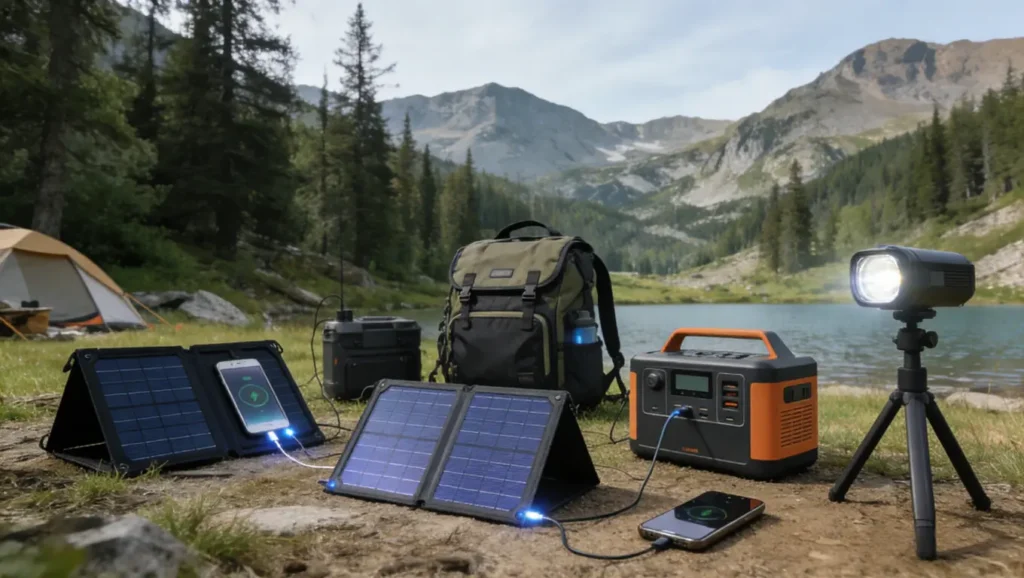
I learned why solar matters on a cold October morning in the White Mountains. My phone — my map, my emergency beacon, my camera — died three miles from the trailhead after I’d been using it for GPS navigation all day. I had a standard power bank in my pack, but it was already at 15% and wouldn’t recharge until I got home. What I needed was sunlight. Instead, I sat on a rock for two hours watching the sky go gray, wishing I’d invested in a panel that could keep my devices alive. That day I realized: solar isn’t about convenience. It’s about not being stranded when your battery hits zero far from civilization.
The best portable solar chargers for hikers balance three competing demands: output under real conditions, weight you’ll actually carry, and durability that survives being dropped in mud. A 100-watt panel sounds impressive until you realize you can’t fold it into your pack. A featherlight 5-watt model saves grams but won’t charge anything on a cloudy day. The panels on this list span that spectrum — from ultralight day-hike companions to heavy-duty base camp units. Choose based on how you’ll actually use it, not what looks most impressive on a spec sheet.
Quick Pick: Which Panel Is Yours?
| Your Use Case | Recommended Panel | Weight | Key Feature |
|---|---|---|---|
| Ultralight day hiking | Voltaic Systems Arc 10W | ~0.68 lb | ETFE coating, 5+ year lifespan |
| Through-hiking | Anker SOLIX PS100 / 625 | < 1.0 lb | Carabiner lash points, dual USB |
| Rugged durability | Goal Zero Nomad 20 | ~2.28 lbs | 180° kickstand, ecosystem chaining |
| Budget multi-device | BigBlue 3-Port 28W | ~1.3 lb | LED ammeter, SunPower cells |
| Built-in battery | BioLite SolarPanel 10+ | Ultra-slim | 3,200 mAh buffer, sundial tracker |
| Base camp power | Jackery SolarSaga 100W | Heavy-duty | Bifacial design, IP68 waterproof |
| Overcast conditions | MARBERO 21W | ~1.32 lbs | Smart protection chip, DC port |
My top three if I had to choose: The Voltaic Systems Arc 10W for anyone who counts every ounce — at less than 11 ounces with an ETFE coating that lasts five years, it’s the most durable ultralight option. The Anker SOLIX PS100 / 625 for through-hikers — carabiner lash points let you charge while walking, which is genuinely useful. And the Jackery SolarSaga 100W if you do car camping or base camp trips — 100 watts of bifacial power is hard to beat for stationary setups.
What to Look For Before You Buy
A good solar charger isn’t just about wattage. Here’s what actually matters on the trail:
| Feature | Why It Matters |
|---|---|
| Cell type | Monocrystalline = better efficiency (20–25%); polycrystalline = cheaper but less output per square inch |
| Weight-to-watt ratio | A 20W panel weighing 2 lbs is fine for base camp; for day hiking, aim for under 1 lb even if wattage is lower |
| Weather resistance | IP ratings matter for rain and dust. ETFE coatings resist UV degradation better than PET |
| Output ports | USB-C PD (Power Delivery) charges phones fastest. Multiple ports let you charge phone + GPS simultaneously |
| Kickstand vs. lash points | Kickstands work for stationary charging at camp. Carabiner/lash points are better for hanging on packs while moving |
| Internal battery | Some panels store charge internally (BioLite), so you can charge your phone at night without a separate power bank |
When shopping for the best portable solar chargers for hikers, prioritize cell efficiency and weather resistance over total wattage. A 10W monocrystalline panel in direct sun often outperforms a 20W polycrystalline one in shade.
Best Portable Solar Chargers for Hikers
Voltaic Systems Arc 10W Solar Charger

At 0.68 pounds, the Arc 10W is one of the lightest solar panels you can carry without sacrificing build quality. Its SunPower cells deliver solid conversion efficiency, and the ETFE laminate coating is the real differentiator — it resists scratches, UV degradation, and abrasion far better than standard PET panels. The auto-reset technology handles partial shade gracefully; when clouds or tree cover temporarily block the cells, the panel resets its output cycle automatically rather than stalling out. Corner eyelets make it easy to lash to a pack or trekking pole. Voltaic Systems also offers a 5-year warranty and repairable design, which matters for a product meant to survive years of trail abuse.
The trade-off: At 10W with a single port, it’s designed for steady trickle charging of phones and small devices. It won’t fast-charge a tablet or power multiple devices simultaneously.
Key specs: SunPower cells, ETFE scratch-resistant coating, auto-reset technology, reinforced corner eyelets, ~0.68 lb (309g), 5+ year lifespan, single USB port.
Best for: Long-distance backpackers, sustainability-focused buyers, and minimalists who want a tough, long-lasting trail charger.
Anker SOLIX PS100 / 625 Solar Panel

The Anker SOLIX PS100 / 625 targets the sweet spot between weight and output. At under one pound, it folds into a book-sized package that slips easily into a pack side pocket or lash-on exterior. The monocrystalline cells deliver up to 21W peak output, and dual USB ports (USB-C + USB-A) let you charge two devices at once. The integrated carabiner lash tracks are genuinely useful — you can clip the panel to the top of your backpack and charge while walking, which captures energy during active movement rather than waiting at camp. The reinforced fabric resists tearing, and the overall build quality matches Anker’s reputation for reliable consumer electronics.
The trade-off: No built-in kickstand. You need to prop it against a rock, log, or pack to angle it toward the sun at camp.
Key specs: Monocrystalline silicon, 21W peak output, dual USB ports (USB-C + USB-A), carabiner lash tracks, < 1.0 lb, book-sized fold.
Best for: Through-hikers, lightweight daypack explorers, and remote backpackers seeking efficient on-the-move charging.
Goal Zero Nomad 20 Solar Panel

The Nomad 20 is built like a tank. Its ruggedized outer casing survives drops, abrasion, and rain — the kind of abuse that cracks cheaper panels. The 180-degree adjustable kickstand is the standout feature: it locks securely at any angle, letting you track the sun across the sky without repositioning the entire panel. At 20W, it charges phones steadily and can handle small power banks in a reasonable timeframe. The integrated 8mm ecosystem cable connects directly to Goal Zero power stations, making it part of a larger off-grid system if you’re already invested in their gear. The monocrystalline cells deliver consistent output even in partial shade.
The trade-off: At 2.28 pounds, it’s noticeably heavier than folding ultralight panels. You pay for durability, and some of that weight goes into armor you might not need on easy trails.
Key specs: Monocrystalline cells, 20W peak output, 180° adjustable kickstand, 8mm ecosystem cable, ~2.28 lbs, rugged weather-resistant casing.
Best for: Multi-week wilderness expeditions, rugged backcountry base camps, and users integrating into the Goal Zero power ecosystem.
BigBlue 3-Port Solar Charger

The BigBlue 3-Port brings 28W of power to a budget price, using premium SunPower cells that perform well even under diffuse light. The standout feature is the built-in LED ammeter — a small digital display showing real-time wattage input. This lets you adjust panel placement instantly instead of guessing whether you’re getting optimal sun exposure. Three USB ports mean you can charge a phone, GPS, and headlamp simultaneously, which matters for group trips. The four-panel folding design maximizes surface area within a compact footprint, and the industrial waterproof sealing holds up in light rain.
The trade-off: When unfolded, the four-panel layout is wide and can be unwieldy to hang from narrow daypacks. It’s better suited for flat deployment at camp.
Key specs: SunPower cells, 28W peak output, triple USB ports, integrated LED ammeter, ~21 oz (595g), waterproof construction.
Best for: Budget-conscious group trips, family base camps, and backpackers in variable or cloudy environments.
BioLite SolarPanel 10+

The SolarPanel 10+ does something most panels don’t: it stores charge internally. The built-in 3,200 mAh battery captures solar energy throughout the day, so you can charge your phone at night without carrying a separate power bank. The patented SunEnabled sundial alignment finder makes positioning simple — align the shadow and you’re oriented correctly toward the sun. At 10W, it’s designed for steady harvesting rather than fast charging. The ultra-slim folding design tucks into a pack easily, and the 360-degree kickstand wire frame keeps it stable on uneven ground. BioLite’s reputation for innovative outdoor electronics shows in the thoughtful details.
The trade-off: 10W means slower charging for larger devices. A phone will take significantly longer to fully charge compared to higher-wattage panels, and tablets may not charge at all under marginal conditions.
Key specs: Monocrystalline cells, 10W output, 3,200 mAh internal battery, SunEnabled sundial tracker, 360° kickstand wire frame, ultra-slim fold.
Best for: Ultralight backpackers, solo through-hikers, and minimalists who value smart multi-functional gear integration.
Jackery SolarSaga 100W

The SolarSaga 100W is a base camp powerhouse, not a day-hike companion. At 100W with a bifacial design, it captures sunlight from both front and rear surfaces — direct rays hit the front while scattered ambient light reflects off the ground and enters the back, boosting total output by up to 30%. The ETFE laminated casing carries an IP68 rating, meaning it survives rain, dust, and mud without issue. Twin integrated kickstands make setup quick, and the heavy-duty TPE rubber handle simplifies transport. For car campers, overlanders, or expedition teams running large gear kits, 100W of clean power is game-changing.
The trade-off: This is a stationary panel. Its size and weight make it impractical for traditional backpacking — it belongs in a vehicle or at a fixed camp.
Key specs: Bifacial monocrystalline cells, 100W output, 25% energy conversion rate, IP68 waterproof/dustproof, twin kickstands, ETFE casing.
Best for: Car campers, overlanding rigs, multi-week base camps, and outdoor media creators running large gear kits.
MARBERO 21W Solar Charger

The MARBERO 21W handles changing weather better than most panels in its class. Its intelligent on-board processor detects your device’s power requirements and adjusts output accordingly, maximizing charging speed while protecting against overloads. Under dense cloud cover, it maintains a stable 12W–16W flow — enough to keep phones and small devices charged even on overcast days. The 23% conversion efficiency is competitive for the price range, and the Oxford cloth wrap adds durability without significant weight penalty. The included 18V DC barrel port and interchangeable adapter cables make it compatible with a wider range of devices than typical USB-only panels.
The trade-off: The DC port and multiple adapters add small accessories to manage in your pack. If you only charge phones via USB, those extras are dead weight.
Key specs: Monocrystalline silicon, 21W peak output, 23% conversion efficiency, smart protection chip, DC barrel port + USB outputs, ~1.32 lbs (600g).
Best for: Backcountry travelers, casual hikers, and seasonal campers wanting a lightweight, adaptable charging setup.
Integrating Your Solar Charger Into the Whole System
A solar panel is only one piece of your off-grid power strategy. Pair it with the right supporting gear.
On navigation. Keeping your GPS, phone, and communication devices charged is critical in remote terrain. Our guide to intuitive trail finding beyond GPS covers sensory navigation techniques that keep you oriented even when your electronics die.
On load carriage. Solar panels add weight and bulk to your pack. Our ultralight backpacks under 2 lbs guide covers how to match pack capacity to your body and trip length — principles that apply whether you’re carrying a hydration system or a full solar setup.
On tool support. Field repairs and gear adjustments often come before charging matters. Our survival multi-tools guide covers which tools handle trail repairs without adding bulk.
On foot support. Good footwear prevents injuries that render even the best solar setup secondary. Our beginner hiking boots under $100 covers grip, ankle support, and waterproofing essentials.
Frequently Asked Questions
How much sunlight do I actually need to charge a phone with a solar panel?
Most smartphones require roughly 10–15 watt-hours to go from empty to full. A 10W panel in direct, optimal sun delivers about 10W per hour, meaning 1.5 to 2 hours of direct sunlight charges a phone from zero. In reality, factors like angle, temperature, and passing clouds reduce effective output. Expect 3–4 hours of real-world charging time for a 10W panel. Higher-wattage panels (20W+) cut this roughly in half. Using an external power bank as an intermediate buffer is more efficient than charging your phone directly from the panel, since power banks smooth out the variable solar input.
Can I charge my solar panel in the shade or on cloudy days?
Yes, but expect dramatically reduced output. Premium monocrystalline panels capture diffuse light, but under heavy cloud cover output typically drops to 10–25% of rated peak wattage. A 20W panel under grey skies may deliver only 2–5W. This means charging times increase proportionally — what takes 2 hours in direct sun could take 8–10 hours under overcast conditions. To maximize output in shade, position your panel facing the brightest part of the sky and clear any dust or debris from the cells. Panels with SunPower cells (like the BigBlue 3-Port) handle diffuse light better than budget alternatives.
Should I connect my phone directly to a solar panel or use a power bank first?
Use a power bank as an intermediate buffer. Connecting a phone directly to a solar panel exposes it to continuous power fluctuations as clouds pass or you walk through tree canopy. The phone’s charging circuit wakes and sleeps repeatedly, generating heat and degrading battery health over time. A power bank absorbs the variable solar energy smoothly and then delivers steady, regulated power to your phone. This protects your phone’s battery and charges it more efficiently. Most modern power banks include USB-C PD input, making them compatible with solar panel output.
How do I know if a solar panel is worth the price difference?
Check three things: cell type, coating material, and warranty. Monocrystalline cells outperform polycrystalline in efficiency and weight. ETFE coatings last 3–5× longer than PET under UV exposure. A 5-year warranty (Voltaic, Anker) signals manufacturer confidence. Cheap panels often use lower-grade cells with inflated wattage ratings — a “20W” panel that delivers 12W in real conditions is worse than a “10W” panel delivering 10W. Read verified reviews and check independent wattage tests before buying.
How do I maintain a solar panel to ensure long-term performance?
Clean the panel surface regularly with a damp cloth to remove dust, dirt, and bird droppings — any obstruction reduces light absorption. Store it in a dry, cool place when not in use. Check connectors and cables periodically for wear or corrosion. Avoid folding along the same crease lines repeatedly, as this can damage internal cell connections over time. For panels with kickstands, lubricate hinges annually to prevent stiffness. A well-maintained panel from a quality manufacturer should last 5+ years of regular trail use.
The Way of Returning
“人法地,地法天,天法道,道法自然。”
(Man follows the Earth, the Earth follows Heaven, Heaven follows the Dao, and the Dao follows nature.)
— Laozi, Tao Te Ching, Chapter 25
The best solar charger is the one you deploy without thinking — it catches the light, fills the battery, and gets out of the way.
Among the best portable solar chargers for hikers available, the right choice depends on where you carry it, what devices you need to power, and how much weight you’re willing to accept. Pick one that matches your real trips, not your fantasy emergencies. Keep it clean. Keep it dry. And let it do the work.
The sun gives freely to anyone who knows where to look. A charger that catches that light without demanding attention is the kind that stays in the pack all season and is only missed when it is not there — light that becomes power without a word said about either.