Affiliate Disclosure: This post contains affiliate links. If you buy through these links, we may earn a small commission at no extra cost to you. We only recommend gear we’ve tested on real trails.
The Day My Carabiner Snapped
I was on a solo trip in the Uintas when my carabiner — one of those cheap ones I’d been using for years without thinking about it — snapped clean in half while I was clipping into a fixed line. No warning, no creaking, just gone. I had a minor scrape from the fall, nothing serious, but the realization hit hard: I’d been carrying a first aid kit that was basically a handful of bandaids and some ibuprofen in a ziplock bag. That night, sitting by a camp stove with a bleeding palm and a kit full of expired bandages, I realized something basic: your first aid kit is only as good as what’s actually inside it, not how many compartments it has.
The best first aid kits outdoor aren’t about packing every conceivable item. They’re about matching your supplies to where you go, who you’re with, and what you can actually do under pressure. A $30 kit from the drugstore works fine for car camping. It doesn’t work for backcountry solo trips where help is hours away. The six kits on this list span that range — from ultralight day-hike pouches to professional-grade trauma packs. Choose based on your actual conditions, not your worst-case fantasy.
Quick Pick: Which Kit Is Yours?
| Your Use Case | Recommended Kit | Weight | Key Feature |
|---|---|---|---|
| Group expeditions | AMK Mountain Series Guide Kit | ~2.0 lbs | QuikClot gauze, C-splint, 14-day supply |
| Advanced trauma | MyMedic MyFAK PRO | ~Heavy-duty | Sam XT tourniquet, chest decompression needles |
| Ultralight hiking | Surviveware 98-Piece Premium | ~1.0 lb | Color-coded compartments, CPR pouch |
| Bleeding control | AMK Trauma Pak Pro | ~7.05 oz | QuikClot sponge, SWAT-T tourniquet |
| Professional EMS | Lightning X Modular Backpack | ~22.0 lbs | 272 BLS supplies, color-coded pods |
| Hunting/overlanding | MyMedic TFAK Pocket Kit | ~1.25 lbs | Tear-away panel, rapid-access tourniquet |
My top three if I had to choose: The AMK Mountain Series Guide Kit for group trips — the organization system alone saves time when someone’s bleeding. The Surviveware 98-Piece Premium for solo hikers — light enough to carry every weekend and well-organized enough to find what you need. And the AMK Trauma Pak Pro as a supplement to any larger kit — hemorrhage control matters more than most people think.
What to Look For Before You Buy
A good first aid kit isn’t just a collection of supplies — it’s a system. Here’s what actually matters:
| Feature | Why It Matters |
|---|---|
| Waterproof case | Moisture ruins bandages, dissolves medications, and destroys adhesive strength. Look for sealed cases or dry bags |
| Organization system | In an emergency, you won’t have time to dig through a black hole of supplies. Color-coded compartments save seconds that matter |
| Trauma vs. basic care | Basic kits handle blisters and cuts. Trauma kits add tourniquets, chest seals, and hemostatic gauze for life-threatening injuries |
| Weight-to-supply ratio | Every ounce counts on long hikes. A 1-pound kit that covers your actual needs beats a 5-pound kit full of items you’ll never use |
| Expiration management | Check dates before every trip. Expired epinephrine and dried-out adhesives are worse than useless |
| Training alignment | Carry what you know how to use. A SAM splint is great until you realize you don’t know how to apply it |
When shopping for the best first aid kits outdoor, prioritize waterproof construction and organization over total item count. A smaller kit you can navigate blindfolded is better than a bigger one you fumble through at 2 AM in the rain.
Best First Aid Kits
Adventure Medical Kits Mountain Series Guide Kit

The Mountain Series Guide Kit is built for groups, not individuals. At 163 components, it covers everything from minor trail injuries to serious trauma for up to seven people over two weeks. The Easy Care organization system divides supplies into clearly labeled sections — wound care, medications, tools, and trauma — which matters enormously when adrenaline is running high and you need to find gauze fast. The included QuikClot hemostatic gauze stops arterial bleeding faster than regular dressings, and the moldable aluminum C-splint can immobilize a forearm or lower leg. The outer carry bag is waterproof and reflective, so even if you drop it in muddy water it survives. Dr. Eric Weiss’s wilderness medical reference book is surprisingly useful — thin enough to fit in the kit, detailed enough to look up specific treatment steps.
The trade-off: At two pounds, it’s too bulky for solo day hikes. It belongs in a group pack or at basecamp.
Key specs: 163 components, QuikClot gauze + C-splint, waterproof reflective bag, ~2 lbs (907g), supports 4–7 people for up to 14 days.
Best for: Professional mountain guides, wilderness group leaders, multi-week backpacking trips, and alpine search teams.
MyMedic MyFAK PRO First Aid Kit

The MyFAK PRO was designed by combat medics for people who need more than bandaids. Its 160+ components include a Sam XT mechanical tourniquet, chest decompression needles, nasopharyngeal airways, and an Israeli pressure bandage — items you’ll find in an emergency room, not a drugstore. The crush-resistant, waterproof shell clips onto MOLLE webbing on tactical frames or vehicle overland rigs. Every component is individually wrapped and dated, making inventory checks straightforward. The heavy-duty construction survives being dropped from height, run over by a vehicle, or submerged in stream water.
The trade-off: Most of these tools require WFR or EMT-level training to use safely. Packing a chest decompression needle without knowing how to place it won’t help anyone.
Key specs: 160+ medical-grade components, Sam XT tourniquet, chest decompression needles, NP airway, Israeli bandage, MOLLE-compatible shell, lifetime warranty.
Best for: Certified wilderness first responders, remote overlanding teams, tactical guides, and experienced backcountry explorers with advanced first-aid training.
Surviveware 98-Piece Premium First Aid Kit

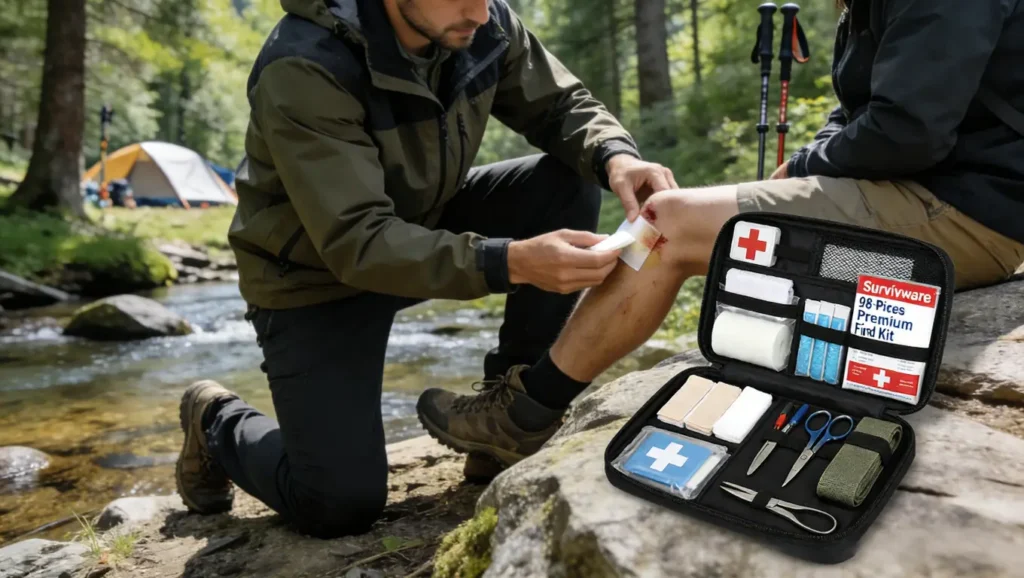
At one pound, the Surviveware kit punches above its weight in organization. The interior layout uses color-coded compartments that make finding supplies without looking possible — useful when you’re treating a wound in low light or with shaking hands. The removable CPR breathing pouch keeps the mask separate from general supplies, and the included first aid reference guide covers everything from heat stroke to snake bites. All internal components are sealed in durable laminate pouches that resist rain and dirt. The 600D polyester outer case is rip-resistant and water-resistant, surviving drops, abrasion, and rough handling. At under $40, it’s one of the best value propositions on this list.
The trade-off: It handles minor wounds, sprains, and lacerations well. Major trauma — deep cuts requiring tourniquets, compound fractures, severe burns — is beyond its scope.
Key specs: 98 essentials, color-coded compartments, removable CPR pouch, first aid reference guide, 600D rip-resistant case, ~1 lb (454g), HSA/FSA eligible.
Best for: Ultralight backpackers, solo day hikers, car camping trips, and minimalist outdoor enthusiasts.
Adventure Medical Kits Trauma Pak Pro with QuikClot

The Trauma Pak Pro does one thing and does it well: stop life-threatening bleeding. It doesn’t include bandaids or painkillers because it’s not trying to be a complete kit. Instead, it packs a kaolin-infused QuikClot Advanced Clotting Sponge that accelerates natural clotting up to five times faster than pressure alone, a SWAT-T elastic tourniquet that anyone can apply under stress, a 5×9 heavy trauma pad, nitrile gloves, and industrial duct tape. At 7.05 ounces, it fits in a jacket pocket or clips to a pack strap for instant access. This is the kind of kit you carry alongside a regular first aid pouch — a dedicated hemorrhage control module for when seconds count.
The trade-off: Zero provisions for minor trail needs like blister care, medications, or antiseptic cleaning. It’s a supplement, not a replacement.
Key specs: QuikClot sponge + SWAT-T tourniquet, 5×9 trauma pad, nitrile gloves, duct tape, ~7.05 oz (200g), pocket-sized.
Best for: High-risk hunting trips, professional wilderness guides, and anyone needing dedicated bleeding control backup.
Lightning X Stocked Modular Responder Backpack

This isn’t a backpacking kit — it’s a mobile medical station. The Lightning X comes fully loaded with 272 BLS supplies across color-coded, transparent internal pods that slide out for easy access. The R.A.T.S. tourniquet line, QuikClot gauze, vented chest seals, stethoscope, blood pressure cuff, trauma shears, and SAM splints cover nearly every basic life support scenario. The integrated hydration bladder slot and ergonomic shoulder yoke suggest it was designed by people who’ve actually carried medical gear in the field. For search-and-rescue teams, outdoor school programs, or large group expeditions, having a single pack that answers most medical questions is invaluable.
The trade-off: At 22 pounds fully loaded, it requires a dedicated bearer. This is a basecamp or team pack, not personal carry.
Key specs: 272 BLS supplies, R.A.T.S. tourniquet, QuikClot gauze, chest seals, stethoscope, BP cuff, trauma shears, SAM splints, hydration bladder slot, ~22 lbs (fully loaded).
Best for: Wilderness search and rescue volunteers, outdoor school educators, youth camp coordinators, and professional first responders.
MyMedic TFAK Trauma First Aid Kit

The TFAK (Tactical Field Application Kit) is built for one scenario: severe penetrating wounds in remote locations where help is hours away. At 35+ components, it’s compact but focused. The tear-away hook-and-loop backing lets you rip the entire kit off a backpack or vehicle mount in seconds — no unzipping, no searching. The external rapid-access tourniquet pouch keeps the most critical tool on the outside where it’s instantly grabbable. Specialized chest seals and hemostatic dressings address the kind of injuries hunters and overlanders face when far from civilization. The coyote-colored exterior blends into field environments without drawing attention. Backed by a manufacturer lifetime guarantee.
The trade-off: Emphasizes trauma care over everyday first aid. You’ll need a separate kit for blisters, medications, and minor cuts.
Key specs: 35+ premium trauma essentials, chest seals, rapid-access tourniquet pouch, tear-away backing panel, ~1.25 lbs (20 oz), lifetime guarantee.
Best for: Backcountry hunters, remote overlanders, vehicle emergency kits, and solo adventurers in high-risk environments.
Integrating Your First Aid Kit Into the Whole System
A first aid kit is only one piece of your safety setup. Pair it with the right supporting gear.
On navigation. Managing an acute injury in remote terrain becomes exponentially harder if you also lose your bearings. A stable medical response starts with knowing where you are. Our guide to intuitive trail finding beyond GPS covers sensory navigation techniques that keep you oriented when electronics fail.
On load carriage. Heavy medical arrays add noticeable weight to your pack. Our ultralight backpacks under 2 lbs guide covers how to match pack capacity to your body and trip length — principles that apply whether you’re carrying a hydration system or a full trauma kit.
On tool support. Mechanical trail adjustments — cutting branches, repairing gear, building shelter — often come before medical treatment. Our survival multi-tools guide covers which tools handle field repairs without adding bulk.
On foot support. Good footwear prevents ankle injuries that render even the best first aid kit secondary. Our beginner hiking boots under $100 covers grip, ankle support, and waterproofing essentials.
Frequently Asked Questions
How do I know if my first aid kit is adequate for a specific trip?
Match three factors: group size, trip duration, and your training level. A solo day hike needs fewer supplies than a week-long group expedition. If you have WFR certification, you can carry and use more advanced tools. If your training stops at basic first aid, focus on quality wound care, splinting materials, and evacuation planning rather than purchasing tools you won’t know how to use. The rule of thumb: if you wouldn’t feel comfortable using it in the dark with shaking hands, don’t rely on it in an emergency.
How often should I check and rotate my first aid kit?
Every six months at minimum. Check expiration dates on all medications, ointments, and sterile items. Verify packaging seals are unbroken. Replace anything past its date or showing signs of degradation — dried adhesives, cracked elastic, corroded metal instruments. Follow the FIFO (First In, First Out) method: when buying replacements, put the new items behind the old ones so older stock gets used first. Seasonal rotation around spring and fall trail openings works well as a calendar reminder.
Should I carry a tourniquet if I’m not medically trained?
Yes, but understand the difference between knowledge and equipment. You don’t need to be a medic to learn how to apply a tourniquet — it’s a four-step process that takes minutes to practice. The SAM XT or R.A.T.S. models are designed for civilian use with clear visual indicators. Take a basic wilderness first aid course (WFA) to learn proper application, then carry the tool. Not carrying one because “you’re not qualified” is more dangerous than carrying one you might misuse — tourniquets save lives when applied correctly, and incorrect application is rare compared to death from uncontrolled bleeding.
How do I protect medical supplies from moisture in the field?
Moisture is the biggest threat to kit integrity. Choose a kit with a sealed waterproof case or store supplies inside a dry bag. Add individual zip-top bags for internal organization — they create a secondary barrier and let you see contents at a glance. Silica gel desiccant packs absorb trapped humidity and are worth their tiny weight. After wet trips, open the kit completely, dry each component, and reassemble before storing. Don’t skip this step; damp kits grow mold and ruin sterile supplies.
When should I retire a first aid kit?
Replace it when the case fails — torn seams, broken zippers, compromised waterproofing. Also replace after major trauma deployments, since opened sterile packages can’t be reused. Even without visible damage, retired kits show signs of wear: degraded elastic bands, corroded metal instruments, discolored medications, and brittle adhesive strips. Most kits last 3–5 years with proper storage and seasonal checks, but quality varies significantly by manufacturer.
The Way of Returning
“知者不博,博者不知。”
(The wise man does not collect much; the collector does not really know.)
— Laozi, Tao Te Ching, Chapter 81
The best first aid kit is the one you can navigate in the dark — not the one with the most items.
Among the best first aid kits outdoor available, the right choice depends on where you go, who you’re with, and what you can do under pressure. Pick one that matches your real trips, not your worst-case fantasies. Check the dates. Keep it dry. And let it do the work.
Final recommendation: The best first aid kit is the one you actually carry. A 2-pound kit at home is useless; a 6-ounce kit in your pack can save a trip. The Adventure Medical Kits Ultralight .7 is the best balance of weight and capability for most hikers. If you travel in groups, the MyMedic MyFAK Pro provides the supplies to handle multiple people. And if you prefer to build your own, the Surviveware Small kit is the best foundation to customize. No matter which kit you choose, the most important component is knowledge — take a wilderness first aid course and learn how to use what you carry.
Every piece of gear in your pack serves the same purpose: to let you walk further, stay longer, and see more. The best firstaid are the ones that do their job so quietly that you forget they are there. Choose wisely, maintain carefully, and the trail will reward you with miles of uninterrupted focus on what matters most — the path ahead and the mountain under your feet.
A first aid kit is the one piece of gear you hope to never use, but you will never regret carrying. The best first aid kits outdoor are the ones that give you confidence to go further, knowing you are prepared for the unexpected.