Affiliate Disclosure: This post contains affiliate links. If you buy through these links, we may earn a small commission at no extra cost to you. We only recommend gear that serves the hiker.
上善若水。水善利万物而不争。
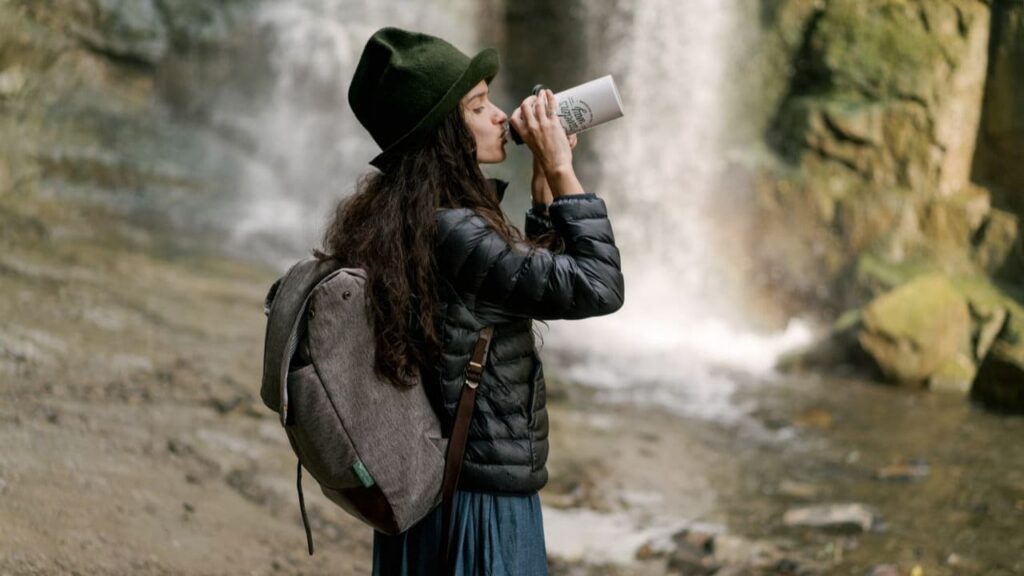
Lao Tzu’s idea is simple. The best thing in the world is water: it feeds everything, it never fights, and it never asks to be noticed. For a hiker, that is exactly what a good backcountry water filter should do. It finds water already in the landscape. It makes it safe through filtration. And it does its job so quietly that the hiker’s attention stays on the trail, not on the bottle.
That is the standard this guide uses. A backcountry water filter that earns its place does four things. It finds water already in the landscape. It takes the water at the source. It returns the water to the body without adding weight, without a second vessel, without a ritual, and without making the hiker think about a mechanism. If any of those four things is done wrong, the filter is one the body has to attend to — and a filter the body attends to is a filter that is in the way.
This guide takes the idea further by applying the Tao of Water — the philosophy of backcountry water filtration — from The True Dao of Water.
How to Choose a Backcountry Water Filter: The Six Filters
| Filter | Weight | Best For |
|---|---|---|
| LifeStraw Go | 8.7 oz | Solo day hikers who fill water directly from a stream and drink straight from the bottle |
| Sawyer Squeeze | 2.5 oz | Multi-day backpackers who need a filter that disappears into the bottle they were already carrying |
| Sawyer Mini | 1.8 oz | Two-person teams and base camp setups where the filter is shared |
| Katadyn BeFree | 2.3 oz | Hikers who want to pour filtered water into a bottle without squeezing or pumping |
| MSR Guardian | 17.6 oz | Hikers who need virus-level filtration and will carry a pump |
| Platypus GravityWorks | 11.5 oz | Group and base camp use where gravity does the work |
The first four filters serve the hiker who walks. They are light. They need no second vessel. They need no separate ritual. The last two serve the hiker who stops and sets up. They are heavier and more involved. They serve a different use case. Pick the one that matches how you move — and how much water you need — before you pick by brand. Whatever you buy, the backcountry water filter you choose is the one the body stops noticing about a mile in.
1. LifeStraw Go — Drink Directly from the Stream
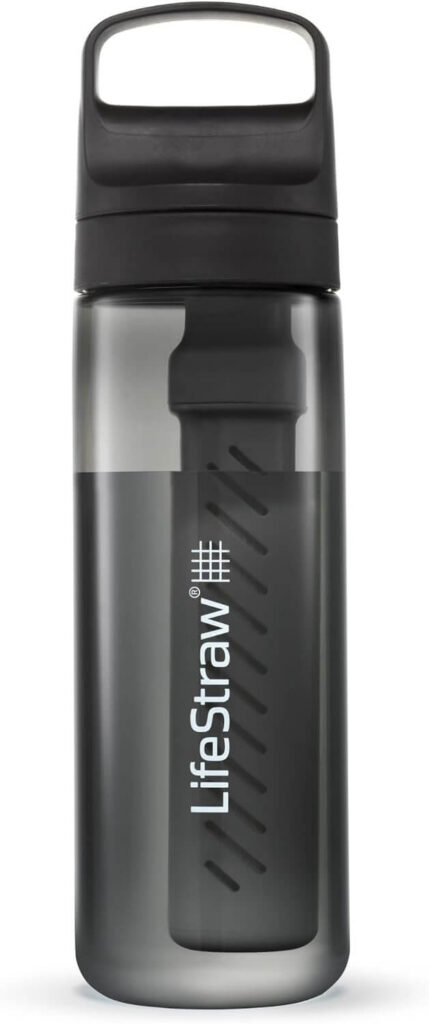
Weight: 8.7 oz (247 g) | Type: Filtered water bottle, 22 oz | Filtration: Membrane microfilter + carbon filter; removes 99.999999% of bacteria, 99.999% of protozoa, 99.999% of microplastics | Capacity: Membrane 1,000 gal (4,000 L); carbon filter 26 gal (100 L) | Price: Listed on Amazon | Best for: Solo day hikers who fill water directly from a stream | Worst for: Areas where viral contamination is a concern
The LifeStraw Go is the filter closest to what Lao Tzu described: it is water-friendly work the body barely notices. You fill the bottle at the stream. You drink from the bottle. There is no assembly, no separate component to pack, and no second vessel to carry. The filtering happens inside the bottle, and because it happens inside the bottle, it happens out of sight.
A membrane microfilter and a carbon filter do the work together. The membrane removes bacteria including E. coli and Salmonella, parasites including Giardia and Cryptosporidium, and 99.999% of microplastics. The carbon filter reduces chlorine, odors, and organic chemical matter, so the water also tastes better. Viruses are not removed, so for most North American backcountry streams this is enough, but it is not the right filter where waterborne viruses are a concern.
At 1,000 gallons of membrane capacity, the LifeStraw Go lasts about five years of daily use. At 8.7 ounces it weighs what a 22-ounce water bottle weighs, so the hiker who is already carrying a bottle is not carrying anything extra.
Why it fits the way water works: the filter is the bottle, and the bottle is the hand, and the hand is the body. The hiker does not add a device to the system — they add no friction at all.
2. Sawyer Squeeze — The Filter That Disappears Into the Bottle
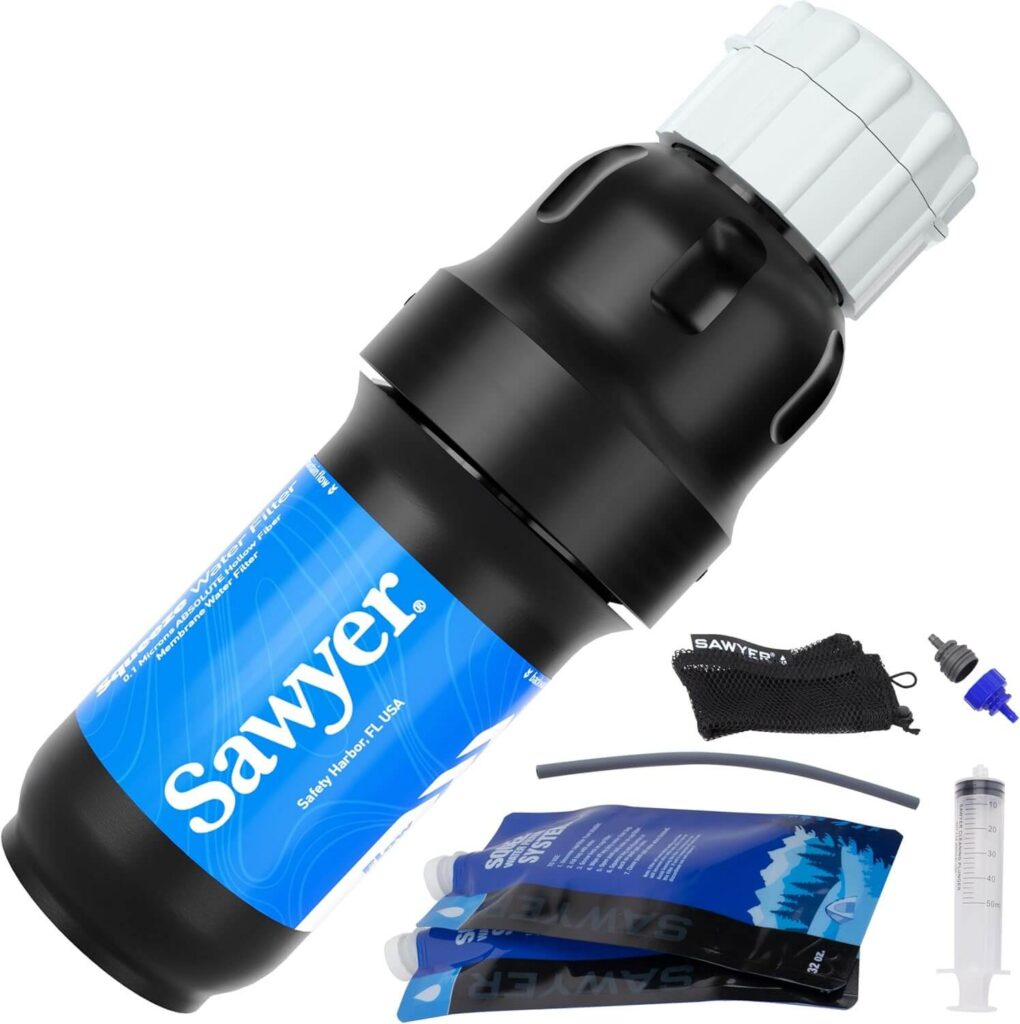
Weight: 2.5 oz (71 g) | Filtration: 0.1 micron hollow-fiber membrane; removes 99.999999% of bacteria, 99.9999% of protozoa, 100% of microplastics | Capacity: 100,000 gallons | Flow rate: 1.7 L/min | Included: Two 32-oz collapsible pouches, drinking straw, hydration pack adapters | Price: Listed on Amazon | Best for: Multi-day backpackers who want the filter to disappear into the bottle they carry | Worst for: Viral-contamination areas
The Sawyer Squeeze is the filter most backpackers reach for, and the reason is not subtle. At 2.5 ounces and 0.1 micron it is light and fine. You attach it to a standard 28 mm water bottle, a Sawyer bottle, or one of the two included 32-ounce collapsible pouches, squeeze, and the water flows through the membrane and into the mouth. The filter does not push the water. You push the bottle. The water does the rest.
That is the practical form of “not competing.” The Squeeze does not impose a new object on the hiker’s hands. It uses the object the hiker already has. The hollow-fiber membrane does the work without a pump, without forcing, without anything for the body to think about between filling the bottle and drinking from it. At 100,000 gallons of rated capacity the filter works for the life of the system, not just the life of the trip.
Included are two 32-ounce BPA-free collapsible pouches, a drinking straw, a set of Sawyer inline hydration pack adapters, and a mesh storage bag. The pouches roll up tightly, so the system packs smaller than the number of components suggests.
Why it fits the way water works: it finds the bottle the hiker already carries and becomes part of it, rather than arriving as a device with its own demands.
3. Sawyer Mini — The Lightest, Shareable Filter
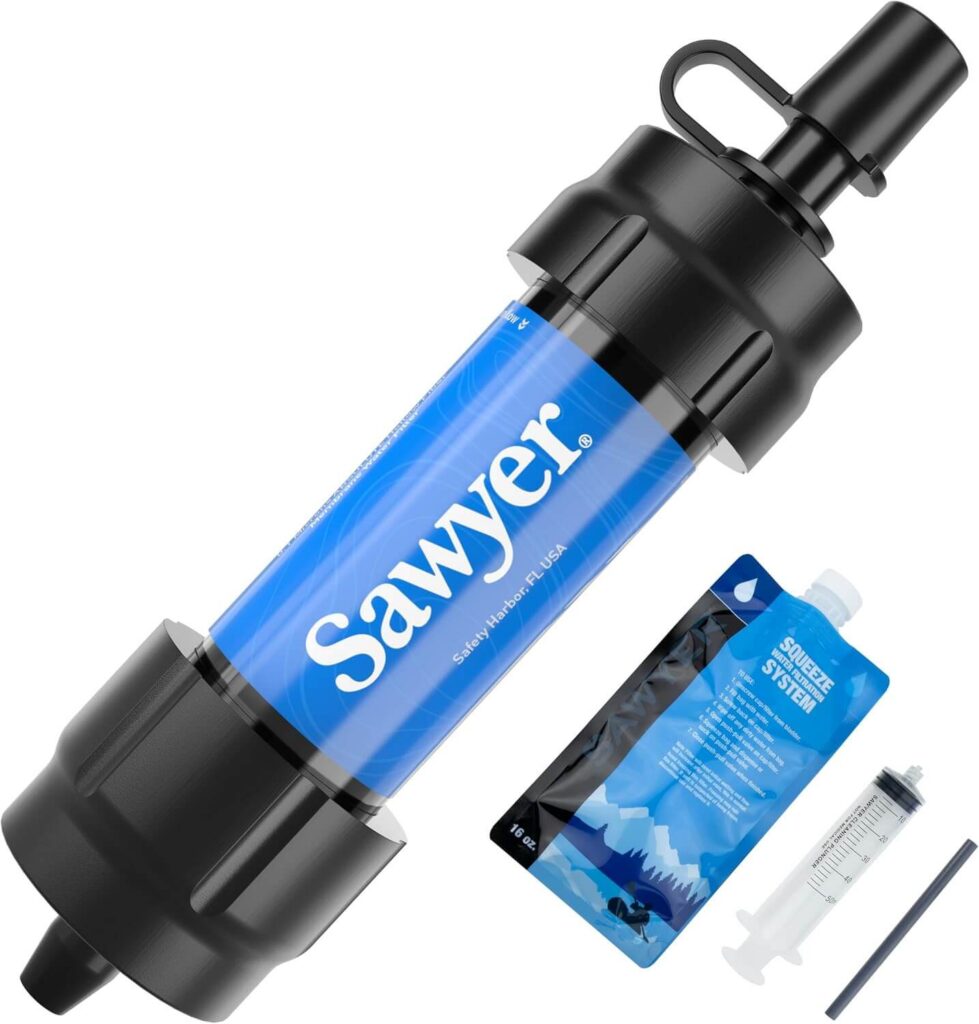
Weight: 1.8 oz (41 g) | Filtration: 0.1 micron hollow-fiber membrane; removes 99.999999% of bacteria, 99.9999% of protozoa, 100% of microplastics | Capacity: 100,000 gallons | Included: 16-oz pouch, 7-inch drinking straw, cleaning plunger | Price: Listed on Amazon | Best for: Two-person teams and shared base camp setups | Worst for: Solo hikers who want a personal filter to carry
The Sawyer Mini is the lightest filter on this list at 1.8 ounces — and it is the filter you grab when the water is not a personal device but a shared one. Thread the Mini onto a hose, thread the hose onto a bladder, and two people draw filtered water from the same bladder all day. It also fits a standard 28 mm water bottle or a hydration pack, and the included 16-ounce pouch and 7-inch straw let you drink directly from the water source without a bottle.
At 0.1 micron it does the same work as the Squeeze: bacteria including Salmonella, Cholera, and E. coli; protozoa including Giardia and Cryptosporidium; and 100% of microplastics. No viruses. At 100,000 gallons it lasts the life of the system. And at 1.8 ounces the hiker who carries it does not feel it, because the Mini is not a device the hiker carries — it is a component in a water system the pack already holds.
The price is the quiet point. The Mini is the cheapest filter on this list for its weight. For the two-person team, the base camp, or the extra filter you keep in the emergency kit, the Mini is the most water-friendly choice because it costs the least and asks for the least.
Why it fits the way water works: it takes the shape of whatever water system the hiker already has, rather than demanding its own.
4. Katadyn BeFree — Pour, Don’t Force
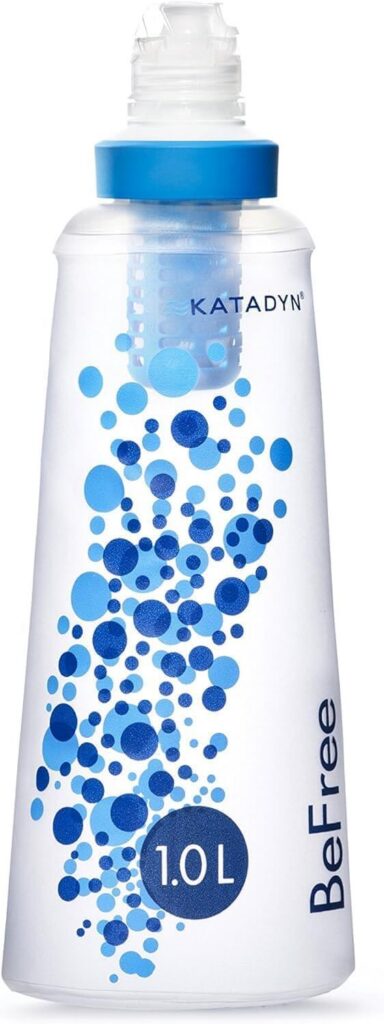
Weight: 2.3 oz (2.24 oz) | Type: Collapsible 1-liter filtered bottle | Filtration: 0.1 micron hollow-fiber membrane; removes bacteria, protozoa, and sediment | Flow rate: 2 L/min | Capacity: 1,000 liters | Included: EZ-Clean filter membrane | Price: Listed on Amazon | Best for: Hikers who want to pour filtered water into a bottle without squeezing or pumping | Worst for: Hikers who need a filter that fits inside a standard bottle; multi-day trips where 1,000 liters is not enough
The Katadyn BeFree is the filter on this list that does the least forcing. Fill the collapsible 1-liter bottle from a stream, a lake, or a spring, and gravity pours filtered water through the 0.1 micron hollow-fiber membrane. You do not squeeze. You do not pump. You do not blow through a tube. You hold the bottle and let water do what water does.
At 2.3 ounces it is light — lighter than the LifeStraw Go and the Squeeze — and the wide-mouth design makes cleaning straightforward. Shaking or swishing in water restores flow, no backflushing, tools, or disassembly required. The capacity is 1,000 liters, which is less than the Sawyer products, so the hiker who uses the BeFree hard will replace it sooner. For most hikers on a week-long trip, 1,000 liters is plenty.
The BeFree’s philosophy fit is the cleanest on the list. A filter the body has to squeeze, pump, or blow through is a filter the body attends to. The BeFree removes that attention entirely. Gravity pours, and the body drinks.
Why it fits the way water works: water finds its level, and the BeFree just gets out of the way of what gravity already knows how to do.
5. MSR Guardian — The Purifier With a Gauge
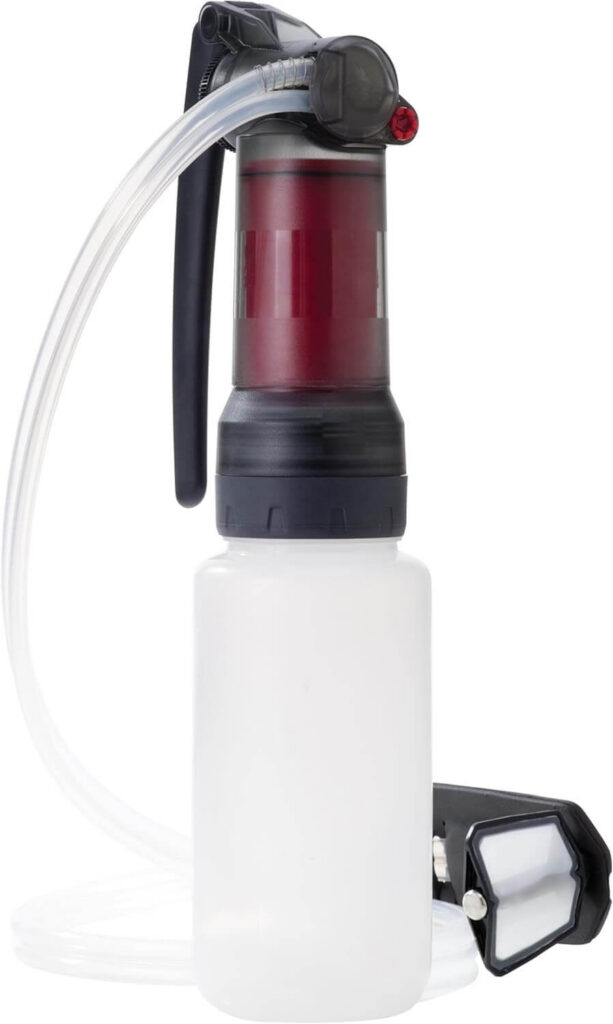
Weight: 17.6 oz (1.1 lb) | Filtration: Medical-grade hollow-fiber + activated carbon; removes viruses, bacteria, protozoa, and particulates | Capacity: 10,000 liters | Flow rate: 2.5 L/min | Self-cleaning: Cleans on every stroke, no backflushing | Price: Listed on Amazon | Best for: Hikers who need virus-level filtration | Worst for: Hikers who do not need virus removal, or who want a filter lighter than 12 ounces
The MSR Guardian is the only filter on this list certified to remove viruses. It meets the NSF protocol P248 testing standard of the U.S. military, using medical-grade hollow-fiber membranes. That certification is the difference between a backcountry water filter that handles bacteria and protozoa and one that also handles what human waste can carry. If you are drinking from a source that has been used by other people, or traveling where waterborne viruses are a concern, the Guardian is the only filter here that answers that need.
It is also the filter on this list that most clearly asks the body to attend to a mechanism. It is a pump. It has a pressure gauge you read, and it pumps at a rapid 2.5 liters per minute. It cleans itself on every stroke — no backflushing, no filter-scrubbing, no service kit. At 17.6 ounces it is the heaviest option on this list, and the weight is the weight of the mechanism that does the virus-level work.
This is not a weakness. It is a trade-off the body makes on purpose. For most backcountry streams, bacteria and protozoa are what matters and a pump is a weight you do not need. For the circumstances that require virus-level filtration, a filter that does not remove viruses is a weight you do not want. The Guardian earns its place by being the right answer to a specific, serious need — and not pretending to be the light, easy answer to every trip.
Why it fits the way water works: water does not compete — but when the landscape carries a threat water cannot simply ignore, the Guardian is the device that takes on the work quietly and fully, even though it is a heavier kind of quiet.
6. Platypus GravityWorks — Let Gravity Do the Work
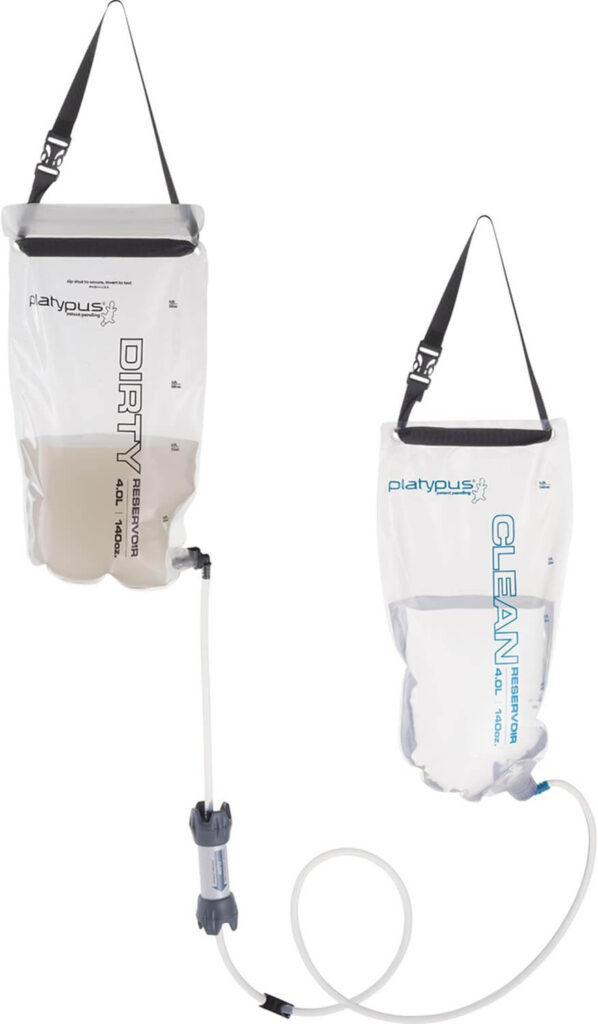
Weight: 11.5 oz | Type: Gravity-fed group camping water filter system, 4 liters | Filtration: 0.1 micron hollow-fiber microfilter; removes 99.9999% of bacteria, 99.999% of protozoa | Flow rate: 1.75 L/min | Filter life: 1,500 gallons | Included: 4-liter dirty water bag, 4-liter clean water bag, tubing, microfilter, shutoff clamp, storage sack | Price: Listed on Amazon | Best for: Group and base camp use where gravity does the work | Worst for: Solo day hikers who need filtered water in the middle of a hike
The Platypus GravityWorks Group Camping Water Filter System is the filter on this list that most clearly earns its place by the absence of mechanical effort. Fill the 4-liter dirty water reservoir at the stream, hang it from a branch or a pack above camp, and the water flows through a hollow-fiber microfilter into the 4-liter clean water reservoir. No pumping. No squeezing. No blowing. Hang a bag, wait, and drink — four liters come through in roughly 2.5 minutes.
At 11.5 ounces the system weighs what a small pack of gear weighs, and it is built for a group rather than a single hiker. The microfilter meets EPA and NSF guidelines for the removal of 99.9999% of bacteria and 99.999% of protozoa, including Giardia, Cryptosporidium, E. coli, Salmonella, and Cholera. The replaceable cartridge lasts up to 1,500 gallons. Viruses are not removed, so for backcountry streams where bacteria and protozoa are the concern, this is enough.
The system is not a filter for the hiker who is walking and needs water now. It is a filter for the hiker who has stopped, set up camp, and is feeding a group — cooking, washing, drinking, and wanting to forget the filter exists.
Why it fits the way water works: the hiker sets up the system once, and then water does what water has always done: it goes down, and the body goes along with it.
The Standard, Applied
The six filters above are ranked by the standard the Tao of Water established: does this filter find water already in the landscape and return it to the body without adding weight, a second vessel, a ritual, or a mechanism to attend to?
The LifeStraw Go is the filter for the day hiker who drinks directly from the bottle. It needs no second vessel.
The Sawyer Squeeze is the filter for the backpacker who carries a bottle. At 2.5 ounces it disappears into the bottle the body is already carrying.
The Sawyer Mini is the lightest and cheapest filter on the list. It serves the shared two-person team and the base camp bladder.
The Katadyn BeFree is the filter that pours without forcing. Gravity does the pouring; the body does the rest.
The MSR Guardian is the only filter here that removes viruses. It is the right answer for a serious need, not the light answer for every trip.
The Platypus GravityWorks is the filter that follows gravity. Hang a bag, wait, drink. No pump, no squeeze, no mechanism.
Integrating Your Water Filter Into the Whole Gear System
A filter that earns its place is one the body does not notice. The gear system described in The Mindful Roaming Gear System works because each piece serves the body quietly and gets out of the way. The second skin that manages warmth, the pack that carries its weight, and the shoes that read the ground — all of these are already working in the hiker’s favor. Whatever you carry, the backcountry water filter you choose is the one piece of gear that, when it disappears, returns the body to the landscape in the same moment it has returned water to the body.
水善利万物而不争 — water benefits all things without competing. The filter that serves the body is the filter that finds water already in the landscape, takes it at the source, and returns it to the body without asking the body to do anything else.