I once almost walked past the best water I ever drank.
It was a late-afternoon stretch on a desert canyon hike — the kind of place where the ground keeps the heat long after the sun has gone down and where the trail itself seems to forget it is a trail. My water was running low. I could feel it before I saw it: the slight dryness at the back of the throat, the way my thinking had grown a touch grainier, the small but unmistakable narrowing of attention that I had been learning to read in my own body. I was not thirsty yet, not in the sharp, screaming sense. I was simply running ahead of myself, the way hikers do when the trail is beautiful and the miles are getting shorter and you convince yourself that you can carry the remaining stretch on willpower alone.
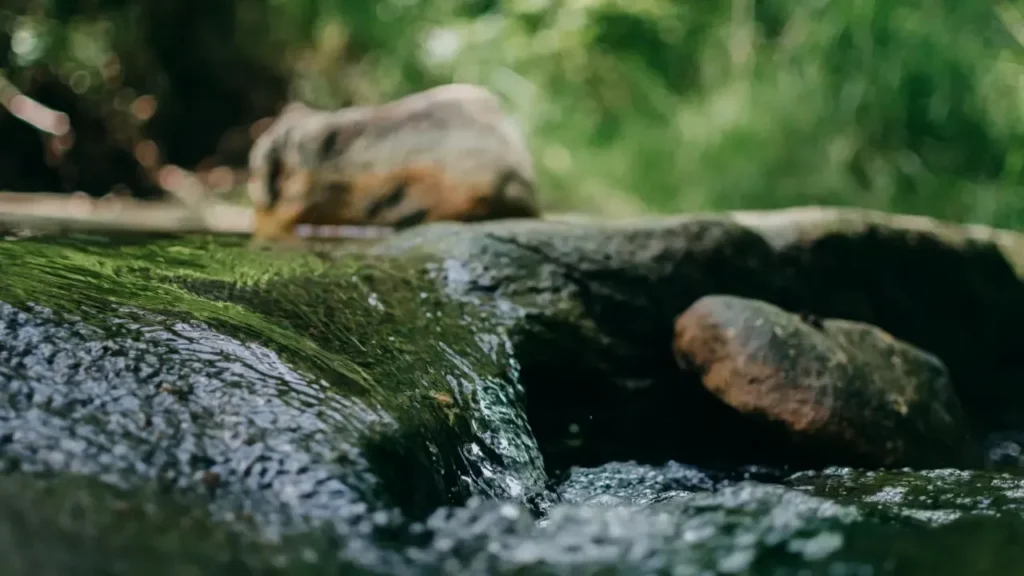
Then I heard it. A soft sound, almost underneath the wind — water moving through rock. I followed the sound for maybe forty yards before I saw it: a spring seeping from a wall of pale sandstone, pooling in a small dark basin lined with a carpet of green that looked almost impossible in that heat. I took my bottle and drank, and for the first time all day my body went somewhere between relaxed and grateful.
I thought about that spring afterward. I thought about how easily I might have walked past it — how a few hundred feet of stubborn forward motion would have erased the encounter entirely. And I thought about how the encounter itself was not really about the water in the bottle. It was about the attention that put the bottle there.
That is the quiet lesson at the heart of a living backcountry hydration philosophy: drinking well in the wilderness is not a matter of volume, or schedule, or gear. It is a matter of presence. It is the practice of learning to hear what the body asks for, and to hear it before the asking becomes a demand. It is, in the deepest sense, the same skill the Daoist tradition calls wu wei — effortless action — applied to the most ordinary and most overlooked substance on earth.
Lao Tzu returns to water again and again throughout the Dao De Jing. He is drawn to it the way a river is drawn to the sea, because water embodies, more completely than any other thing in nature, the paradox at the center of the philosophy. In Chapter 8, he writes:
上善若水。水善利萬物而不爭,處眾人之所惡,故幾於道。
The highest excellence is like water. Water benefits all things and does not contend; it dwells in places that people reject, and so it is close to the Dao.
There are seven qualities Lao Tzu attributes to the person of highest excellence, each drawn from the nature of water — and each of them a principle that a true backcountry hydration philosophy can make tangible in the body, on the trail, in the act of drinking itself:
居善地 — dwell in the right place, like water always finding its level, neither too high nor too low.
心善淵 — cultivate still depth in the heart, like a pool undisturbed by wind, holding clarity beneath the surface.
與善仁 — give freely in relationships, like rain that falls without keeping accounts.
言善信 — keep your word, like a river that always, without fail, reaches the sea.
正善治 — govern with order, like water carving the most efficient channel through stone over time.
事善能 — act with perfect capability, like the flood that arrives in its season, neither early nor late.
動善時 — move with perfect timing, like the drought that teaches the value of rain only by its absence.
And then the line that anchors all of them, the one that matters most to anyone who has ever run dry on a long trail:
夫唯不爭,故無尤。
Because they do not contend, they are without reproach.
In the wilderness, this philosophy has a body. You can feel it in your own body, specifically in the way you relate to water — not as a problem to be managed, but as a teacher to be attended to. The hiker who forces hydration — drinking on a fixed schedule, ignoring the body’s signals, treating water as a task to check off — is doing the opposite of what water itself does. Water does not follow a schedule. It follows the path of least resistance, responding to gravity and terrain, finding its way with an intelligence that has nothing to do with planning and everything to do with attunement.
This is the art of effortless exploration applied to the most basic substance you carry. And it is, on a long day in the backcountry, a skill that may matter more than any gear you own.
The Body as a River: What Hydration Actually Asks of Us
The human body is, in its composition, more like water than like anything else. Approximately 60 percent of your body weight is water. Your blood is roughly 90 percent water. Your brain and your heart are about 73 percent water. When Lao Tzu wrote that the highest excellence is like water, he was, in a sense, describing the nature of the organism doing the reading.
This matters in the backcountry because dehydration arrives more quietly than most hikers expect. The commonly cited figure — that you begin to lose physical performance when you lose about two percent of your body weight in fluids — is only the beginning of the story. Long before you reach two percent loss, your body begins making micro-adjustments that happen below the level of conscious notice: the blood thickens slightly, reducing the delivery of oxygen to the working muscles; the kidneys begin conserving water by concentrating the urine; the brain, which is the most water-dependent organ in the body, starts quietly dimming the lights on what it considers non-essential processing — emotional regulation, creative thinking, spatial awareness, patience, the openness to the unexpected. As the NHS notes on dehydration, these shifts affect cognition and physical performance before they ever register as pain. These are precisely the qualities that make a wilderness experience meaningful, and they are precisely the first things that thin out when you do not drink enough. You do not become unable to hike. You become unable to feel the hike. The trail is still there. The light is still extraordinary. But the instrument through which you would perceive it has gone quiet.
Daoist thought has a name for this state — a scattering of the animating awareness, a thinning of the presence that allows us to inhabit the world fully. When that awareness becomes dispersed, the body continues to function but the person inside it has gone somewhere else. Mild dehydration produces exactly this: a functional body carrying an absent mind. A true backcountry hydration philosophy understands that drinking water is not merely a physiological act. It is the maintenance of the vessel through which wonder becomes possible.
At the same time, the opposite error — drinking too much, too fast, in a panic to stay optimally hydrated — carries its own risks. Overhydration can dilute the sodium in the blood, a dangerous condition that has cost lives on long mountain races and multi-day traverses, particularly when hikers push large volumes of plain water without replacing the salts that the body has actually lost through sweat. The body is not a tank to be topped off. It is a river — a dynamic, self-regulating system that asks to be responded to, not controlled.
Sweat rate varies enormously from one person to the next, and from one hour to the next, depending on terrain, temperature, altitude, exertion, and the weight of the pack on the back. A hiker moving at three miles per hour in comfortable temperatures at sea level may lose half a liter of fluid per hour. That same hiker, ascending a steep ridgeline in ninety-degree heat at altitude, may lose two liters per hour or more. No universal rule can account for that range of variation. Only attention can.
What this means is that the Daoist approach asks for a different relationship to hydration altogether. It asks for sensitivity rather than a schedule — the ability to know, moment by moment and terrain by terrain, what the body is asking for. It is responsiveness, not passivity. It is the knife of the master craftsman, finding the spaces that already exist between the joints, rather than cutting against the grain.
Sensory Roaming and the Thirst Before Thirst
There is a practice at the heart of the QuietRoam philosophy that applies as fully to water as it does to the ground beneath the feet. It is the practice of descending the awareness from the head into the body — into the soles of the feet, into the throat, into the belly — until the organism begins to report what it is actually experiencing, rather than what the mind has decided it should be experiencing.
When you are fully present in your body, you feel thirst long before it becomes deficit. You notice the dryness at the back of the palate. You feel the slight shift in the texture of your thinking — a narrowing, a graining, a small closing down that is not yet pain but is clearly a signal. You hear it before you name it. And this is the whole of the skill.
It is the same principle that guides the art of flow explored in depth in the essay on wu wei and hiking — the practice of moving with the current of things rather than against it. There, the lesson was about giving up the map. Here, the lesson is about giving up the schedule. The body has its own internal map, its own internal rhythm. It is a map that has been written by millions of years of evolution and updated, moment by moment, by the cells that know more about your hydration than any application ever could.
The mistake most hikers make is not that they drink too little. It is that they stop listening. They replace the body’s quiet signal with an external rule — drink every thirty minutes, drink one liter per hour, drink when the app tells you to drink — and in doing so they train themselves to ignore the intelligence that was already there, already sufficient, already older than any piece of technology they carry.
The hiker who has learned to attend to the soles of the feet, as explored in the essay on heel breathing and hiking, already knows this descent of awareness. Drinking mindfully — what many call mindful hydration — is the same movement applied to a different sense: not the soles on stone, but the throat on water. Both are acts of listening downward, into the body, into what it is actually telling you.
There is a deeper version of this mistake, and it is the one I made most often myself. It is the mistake of drinking without being present to the act. We pull the bottle from the pack, tip it up, drink for three seconds, and move on. We have performed the motion of hydration without performing the attention. We have moved water through the body without allowing the body to register the act. And because we did not register the act, we cannot learn from it. We cannot know what our body needs, because we never gave it the chance to tell us.
Water as the Trail’s Language: Reading Sources Like a Text
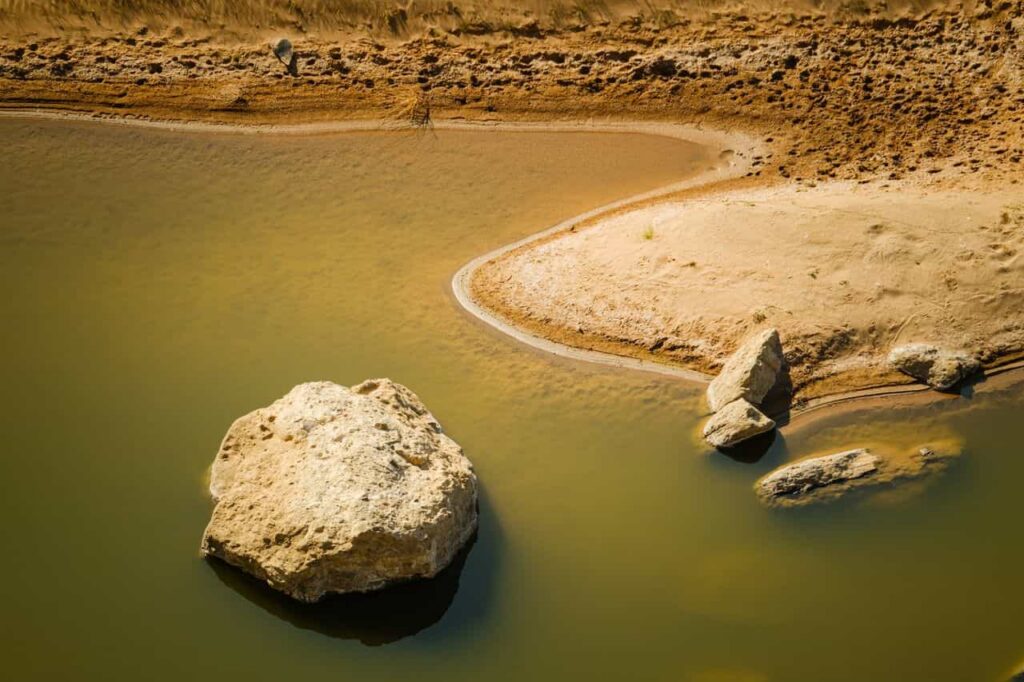
One of the most underrated skills in backcountry travel is the ability to read water in the landscape — to understand where it is likely to be found, how reliable it is, what its presence or its absence tells you about the terrain ahead.
Running water is almost always safer than still water, because movement inhibits the growth of certain pathogens and carries sediment downstream. Water that runs over granite or sandstone often carries fewer biological contaminants than water that collects near grazing land or trails frequented by animals. Water that sits in the sun in a shallow pool can develop algal blooms that filter treatment will not fully remove. A spring that emerges directly from the earth, in a landscape far from agricultural activity, is often the purest water you will ever drink.
These are not rules. They are signals. They require the same quality of receptive awareness that the practice of sensory roaming asks of your feet: the capacity to be curious rather than certain, to observe before you act, to let the landscape inform your decisions rather than imposing a predetermined strategy upon it.
In Daoist cosmology, water is the element of wisdom precisely because it is the element of receptivity. It receives the shape of the vessel. It receives the path of least resistance. It receives the weight of what falls into it, absorbs the shock, and returns to stillness. When you approach a backcountry water source with this quality of reception — pausing before you filter, observing the source, reading the landscape around it — you are practicing something older and more elegant than any protocol.
You are learning to read the land.
And there is a quiet elegance to this that most hikers miss. Water in the backcountry is not simply a resource to be consumed. It is a message from the terrain. The location of a spring tells you something about the geology. The clarity of a stream tells you something about the watershed. The presence or absence of animal tracks at a water source tells you something about the safety of the ground. The temperature of the water, when you hold it in your hand, tells you something about the season and the depth of the earth from which it came.
To read water is to enter into a conversation with the land that the land has been ready to have all along. The conversation requires nothing from you except attention — and attention is, as the philosophy of Daoist simplicity and effortless exploration insists, the one resource the wilderness asks of us above all others.
The Tools That Disappear: Choosing Water Treatment That Gets Out of the Way
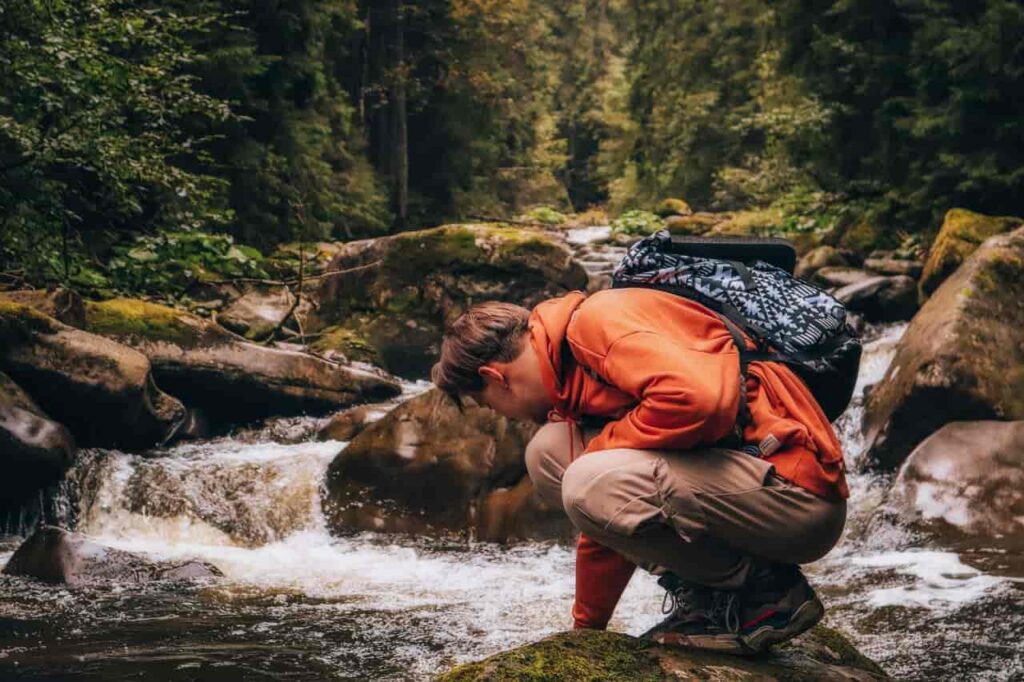
In keeping with the QuietRoam principle that great skill looks like clumsiness — the idea that the best gear is the gear that disappears — the ideal backcountry water treatment system is the one you stop thinking about. The one that becomes as natural and unremarkable as reaching into your pocket. The one that lets you focus on the water itself, rather than on the technology you are using to process it.
The question to ask of any water treatment system is the same question we ask of all gear at QuietRoam: when I am using this, am I thinking about the tool, or am I thinking about where I am? The answer will tell you everything you need to know.
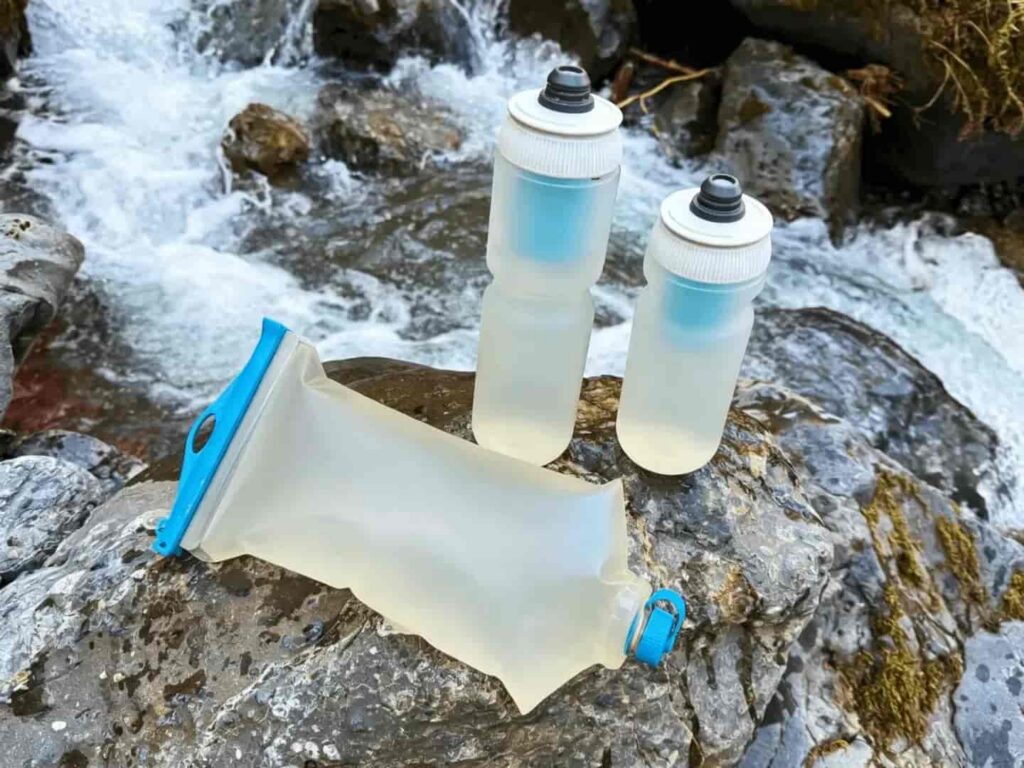
A squeeze filter is the closest thing to invisible gear that water treatment currently offers. It weighs almost nothing, requires no batteries, no pumping, no waiting. You fill a soft flask at the source, attach the filter, and drink directly. The interaction between you and the water is nearly unmediated. The filter is there, but it does not announce itself. It does not demand your attention. It simply does its work and lets you get on with the experience of being where you are.
A gravity filter asks more of your time but less of your effort. You fill a reservoir, hang it from a branch, and walk away. The water processes itself — gravity does the work, the way water always prefers to let gravity do the work. There is something deeply fitting about this: you have created the conditions, and then you have stepped back. You have not forced the outcome. You have allowed it.
Ultraviolet purifiers destroy pathogens without adding any taste or chemical trace. They are fast and highly effective against viruses in water sources where a filter alone may fall short. Their weakness is that they require care — batteries, handling, a level of responsibility that can make them feel more like a piece of technology you are attending to than a tool that serves you.
Chemical treatment — tablets and drops — is the oldest and most minimal method of all. A few tablets, a short wait, and the water is ready. It requires patience, which is not a flaw. It is, in the backcountry, a practice. Patience is the muscle that hydration trains, and the backcountry is the gym.
I carry a squeeze filter on most of my hikes, and for years I treated it like a piece of equipment — something to inspect, refill, check, and worry about. A pump was clogged. A cartridge was expired. A seal was suspect. I would arrive at a stream and find my first thought was not about the stream itself, but about the state of the gear in my pack. The tool had stopped disappearing. It had become the foreground.
Something shifted after I stopped treating the act of filtering as a procedure and started treating it as a moment in the hike. I still fill the flask and squeeze the filter. But I no longer do it while thinking about the filter. I do it while standing in the stream, feeling the cold water on the stones between my feet, noticing how the light sits on the surface, listening to the sound of the current moving downstream. The tool does its work in the background. I am present to where I am.
This is what the philosophy asks of every piece of gear we carry, not just water treatment. It is a request that the tool should step quietly aside so that the experience can move forward. When the tool stops stepping aside, when it begins to demand our attention and our worry, we have moved away from the path of least resistance — away, in other words, from wu wei. The body has its own rhythm. The trail has its own pace. And the water, in its patient and unforced way, is showing us how to move with both of them at once.
The choice between methods is not a matter of which one is universally best. It is a matter of which one lets you remain present to the water. Whatever tool you carry, the goal is that it should disappear into the act of drinking, so that what remains is only you and the water. A backcountry water filter, chosen and used against that standard, is simply a quiet tool that returns you to the stream — Best Backcountry Water Filters judges six systems on exactly whether they do that.
Practicing the Art of Flow: Three Ways to Bring Water Awareness Into Your Hike
You do not need a desert traverse or a near-dehydration experience to begin practicing a more attentive relationship with water in the backcountry. You need only three things: a willingness to slow down, a commitment to listening, and the patience to drink before you are thirsty.
The pre-source pause. Every time you approach a water source in the backcountry — a stream, a spring, a lake, a seep in the canyon wall — stop before you do anything. Stand still for sixty seconds. Look at the water. Where is it coming from? How fast is it moving? What does the landscape around it look like? Is there animal activity nearby? This is not a checklist. It is a moment of receptivity — the same quality that wu wei asks of us in every context. Let the water tell you something before you take from it.
Drinking as practice, not task. Most backcountry hikers drink water the way they check their phone — quickly, habitually, while still moving, barely registering the act. Try this instead: when you stop to drink, stop completely. Take off your pack if the terrain allows. Sit down. Hold the water in your mouth for a moment before you swallow. Notice the temperature, the mineral character, the way it feels in the back of the throat. Notice what shifts in your body after the first two swallows. This is not a mindfulness exercise in the self-conscious sense. It is simply paying attention to something that deserves your attention — the substance that makes your life in the wild possible.
The evening water inventory. At the end of each day on trail, before you make camp, take stock not just of how much water you have left, but of how water moved through your day. When did you feel the first signs of thirst? When did you drink proactively versus reactively? Were there moments when you pushed past a source because you were making good time, and did that decision serve you or cost you? This is not self-criticism. It is the kind of reflective practice that the craftsmen in Zhuangzi embody — the ongoing, attentive refinement of a skill through honest observation. The hiker who keeps this kind of inventory, even informally, is the hiker who learns to carry less water with confidence, because the confidence comes from knowing the body, not from carrying a spare bottle as insurance against not knowing.
These three practices are small. They are the kind of small practices that accumulate into something that feels, over months and years, like a different way of moving through the world. They are also the kind of small practices that the philosophy of effortless exploration describes — the gentle shedding of musts and shoulds, the meeting of the wilderness on its own terms, the quiet discipline of showing up fully for the most ordinary moments.
The Lowest Place: Why Water Always Wins
Lao Tzu returns to water again and again throughout the Dao De Jing, drawn back to it the way a river is drawn back to the sea. In Chapter 78, he writes a line that captures the paradox at the heart of the philosophy, and at the heart of every wilderness journey:
天下莫柔弱於水,而攻堅強者莫之能勝,其無以易之。
Nothing in the world is as soft and yielding as water. Yet for dissolving the hard and the inflexible, nothing can surpass it.
This is the lesson that the backcountry teaches, and it is the lesson that a true backcountry hydration philosophy is really about, beneath the practical advice and the gear and the schedules. The thing that yields, wins. The thing that flows around every obstacle rather than trying to break through it, eventually reshapes the landscape entirely. The Colorado River did not carve the Grand Canyon through force. It carved it through relentless, patient, effortless attention to the path of least resistance — a million years of wu wei, written in stone a mile deep.
We go to the wilderness to be changed by it. Not to conquer it, not to complete it, not to post proof of it, but to be genuinely altered by the encounter — to come back a little less rigid, a little more responsive, a little more willing to find the lowest place and rest there.
Water teaches this better than any book. Not through instruction, but through example. It does not tell you to yield. It simply yields, in front of you, every time you encounter it — finding the crack in the rock, the hollow in the earth, the space between the stones where no force could reach but water can.
Drink deeply. Pay attention. Let the trail shape you the way water shapes stone — not through effort, but through the patient, unhurried practice of being present, one step, one sip, one quiet mile at a time.
This is the highest excellence. This is the art of flow. This is the QuietRoam way of water.