Picture this. You have just finished a fourteen-mile day on the trail. Your legs ache in that honest, specific way that means the day was long enough to matter. The sun is sinking behind the ridge, and all around you the forest is cooling into the blue light that marks the end of an active day. You have one canister of hot water, a packet of freeze-dried something, and about eight minutes of energy left in your hands.
Sound familiar.
There is nothing technically wrong with a freeze-dried meal. It fills the tank. It hits the macros. But somewhere along the way, modern outdoor eating became a transaction, and the meal became something to be processed between the mile and the sleep, rather than the moment the day finally stops moving and lets you feel it.
What if cooking in the backcountry is not a chore to be optimized, but a practice?
Minimalist backcountry cooking is the art of turning the most mundane moment in camp into something that restores the nervous system instead of just refilling the tank. It is an old idea dressed in titanium, and it works without adding weight, complexity, or time to the day.
Why Modern Backcountry Eating Falls Flat
The problem is not malnutrition. Most hikers are eating enough calories to finish the trail. The problem is that the meals most hikers bring are designed for a different kind of body, in a different kind of place. They are dense, chemically processed, and engineered for shelf stability on a supermarket shelf, not for the kind of body that has been walking fourteen miles through altitude and wind and then has to sleep in a shell on the ground.
Most commercial freeze-dried meals carry between 600 and 1,400 milligrams of sodium per serving. They are formulated to survive a year in a warehouse and a decade in a pantry. The calories are real, and they will move a body forward. But the body absorbs them differently when it is stressed, cold, and exhausted, and a hot can of sodium-dense sludge does not tell it anything useful about the day it just completed or the day it is about to wake up into.
The Frontiers in Nutrition journal, in a 2021 study on whole food diets, found that people who ate diets rich in anti-inflammatory, unprocessed foods reported significantly lower fatigue levels than those relying on calorie-dense processed meals. The difference is not theoretical. It is the difference between arriving at the next morning with your legs still feeling like they belong to you, and dragging them into a second day of hiking with the sense that the body has been spending energy all night on the food from the night before.
There is an older way to think about it. The same way that the Second Skin philosophy treats a base layer not as fabric but as a thermal conversation between body and air. The meal can be the same kind of thing: not fuel, but nourishment. The calories may be the same. The way they land is not.
A body that has been walking all day is not a car at a gas station. It is a person, in a specific place, at a specific hour, with a specific set of muscles that have been under load since morning and a nervous system that has been alert to terrain, to weather, to the decisions that a trail requires all afternoon long. The body does not need more fuel. It needs something that signals, at the level of smell and warmth and texture, that the day is done and the body can relax into the evening. A hot meal signals that. A cold one does not. The backcountry hydration philosophy makes the same point for water: a body that is hydrated processes everything it receives with more clarity, and the meal that arrives into a hydrated body lands differently than the same meal into a body that has been slightly dry since noon.
The great skill looks like clumsiness essay makes a related case: the gear that disappears is the gear that does the most work. The same is true of the meal. The meal that does the most work for the body is the one the hiker barely notices they are eating, because by the time they lift the cup the body has already begun to feel like itself again. The meal that announces itself. It is the one with the complicated instructions, the separate pouches, the chemical smell — is the one the body is still working through at midnight.
Campfire alchemy is the name for the shift from the meal as fuel to the meal as part of the day’s closing ritual. It is a word that suggests transformation, and it means it: water and fire and a few simple ingredients turn, over five minutes, into something the tired body receives as something more than calories. The alchemy is not in the ingredients. It is in the act of making them, and in the attention the hiker brings to that act.
The seven shifts below are not techniques. They are small, deliberate changes in how the hiker approaches the most ordinary moment in camp. None of them adds weight to the kit. Most of them reduce it.
Water and Fire: The Oldest Kitchen in the World
In the I Ching, one of the oldest texts in the Chinese philosophical tradition, the sixty-third hexagram is called Ji Ji. Water above, fire below. Two opposing forces placed in the exact relationship that makes them useful to each other. Fire heats the water. The water cools and tempers the fire. Neither is in charge. Both are working.
Light your stove at nine thousand feet and the same thing is happening in your hands. You have fire, ascending and warm. You have water, drawn from a stream or filtered from a snowfield, cold and descending. Between them, in a vessel that weighs forty grams, something turns into something else. Hot food. Warm hands. A body that finally has permission to stop processing the last mile and start processing the meal.
This is not poetic decoration. It is a genuinely different orientation toward what cooking in the wild is for. When you watch water come slowly to a boil, when you see the steam and smell the broth, the act of making food shifts from a fueling step to a restoring one. The meal stops being something you get through. It becomes something you are in.
That shift is the whole point of minimalist backcountry cooking done well. The rituals below are not complicated. They are intentional, and almost all of them reduce the weight, the complexity, and the time your cook kit takes up, rather than adding any of those things.
Seven Shifts That Change the Meal
1. The Meditation of Boiling Water
The practice is small. While you wait for water to boil, put the phone away. Do not plan tomorrow’s miles. Watch.
Most hikers choose a stove that boils water in ninety seconds, and there is a time and place for that. But the ten seconds you save are rarely spent on anything. What you lose, if you rush past them, is the moment when the body finally registers that the day is over. Mindful eating practices, as described by Kripalu Center, note that the breath before a meal signals the digestive system to begin its work. In the backcountry, the breath while the water boils is the same thing. The mind stops narrating. The hands warm. The nervous system, which has been running hard all day, finally exhales.
The ritual does not require hours at the stove. It requires the five minutes the water was going to boil anyway. You are already paying that cost, whether you notice it or not. The question is what you do with it, and the difference between watching the water boil and planning the next day in your head is the difference between a nervous system that settles down for the evening and one that keeps running, quietly, past bedtime.
2. The One-Pot Doctrine
Bring one vessel. Just one.
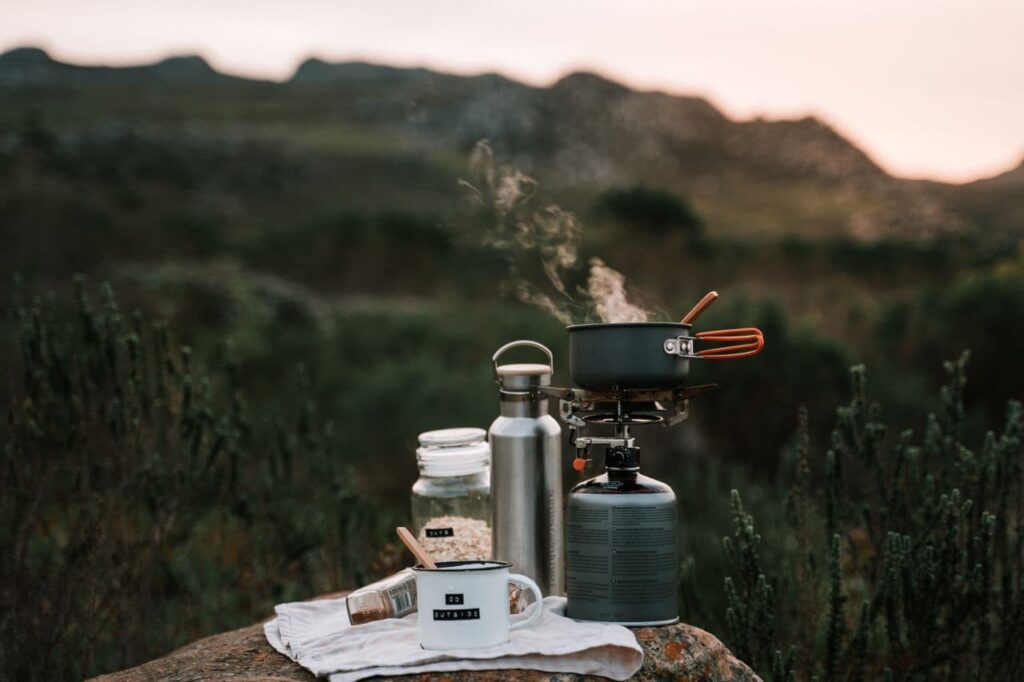
A titanium cup, around seven hundred milliliters, is one of the most elegant pieces of outdoor cookware ever invented. You can boil water in it, cook a full meal in it, drink from it, and wash it with a spoonful of water in the creek. It disappears into the pack the way good gear should, and it makes the decision of what to cook for the evening trivially simple: whatever fits in the cup fits in the plan.
One-pot cooking is not a constraint. It is a decision-making system. The day you have just walked does not need a menu. It needs something warm and nourishing and finished in five minutes. A single vessel removes the question of which pot, which lid, which pan to unpack, and replaces it with the only question that matters: what is already in the cup.
This is the same principle that makes a minimalist pack system work. Choose one thing that does several jobs well, rather than several things that each do one job and compete for weight. The Daoist concept of pu, the uncarved state of a thing before it is shaped into something more complicated than it needs to be, describes it exactly. A single cup is already enough.
3. Build a Small Spice Kit
Replace at least one processed meal pouch with a small collection of real ingredients that nourish rather than merely fill.
A kit that weighs under three ounces fits in a single ziplock and sits inside any pack. It might include dried shreds of coconut, goji berries, a little dried onion or garlic, a pinch of ginger or turmeric powder, and a small packet of ghee or coconut oil. In the morning: whole oats, coconut milk powder, goji, a pinch of cinnamon. In the evening: a miso broth with dehydrated mushrooms and crushed ramen noodles. Both meals take three minutes more than boiling the water did, and both taste like something a human being made for a body that has been working.
Research on ginger’s anti-inflammatory and antioxidant effects, published in peer-reviewed clinical studies, confirms what cooks have known for a very long time: the small, warming ingredients matter. They do not change the calorie count of the meal. They change the way the calories land. A hot broth with ginger in it is, at the caloric level, a broth with calories in it. At the body level, it is something the tired body receives differently, because it is being given something that looks like care rather than like fuel.
The Qi Kit weighs less than most hikers’ phone chargers and lasts a week on a typical trip. The return on that weight is not measured in grams saved. It is measured in how the body feels at the end of day three and day five, when the accumulated effect of eating hot, unprocessed food over several days begins to show up as better sleep, easier mornings, and a steadier energy curve across the day. The hiker who switched one freeze-dried pouch for a three-ounce kit of real ingredients may not notice the difference on day one. They notice it on day five. The the shoes reading the ground notices it in the quality of the steps on a cold morning. The body that is hydrated notices it in how cleanly the stomach processes the morning meal. The meal the hiker ate the night before is not a memory by day five. It is a body condition.
4. Breathe Before You Eat
Before you lift the cup, breathe.
This is an ancient practice, and in its simplest form it takes four seconds. Lean in close to the steam. Inhale. The hot, wet air carries the volatile compounds of whatever is cooking: the ginger, the herbs, the wood smoke if you have been cooking over an open fire. That warm air tells the digestive system to wake up before the food arrives, and the meal that follows is digested with less effort.
Eating the steam is the shortest ritual on this list and the one that costs the least. It requires no gear, no ingredients, no preparation. It requires only that the hiker who has been walking all day stops, for four seconds, and does something with their breath instead of their feet. The difference between eating while still processing the last mile and eating after the body has begun to settle into the evening is one of the few variables a hiker can control. The meal is the same meal either way. The body that receives it is not.
5. Match the Food to the Mountain
Think about where you are, not just what you packed.
Daoist dietary thought has always been seasonal and environmental: warm foods in cold places, lighter foods in warmth. The same principle applies on the trail, and it is easier to apply than it sounds. Heading into a cold, wet coastal range in autumn, pack warming spices, a little extra fat, coconut oil, nut butter, ghee, and slow-releasing grains. Planning a high-alpine summer ridge, lean toward lighter, easier-to-digest meals that do not sit heavy against the ribs on an exposed summit day.
It is not complicated. It just asks that you think about the mountain before you leave for it, not just the mileage and the elevation gain. The mountain will tell you, in the temperature and the wind and the quality of the afternoon light, what kind of body it is going to ask you to be the next morning. Feed that body, not the abstract body on the nutrition label.
A hiker headed into a rain shadow in late spring will eat differently from a hiker on a desert plateau in July, and not only in the amount of water they carry. The rain-shadow hiker benefits from dense, fatty, warming meals that hold their energy through a day of cool, wet walking. The plateau hiker benefits from lighter, easier-to-digest meals that do not sit heavy against a body that is already losing heat to a thin, hot sun. The same pack, the same weight budget, two different menus. The meal is not a fixed requirement. It is a variable, and the variable that changes it is the mountain, not the hiker.
The great skill of invisible gear applies here as well: the gear and the food that fit the mountain disappear into it, and the ones that do not are the ones the hiker notices all day long, because the body is working around them instead of through them. A meal chosen for the wrong environment is the same kind of noise as a jacket that rustles in the wind. It does not stop the hike, but it raises the baseline effort the body is already expending.
6. Let the Fire Set the Pace
Cook with the fire’s rhythm, not your watch’s.
Modern outdoor culture puts a timeline on everything: water boiled in ninety seconds, camp made in twenty, lights out by a specific hour. Cooking is one of the places where a rigid timeline is hardest to hold and easiest to let go of.
On evenings when the conditions allow it, let the stove or the fire set the tempo. Stir slowly. Add ingredients in small gestures. the essay on nature sounds hiking, applies just as well to the pot as to the forest. A meal cooked slowly is not a slower meal in any measurable sense. It is one that the person eating it arrives at in a different state, and the difference between arriving calm and arriving rushed is a difference the body can feel the next morning.
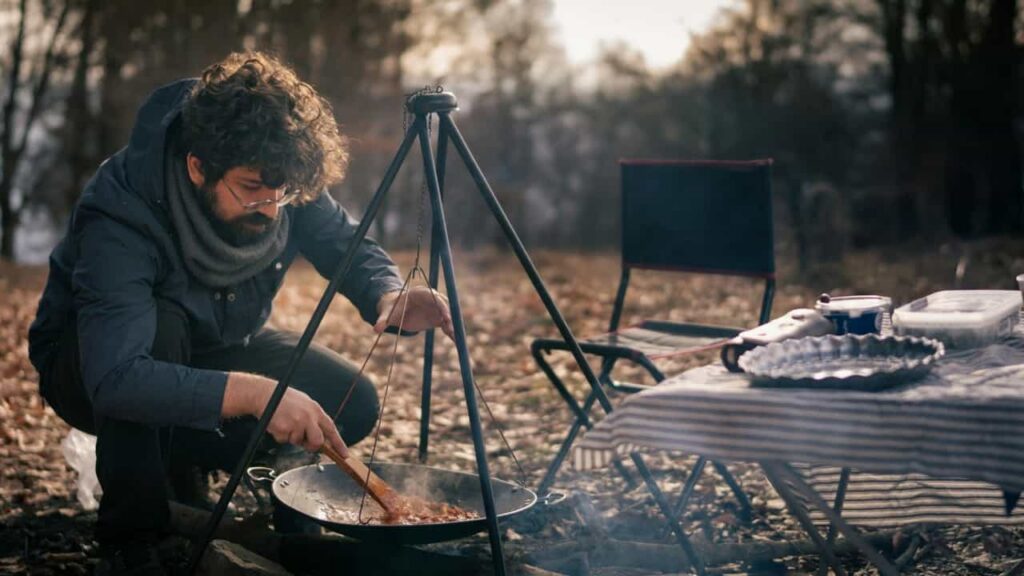
The campfire itself is the slowest fire a hiker carries. It sets a tempo that no stove can match. When conditions allow it, the open fire is not just a mood. It is a different rhythm, and the body adjusts to it.
The difference between a canister stove and a wood fire is not only a matter of warmth. A canister stove boils water in a fixed, predictable time and returns the hiker to the next task. A wood fire does not. It requires gathering, arranging, lighting, tending, and eventually letting die. Each of those gestures takes time and attention, and the hiker who cooks over a wood fire is not cooking more slowly in a meaningful sense. They are cooking with a different body, one that has spent the last twenty minutes doing something with their hands that is not related to the trail or the pack or the decision-making the day has been demanding. The fire, in other words, does a small amount of nervous-system work of its own, and the meal that follows is received by a body that is already quieter than the one that arrived at the camp. A canister that can be trusted to boil without noise, without hiss, without a smell that lingers in the wind, is part of that same choice: the tool should serve the tempo, not announce it. Best Backcountry Stoves and Camp Cookware is the practical extension of this — six stoves and kitchen systems judged not on boil time, but on whether they hold the meal to the moment.
Even a stove cook can borrow part of this principle. The five minutes the water is coming to a boil is the moment between the day’s pace and the evening’s. What the hiker does with those five minutes — and watches the water, or plans the next day, or scrolls — determines, more than anything else in the camp routine, whether the evening begins as a continuation of the day or as a different state entirely.
7. Clean Up as Part of the Meal
Treat the end of the meal as intentionally as the beginning.
In Japanese Buddhist temple cuisine, preparation, eating, and cleaning are all one practice. Nothing is just a task and the rest is the real thing. Leave No Trace is more than an environmental principle. When you wash the cup and scatter the rinse water and put the stove away with the same care you used to light it, you close the circuit of the meal. The ritual is finished. The day can end.
This is also the part most hikers skip. The meal is done, the food is gone, and the attention goes to the next thing. The cleanup is not a task. It is the last gesture of the meal, and skipping it leaves the circuit open.
Water above, fire below. Two opposing forces placed in the relationship that makes them useful to each other — Ji Ji, the hexagram of the I Ching that describes cooking, balance, and the completion of a single circuit.
朴 — The uncarved state of a thing before it is shaped into something more complicated than it needs to be.
食气 — Eating the steam: inhale the steam before you eat, and the body begins to digest before the food arrives.
Integrating the Quiet Kitchen Into the Whole Practice
The meal is not separate from the rest of the hike. A a base layer that manages warmth keeps the body at a temperature where digestion works, and a cold core makes even the best meal feel like dead weight in the stomach. Hydration philosophy keeps the awareness clear through the cook and the cleanup, and a hydrated body processes food with a clarity that dehydration quietly erodes. Gear that disappears is the same curatorial standard the Qi Kit applies to the pantry: choose one thing that does several jobs, and leave the rest behind.
The quiet kitchen works with every other element of the system. A backpack that carries its weight quietly makes the camp feel calm before the cook even begins, and the feet reading the ground all day mean the body arrives at the cup with all five senses still available.
The quiet kitchen also connects to the body’s relationship with the elements in a way that most outdoor cookbooks do not address. A hiker cooking on a cold, wet evening is not just making food. They are creating a small zone of warmth and dryness in a landscape that is actively trying to cool and wet everything it touches. The fire, the cup, the steam rising from the hot broth. All of these are tiny reversals of the environment, and the hiker making them is participating, briefly and directly, in the same exchange of heat and water that the base layer manages against the skin and that the body manages, through breath and blood, inside itself. The second skin and the pot are doing the same work in different registers: keeping the body’s internal environment one step ahead of the mountain.
The backpack the hiker carried to the camp, the shoes that read the ground all day, and the water that kept awareness clear. All of these elements are already working before the cook begins. The meal does not reset the day. It closes it. A body that has been cold, hungry, and tired since mid-afternoon arrives at the camp still carrying all of those conditions inside it — the muscle tension, the nervous-system fatigue, the accumulated decisions a trail requires — and the meal is the gesture that signals the body to stop holding them and begin, slowly, to let them go. The great skill of invisible gear makes the same point: the best thing a piece of equipment can do is disappear, and the same is true of a meal. The meal that does its job well is the one the body has forgotten by morning, because it was already absorbed.
The practice of one-pot cooking extends this principle further. When the cook kit is one vessel, the decision of what to eat is made before the trip, in the kitchen at home, and the only decision made in camp is to light the fire and pour the water. That is a small thing, but on a day when the body has been making decisions continuously: the path to take, the pace to hold, the moment to stop and drink, the place to break for a snack — the meal is one of the few moments the hiker does not have to decide anything at all. The decision is made. The only work left is to let the body receive it.
The wu wei flow of the backcountry, the way the right thing happens when the hiker stops forcing it — applies to the pot on the stove as much as it applies to the path ahead. A meal that is forced, prepared in a hurry, eaten standing up between checking the map and repacking the tent, is a meal the body takes in without registering it. A meal that is made slowly, with the fire set and the cup in hand, is registered as nourishment, and the body keeps it.
Minimalist backcountry cooking is not a new category of gear. It is a different relationship to the most ordinary moment in camp. The gear stays simple. The stove, the cup, the single spoon, the three-ounce kit. What changes is the attention the hiker brings to the act of making the meal, and the attention the body brings to receiving it. The hybrid stove systems that the backcountry kitchen often uses, a canister for speed, a fire for rhythm, mirror the balance the practice itself is trying to hold: efficient enough to get through the day, slow enough to let the day end.
The meal is the moment the body stops processing the trail and starts processing what it is given. Some hikers make that moment worth giving to. Others do not. The meal is there either way, hot from the cup, and the body takes it in.
For a practical look at the stoves and cookware systems that carry this philosophy into the backcountry, Best Backcountry Stoves and Camp Cookware evaluates six options against the same standard.