

Walk into any outdoor outfitter in search of minimalist hiking gear, and the contradiction hits you immediately. The walls gleam under fluorescent light. Trekking poles with built-in GPS displays. Cook systems that promise to boil water, brew coffee, and charge your phone all at once. Tents with internal light strips, dedicated gear garages, and removable room dividers. A relentless tide of innovation, each product louder and more feature-packed than the last.
We fixate on specs with religious fervor. The denier of the fabric. The weight of the titanium. The waterproof rating of the coating. The number of functions crammed into every ounce of material. We have come to believe that more features equal better gear. That more technical innovation equals a more legitimate outdoor experience. That the gear we carry is a marker of our skill, our dedication, our place in the outdoor community.
But here is the quiet truth we keep running from. We choose minimalist hiking gear to help us disappear into the wilderness, yet we end up carrying gear that demands to be seen, to be used, to be the center of our attention.
Nearly 2,500 years ago, Lao Tzu wrote a line in the Dao De Jing that cuts through this noise with radical clarity:
曲则全,枉则直,洼则盈,敝则新,少则得,多则惑。
Yield and become whole. Bend and become straight. Be hollow and become full. Be worn and become renewed. Have little and gain. Have much and be confused.
This is the Dao of minimalist hiking gear. The greatest skill looks like clumsiness. The best gear is the gear you never think about. The Chinese character behind this idea is Zhuo, a word that in everyday speech means clumsy, awkward, unpolished. In Daoist philosophy, it means something else entirely. Zhuo describes mastery so complete that it no longer announces itself. It is the skill of the master carpenter who has spent a lifetime with the wood, and whose hands move without hesitation, without show, without the need to prove anything. The craftsman looks, to the untrained eye, like an ordinary worker. The gear looks, to the untrained eye, like an ordinary tool. But underneath that ordinary surface is a depth of refinement that only reveals itself to someone who knows what to look for. This is the Daoist meaning of Zhuo, and it is the meaning Lao Tzu intended when he wrote that great skill looks like clumsiness.
The paradox is simple. The more features you cram into a tool, the more your attention is consumed by the tool itself. The fewer features it has, the more of the wild you can actually experience. A gear with no moving parts has nothing to break. A gear with one clear purpose has no room for confusion. The tool that does one thing perfectly and does it without demanding a single thought from you is the tool that has mastered the Dao. This is the heart of minimalist gear and the essence of the Daoist gear philosophy that guides every choice we make.
For those who want to understand minimalism as a design philosophy rather than a passing trend, the Wikipedia entry on Minimalism traces its roots from art to architecture to everyday objects. But Lao Tzu’s wisdom goes a step further. He ties this invisible design to a state of harmony with the world around us. The point is not merely aesthetic. The point is to dissolve the boundary between the tool, the user, and the wild.
The Dao of Invisible Design: What Clumsiness Really Means
To understand what makes truly great outdoor gear, we must first explore Lao Tzu’s wisdom, for it upends everything we have been taught about what makes a tool good.
“Great skill looks like clumsiness” is not a celebration of mediocrity, of poor design, or of cutting corners. It is the opposite: the highest form of mastery a design can achieve. This phrase describes the highest form of mastery a design can achieve. It is the understanding that the ultimate goal of any tool is not to be admired for its cleverness, but to serve its user so completely that it ceases to exist in their awareness.
When a piece of minimalist hiking gear does its job perfectly, it becomes invisible. You do not notice the warmth of your base layer. You do not notice the stability of your trekking poles. You do not notice the quiet, unassuming way your titanium cup boils water over an open flame. The tool has vanished into the task, and only the experience remains.
This is the essence of minimalist gear and the Daoist gear philosophy that guides every choice we make.
We see this echoed in the most timeless design principles of the West. The concept of invisible design appears in countless forms. Dieter Rams’s less, but better. The Bauhaus movement’s radical reduction to essential form. The Japanese aesthetic of wabi-sabi. But Lao Tzu’s wisdom goes a step further. He ties this invisible design to a state of harmony with the world around us. The point is not merely aesthetic. The point is to dissolve the boundary between the tool, the user, and the wild.
If the tent creates the void, then the clumsy gear is the humble guardian of that void.
This is the core of what we call Wu Wei Flow at QuietRoam. When you are fully immersed in a hike, fully present in the wilderness, fully in flow with the world around you, you do not want to be thinking about your gear. Every time a tool demands your attention, every fumble with a finicky regulator, every tug at an overcomplicated locking mechanism, it yanks you out of the present moment. It forces you to focus on the object in your hand, not the world around you.
Truly great gear eliminates this friction. It does not force you to adapt to it. It adapts to you. It does not demand your attention. It fades into the background. It does not celebrate its own cleverness. It makes you feel more capable, more present, more connected to the wild. This is the great skill that looks like clumsiness. It is design so masterful, so perfectly aligned with your needs, that it looks like no design at all. It is invisible. And in that invisibility, it lets you achieve the very thing you came for: to disappear into the wilderness, and find peace in the process.
Lao Tzu’s second truth, great eloquence sounds like stammering, carries equal weight for outdoor gear. We can translate it plainly through the lens of a product’s interface. Gear covered in buttons, blinking LED lights, and multi-mode settings is the eloquent one. It chatters constantly, demanding you parse its features, consult its manual, and acknowledge its cleverness at every turn.
By contrast, the gear that embodies stammering is the one with a single, intuitive switch or no switch at all. It needs no instruction manual. It communicates only through its function, not its frills. A product that needs to explain itself is not truly finished. True mastery is a tool that speaks only when you use it.
The true measure of a tool’s greatness is the number of times you have to think about it. The best gear is not the one that makes you say, Wow, look at how clever this is. It is the one that lets you say, Wow, look at this beautiful world around me.
The Clumsy Cup That Taught Me Invisibility
I learned this lesson on the same Blue Ridge Mountains hike that taught me the gift of emptiness. On that trip, my gear, not the storm, became the biggest barrier between me and the wild.
Before that trip, I had splurged on a top-of-the-line, award-winning backcountry cook system. It was a masterpiece of engineering. A compact pot with a built-in heat exchanger. A pressure-regulated stove. A nested mug and spork. Even a tiny French press insert for morning coffee. It had pages of positive reviews, a laundry list of features, and a price tag that made my wallet wince. I was proud of it. I thought it made me a more serious, more prepared hiker.
But on that trip, that cook system became my nemesis. Every morning, I had to fumble with the pressure regulator to get the stove to light. Each twist was accompanied by the sharp, grating click of plastic buckles and the faint, irritating hiss of air leaking from the pressure valve. I had to disassemble the French press insert to boil water, then reassemble it for coffee, then clean half a dozen different parts before I could pack it away.
Every small task was punctuated by the gear’s noisy demands for attention. The snap of a latch. The whine of a misaligned burner. The rattle of nested parts clinking together. I spent more time staring at that cook system, troubleshooting its quirks, admiring and resenting its clever design, than I did watching the sunrise over the mountains. It demanded my attention, every single time I used it. It was the opposite of invisible.
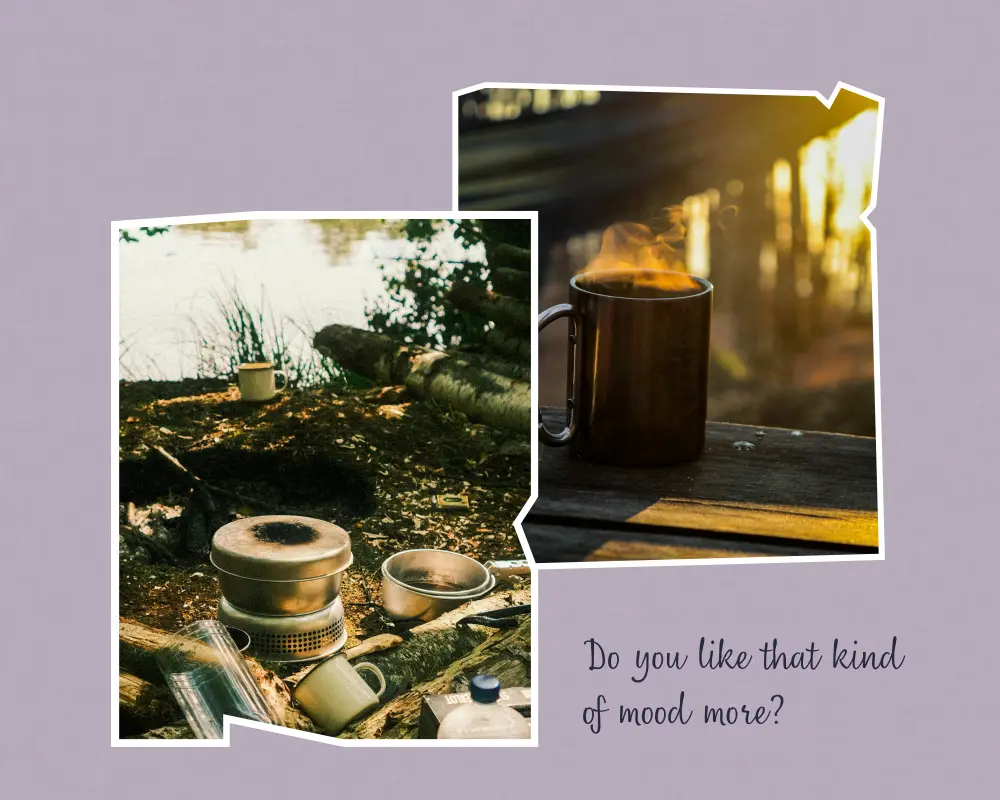
On the third day, the pressure regulator broke. I panicked. No way to boil water. No hot food. No coffee. I thought my trip was ruined. But then I remembered the tiny titanium cup I had tossed into the bottom of my pack at the last minute. A plain, unadorned, 8-ounce cup with no features, no inserts, no clever engineering. Just a cup. By all modern outdoor standards, it looked clumsy. Basic. Unimpressive.
I set that cup on a small bed of hot coals, its base hitting the stone with a deep, muted thud. No sharp clicks. No hisses. Just the quiet weight of metal meeting rock. I filled it with water and waited. Three minutes later, the water was boiling.
I poured it over my coffee grounds and sat down on a log. For the first time all trip, I did not spend my morning fumbling with gear. I did not think about the cup in my hand. Its smooth, unadorned surface. Its lack of any moving parts. Its total silence as it did exactly what it was made to do. I just sat, sipped my coffee, and watched the mist lift off the valley below. I listened to the birds call. To the wind in the trees. To the quiet of the wild.
That plain, clumsy titanium cup did its job so perfectly, so effortlessly, that I forgot it was there. It did not demand my attention. It did not celebrate its own cleverness. It just served me, and in doing so, it let me fully step into the moment.
This is the magic of great skill looks like clumsiness in action. The fancy cook system was designed to be admired. The simple titanium cup was designed to be used. The fancy system made me focus on the gear. The simple cup let me focus on the wild. The fancy system was a spectacle. The simple cup was a companion.
That day, I realized that every piece of gear we carry is a choice. We can choose gear that makes itself the star of the show. Or we can choose gear that fades into the background, and lets us be the protagonist of our own journey.
The morning I discovered that cup is still the clearest moment of my hiking career. Not because the view was better, or the trail was easier, but because for the first time, I was actually there. The fancy cook system had been between me and the wild, layer after layer of complexity and demands. The cup, by being nothing, made room for everything.
The Tyranny of Spectacle: Why Brands Build Noise on Purpose

The problem with modern outdoor gear culture runs deeper than bad design. It is, in large part, intentional.
Outdoor brands are not in the business of selling you flow states. They are in the business of selling gear. And gear that disappears, gear so simple and reliable that you use it for a lifetime and never think about it, is gear you only use once. So the industry has a structural incentive to do the opposite. To build complexity, novelty, and visible cleverness into every product, so that there is always something newer, smarter, and more feature-laden to chase.
Every unnecessary feature, every clever gimmick, every overcomplicated mechanism is a barrier between you and the wild. But it is also a reason for you to return to the store. The gear that demands your attention was designed to demand your attention. Not to serve your experience in the wilderness, but to justify its own existence, its own price tag, its own place in the endless upgrade cycle.
This is the definition of Forcing. The friction we create when we let the industry’s logic override our own experience. It is the belief that we can purchase our way deeper into the wilderness with better specs, rather than arriving there by shedding the noise. When we confuse the map for the territory, we end up carrying a pack full of clever objects that keep us perpetually focused on the objects themselves.
The antidote is clarity about purpose, not cynicism about gear. Ask not what the gear can do, but whether it will disappear.
This is where the Daoist principle of effortless exploration becomes practical. We do not need to conquer nature with increasingly sophisticated tools. We need to shed the noise and let the wild speak.
I remember standing in a flagship outdoor store, holding two backpacks side by side. The first was a 40-liter behemoth, covered in pockets, compression straps, attachment points, and color-coded gear dividers. It had a rain cover, a hydration port, a sleeping pad attachment, a tent-compatible carry sleeve, a laptop compartment, and a gear loft. The salesperson explained each feature with genuine enthusiasm.
The second pack was smaller. It had one main compartment, one side pocket, and a compression strap. That was it. I could fit everything I needed for a week-long trip into that second pack. The first pack was heavier, more complicated, and less comfortable to carry, despite all its thoughtful additions.
I bought the second pack. It was clumsy in the best sense. It had no clever features to fumble with. No zippers to jam. No attachment points to consider. It just carried my gear, and disappeared.
That pack was with me on a six-day trek through the Smokies. It never failed me. It never demanded my attention. It did its one job, perfectly, and vanished. That was the greatest skill of all.
Years later, I thought about why that moment mattered so much. It was not about the pack. It was about what the pack represented. A choice to let the tool serve the experience, rather than letting the tool become the experience. A choice to be present, rather than presentable. That is the quiet revolution of minimalist hiking gear, and the deepest lesson Lao Tzu left us in Chapter 22.
What Great Skill Looks Like Clumsiness Looks Like in Practice
You do not need to throw out all your gear to embrace this wisdom. Clumsiness is a practice, not a purge. Here are three questions to carry with you, into the outfitter and into the wild.
The Invisibility Test
Before any trip, lay out every piece of gear you plan to carry. For each item, ask yourself this question. The last time I used this, was I thinking about the gear, or about where I was? If the answer is I was thinking about the gear, every time you used it, that tool is breaking your flow. It is demanding your attention when your attention belongs to the trail. Simpler, more reliable, more invisible gear exists. Whether it is a single-piece shelter that pitches in seconds, or a plain titanium cup that boils water without fuss, the best gear vanishes the moment you use it. Find it.
The One-Job Question
For every piece of minimalist hiking gear you carry, ask what is its one job? Then look honestly at whether the design serves that job, or obscures it beneath a layer of added features. A knife’s one job is to cut. A pot’s one job is to boil water. A tent’s one job is to keep you dry and give you rest.
A great knife does not need to be a saw, a bottle opener, and a fire starter. A great pot does not need to be a coffee maker, a frying pan, and an entertainment center. A great tent does not need to be an office, a garage, and a lounge. Radical simplicity is not about compromise. It is about mastery. The tool that does one thing perfectly is the tool that disappears. This radical simplicity is the same philosophy explored in Daoist simplicity, rooted in the quiet wisdom of Daoist thought.
The Gear Silence Practice
On your next hike, commit to one full day where you do not fidget with, adjust, or admire your gear unless it is absolutely necessary. No playing with the settings on your trekking poles. No disassembling your cook system out of habit. No checking the specs on your tent tag. Use the gear when you need it, and then forget about it entirely. Notice how much more present you feel. Notice how much more of the wild you actually see, when you are no longer focused on the tools in your hand.
One more thing to consider. When you do choose gear, think about how it sits in the wilderness. Earthy, muted tones that fade into the forest and the mountains do something that bright, high-visibility gear does not. They let your gaze soften. A neon tent pulls your eye toward itself every time you glance back at camp. A quiet, earth-toned shelter dissolves into the background and lets the wild remain the frame. Humble gear, in color as in function, protects your flow state.
Over the years, I have noticed something about the gear I keep returning to, again and again. It is not the gear with the best specs, or the most innovative features, or the most compelling marketing story. It is the gear that, after a decade of use, still feels like the first day I picked it up. The gear that has not worn out, because it was never complicated enough to wear out in the first place. The gear that has simply done its job, quietly and reliably, every single time. That is the mark of a tool that has mastered the Dao. It has not aged. It has not degraded. It has simply disappeared into the task, and left nothing behind but the memory of a job done well.
The Gear That Disappears: A Philosophy for Choosing
The question of what gear to carry is never just a question of function. It is a question of attention. Every item in your pack is a vote for something you want to notice, and a vote against something you want to miss.
When you carry a heavy, complicated pack, you spend your hike thinking about the pack. The weight pulls at your shoulders. The straps dig in. The zippers catch. You feel it, constantly, and that feeling is between you and the trail. When you carry a simple, light pack, the pack disappears. The trail comes forward. The weight is gone, and what replaces it is the sensation of the ground under your feet, the air on your face, the light filtering through the canopy above.
This is about presence. The gear we carry shapes the experience we have. A noisy tool creates a noisy mind. A quiet tool creates a quiet mind. The Daoist understanding of great skill looks like clumsiness is not a style preference. It is a technology for creating the conditions in which we can actually be where we are.
Think about it this way. If you are hiking with someone who constantly checks their GPS, adjusts their settings, and fusses with their gear, you are not sharing a hike. You are sharing the space with someone who is sharing the hike with their gear. The person is physically present, but mentally, they are in a different place entirely. The distance between them and the trail is measured not in feet, but in the attention their gear demands. Every time their eyes drop to a screen, or their hands adjust a strap, they are pulled out of the moment. The trail passes by, and they miss it.
Now imagine the opposite. You are hiking with someone whose gear has vanished into the task. Their pack is light. Their boots are quiet. Their hands are steady. They notice the way the light changes as they cross the ridge. They stop to listen to the sound of water somewhere below. They do not say anything, but you feel them, fully, beside you. That is the presence that great gear creates, and that is the presence that the Daoist philosophy of minimalist hiking gear is designed to serve.
Carrying the Clumsiness Forward
The wisdom of great skill looks like clumsiness is about how you show up in the wild, and in your life.
We live in a world that celebrates spectacle. It rewards cleverness. It demands we show off our skills, our achievements, our things. We are taught to make ourselves seen, to make ourselves the center of attention, to force our way through the world with better tools, louder voices, more impressive credentials. But Lao Tzu’s wisdom invites us to do the opposite. To embrace humility. To embrace simplicity. To embrace the kind of mastery that fades into the background, and lets the world speak for itself.
When we choose gear that disappears in the wilderness, we are not just choosing better tools. We are choosing a different way of being. We are choosing experience over spectacle. Flow over force. We are choosing to let the wild be the star of the show, rather than our gear, rather than our egos.
This is the quiet promise of invisible gear. When you forget about your tools, you can finally remember yourself. When the gear disappears, the boundary between you and the wild dissolves. You are no longer a hiker with a pack full of clever objects, navigating the wilderness from behind a wall of specs. You are just a part of the wild itself, flowing with it, present in it, at peace in it.
The next time you find yourself poring over gear reviews, chasing the next innovative feature, the next impressive spec, pause. Ask yourself this question. Will this help me disappear into the wild? Or will it make me focus on the gear?
This question is a practical filter, one you can apply to every purchase you make and every piece of gear you already own. The answer will not always be obvious. Sometimes a piece of gear that feels complex is genuinely useful, and sometimes a piece of gear that feels simple is merely insufficient. The filter does not give you answers. It gives you a way of asking better questions, and that is enough.
When you return home from a hike, the gear that has mastered the Dao is the gear that quietly goes back into its place on the shelf, undramatic and uncelebrated. It has not demanded your attention. It has not broken. It has not let you down. It has simply done its job, and faded from your mind the moment the trail ended. The gear that did not master the Dao is the gear that still occupies your thoughts, the thing you want to fix, the thing you wonder why it failed, the thing you already have an eye on replacing. The difference between them is not in the spec sheet. It is in the question Lao Tzu asked us two and a half millennia ago. What is enough? And what looks like clumsiness to the eye, but is mastery to the hand?
Great skill does not need to be seen. Great gear does not need to be celebrated. The best tools are the ones that fade away, and leave you with nothing but the wild, the quiet, and the peace of being fully present. This is the heart of minimalist hiking gear, and the quiet promise of the QuietRoam philosophy.