

Picture this scene.
A solo backpacker moves through old-growth forest at the golden hour. The trees here are enormous, Douglas fir and western red cedar, hundreds of years old, their canopies forming a cathedral ceiling above a carpet of wet moss and ancient fern. A creek is cutting its slow course through rock and soil somewhere to the left. Somewhere to the right, a deer is stepping between the tree trunks, its head lifting to listen.
Instead of all of this, his ears are sealed inside two wireless earbuds. A true-crime podcast is playing at medium volume. The host is explaining, with considerable urgency, the details of a 1987 criminal case.
He does not hear the deer. He does not hear the creek. He does not hear the wind beginning to move in the upper canopy, or the distant, tentative opening notes of the evening bird chorus. He is walking through one of the most acoustically rich environments on the planet, and he is hearing a stranger’s voice about a murder in a city three hundred miles away.
This is the central paradox of modern outdoor travel: we leave the city to escape its noise, and then we bring the noise with us. We carry the city in our ears. We have mastered the art of physical presence, getting ourselves to the trail, into the trees, onto the ridge, and we are failing quietly at the next, more difficult step, which is staying present once we are there.
At QuietRoam, we have explored what it means to shed physical weight: to choose gear that disappears, to let the trail find itself, to move through the wilderness with less rather than more. But there is a weight that is not physical, and a noise that is not carried in any pack. It is the continuous, manufactured soundtrack that modern hikers bring into spaces that are asking for silence.
True nature sounds hiking is not just about what you hear. It is about what you allow yourself to hear, and what you are willing to stop filling the silence with.
This is the art of Tian Lai. And it begins, as most things in the Daoist tradition, with a very old story about wind.
Tian Lai: Zhuangzi’s Acoustic Universe
In the opening pages of the Qi Wu Lun, the second chapter of Zhuangzi’s masterwork: there is a conversation about sound between two characters, Ziqi of Southwall and his friend Ziyou. Ziqi has just finished playing his qin, a seven-stringed zither, and Ziyou listens and finds himself moved, almost to tears, by what he is hearing.
What follows is one of the most extraordinary passages in all of philosophical literature: Zhuangzi’s taxonomy of sound, which he divides into three categories of ascending mystery.
The first category is the music of humans. The sounds of crafted instruments: flutes and strings and percussion, the deliberate arrangements of tone and rhythm that humans create to express themselves. In our own world, this category includes the podcast in the earbud. It includes the playlist on the speaker at the base camp. It includes the voice of the navigation app reading the next turn. It is the category of sound that has intent, authorship, and agenda.
The second category is the music of earth. This is where Zhuangzi’s imagination takes flight. He describes the wind blowing through the “ten thousand hollows” of the earth: through caves and valleys, through the hollow trunks of dead trees, through the spaces between stones. Each hollow produces a different sound, a different tone, a different register, and together they produce an acoustic landscape so vast and so varied that it cannot be heard by an ear that is only listening for one thing.
And here Zhuangzi does something philosophically extraordinary. He does not describe what the music of heaven sounds like, because it has no fixed sound. When Ziyou asks what it is, Ziqi answers by pointing to a tree whose branches are bending in the wind: the movement is not the tree’s. The movement is not the wind’s. The movement is the tree’s response to the wind, and the wind’s passage through the tree, together. The music of heaven is the condition in which every thing expresses itself freely, without external imposition.
It is the symphony of self-arising sounds, the creek singing because that is what moving water does, the bird calling because that is what a bird does at this hour, the leaves shaking because the wind is passing through them. None of it intends to make music. All of it, together, is music.
You cannot record it. You cannot download it. You cannot listen to it through earbuds, because the earbuds are precisely the barrier that keeps it out.
You can only receive it by becoming quiet enough, and present enough, and empty enough, to let the world’s own music reach you.
The Acoustic Scattering of Spirit: How Earbuds Create Scattered Awareness
In The Highest Excellence Is Like Water, we introduced the concept of the scattering of spirit, a state of dispersed, thin awareness, in the context of dehydration and the way physical deficit dims the body’s capacity for presence. Auditory scattering is the third and perhaps most pervasive form of this phenomenon in modern outdoor travel. It operates through a mechanism that the science of auditory processing makes remarkably clear.
The human auditory system is not passive. Unlike the eyes, which you can close, the ears are always open, always receiving, always processing. The brain cannot simply ignore sound the way it can ignore visual input. Every sound that reaches the ear travels forward, through a series of neural pathways, to regions of the brain that are specialized for spatial processing and for identifying and locating the sources of what is being heard. research on auditory attention and cognitive workload.
When the earbuds are in, the brain’s spatial audio processing centers are working on the podcast. They are doing excellent work. They are locating the voice in the stereo field, tracking the cadence, parsing the content. And because that capacity is occupied, it is not available for locating the deer, or the creek, or the wind.
The ears are open. The forest is singing. And you cannot hear it.
This is scattering through sound: the spirit dispersed not by physical deficit or technological dependency, but by the continuous stream of manufactured audio that fills every silence before the silence can do its work. And something quietly vital is lost. It is not dramatic, not all at once, but gradually, over the course of a hike, over the course of a season, over the course of years of outdoor experience conducted through the same small barrier in the ears.
This is why nature sounds hiking, the practice of intentional auditory openness in the wilderness—is not just a wellness trend. empirical studies on natural soundscapes. The brain is not designed to be occupied by manufactured sound while it is in the wild. When it is free to process the wild, something in the nervous system returns to itself.
Three Practices of Auditory Minimalism
The path back to the music of heaven is not complicated. It does not require special equipment, advanced training, or a remote wilderness location. It requires only the same quality of intentional attention that every other QuietRoam practice asks for: the willingness to do something deliberately, in full awareness, rather than by default.
Here are three practices, ordered from the most immediately accessible to the most deeply transformative.
Practice One: The Digital Fast for Ears
The simplest rule, and the one that creates the most immediate change: for the first hour of every hike, leave the earbuds in the pack. Not in your ears with the audio paused. In the pack. Out of reach. Out of the question.
This sounds easy. It is not, at first. The first five minutes of intentional silence after months of audio-filled hiking feel strange, almost uncomfortable. The mind, accustomed to having something to follow, something to process, something that has narrative shape and emotional arc, turns restless when that input is removed. It scans for stimulation. It begins to notice the silence itself, which feels, at first, like an absence rather than a presence.
And then, somewhere between five and fifteen minutes in, something shifts. The auditory processing capacity that was being devoted to manufactured content is gradually released back to the ambient environment. The forest begins to come in. At first in broad strokes: the general quality of wind in the canopy, the presence of water, the absence of other human voices, and then, with time, in finer detail. The difference between wind in coniferous needles and wind in broad leaves. The change in pitch as the creek drops over a small waterfall. The first notes of the bird chorus, which you had not heard for months, returning like a language you had forgotten and remembered in the same moment.
You have not done anything remarkable. You have simply stopped interrupting.
The first hour becomes the practice. And the practice, repeated consistently, begins to rebuild the auditory sensitivity that earbuds have been quietly eroding. The silence is no longer uncomfortable. It is the medium in which everything you came to the mountains to experience is transmitted.
Practice Two: Tuning into the Earth Pipes
This practice builds on the digital fast by adding active, directed attention to the earth’s acoustic vocabulary.
Find a place to stop, on a trail, at a stream crossing, at the base of a tree, and stand or sit still for two full minutes. Not approximately two minutes. Two minutes, timed if necessary. Close your eyes. Breathe. For the next two minutes, listen to the space around you right now.
Your first task is simply inventory. How many distinct sounds can you identify in the acoustic environment right now? Start with the loudest and most obvious: a nearby stream, a strong wind, a bird calling nearby, and work outward. The sound of wind higher in the canopy than you are standing. The sound of a distant bird that you cannot locate. The sound of your own breathing, which you will notice is also a sound, and is also part of the acoustic environment, and is the one sound you did not realize you were making until this moment made it audible.
Your second task is differentiation. The sound of wind in a stand of Ponderosa pine, with its long, resinous needles clustered at the branch tips, is a higher, more sibilant sound than the wind in a stand of oak, with its broader, stiffer leaves. The sound of water over smooth, rounded stone is different from the sound of water over rough, angular rock. A single bird call can come from the ground, from the understory, or from the upper canopy, and the source location changes the quality of what you hear.
Learning to hear these distinctions is exactly what Zhuangzi means by listening to the music of earth. It is the practice of allowing the earth’s own material language to register at the level of detail it possesses, rather than reducing the entire acoustic environment to a background soundtrack that is pleasant enough but not paid attention to.
This two-minute practice, done at natural pause points throughout a hike: before crossing a creek, at the top of a short climb, while waiting for a companion to catch up. It gradually rebuilds the auditory granularity that earbuds have suppressed. And it creates, over time, a deepening sense of the specific acoustic character of different landscapes, a fluency in place that is one of the most profound pleasures of the serious backcountry traveler.
Practice Three: The State of Xin Zhai
This is the deepest practice, and the most distinctly Daoist in its character. Zhuangzi describes it as Xin Zhai, fasting of the heart-mind, a state in which perception continues but judgment ceases.
In ordinary listening, we apply a continuous stream of micro-evaluations to every sound we encounter: *that bird call is beautiful. That aircraft is annoying— that wind is peaceful— that other hiker’s footsteps are intrusive— that stream sounds nice— that tent is making noise. The evaluations are automatic, constant, and almost entirely unconscious. But they are a layer of judgment sitting between the ear and the sound, and they are filtering what is heard into categories of pleasant and unpleasant before the hearing itself is finished.
Xin Zhai is the practice of dropping the assessment. Not suppressing it through effort. That is simply another form of mental noise, but allowing it to arise and pass without claiming authority over the acoustic environment. The sound is what it is. The evaluation is your contribution to the sound, and it is not the sound itself. When the evaluation passes, the sound remains.
This sounds abstract until you practice it, and then it becomes the most immediately practical thing in this entire essay. Because the acoustic environment of the backcountry is not uniformly beautiful. There is aircraft noise. There are other hikers who do not practice the digital fast. There are mechanical sounds from the camp nearby. There is the sharp, intrusive sound of a poorly maintained pack zipper in the wind. The practice of Xin Zhai does not require the environment to be perfect. It requires only that you stop insisting that it be.
Xin Zhai is the practice of hearing everything, evaluating nothing, and remaining present with the total acoustic reality of the moment. Wind and aircraft and creek and neighboring campers and beetle on the dry leaf, all in the same acoustic field, all equally real, none more important than another, all part of the music of heaven because all are expressing themselves freely and without the ear’s permission.
This is not resignation. It is not passivity. It is the state Zhuangzi describes as Zuo Wang, “sitting” in forgetfulness,” where the boundary between the listener and the listened-to quietly dissolves, and the forest is no longer a place that you are hearing, but a sound that you are part of.
The Zen of Quiet Gear: When Equipment Has Its Own Voice
There is a dimension of nature sounds hiking that almost no gear review addresses, and it is one that the QuietRoam philosophy of invisible gear makes impossible to ignore: the acoustic footprint of the gear you are carrying.
Your gear makes noise. More than you probably realize, and in ways that matter more than the technical specifications suggest.
The most acoustically disruptive piece of standard hiking kit is almost certainly the hardshell jacket, specifically, the high-denier, highly waterproof fabrics that most backcountry travelers carry as protection against weather. These fabrics, when rubbed together, produce a distinctive, high-frequency rustling sound that carries surprisingly far through quiet forest. A jacket that is perfectly adequate from a weather perspective can be almost unbearable from an acoustic one, and the difference is not a matter of volume but of frequency. The sound is not loud, but it is high, and high-frequency sound carries efficiently through the kind of dappled, mid-distance acoustic environment that a forest provides.
Trekking poles, similarly, are acoustic intruders when they are not properly maintained. The metal-on-metal sound of a pole with worn ferrules, or the dry squeak of a locking mechanism that needs lubrication, cuts through the ambient acoustic field with a clarity that most hikers do not notice because it is the sound of their own equipment, and the brain tends to filter out the sounds that are clearly self-generated. The surrounding forest does not filter them out.
The sleep system is another vector. Certain foam sleeping pad materials, the closed-cell foam that many ultralight hikers carry produce a distinctive crinkling sound when compressed or shifted, a sound that is perfectly tolerable to the sleeper and is acoustically intrusive to anyone within hearing distance. A tent with loose guylines rattles in the wind. A pack with poorly secured straps clicks against itself with every step.
These are not arguments against carrying rain protection or trekking poles or sleeping insulation. They are arguments for the same curatorial standard that the Second Skin philosophy applied to base layers: every element of the gear system, before it is accepted, should be held to the question of how it will perform in the acoustic environment of the trail, not just in the temperature environment or the weather environment.
Maintain your equipment’s acoustic baseline. A well-maintained pack with smooth-running buckles and properly adjusted straps moves silently. A tent with properly sealed guylines and taut panels does not rattle. A set of trekking poles with lubricated locks and properly fitted ferrules clicks on rock without the grinding sound of worn metal. A jacket selected for its acoustic properties as well as its weather performance is quieter, and the whole trail is quieter for it.
Acoustic gear maintenance is not a luxury. It is a practice of respect for the landscape you are moving through, for the people who are sharing the acoustic space with you, and for the version of yourself that has left the earbuds in the pack and is trying, for the first time in months, to hear the world.
The mountain does not need your announcement. Move through it as quietly as your gear allows, and it will tell you things that only silence can reveal.
When the Noise Stops, the Real Journey Begins
We have come a long way together in these essays: from the weight of our packs to the weight of our plans, from the soles of our feet to the clarity of our thirst, from the Yin and Yang of warmth against the skin to the reading of the trail without a screen. The auditory dimension is where this question becomes most intimate. Because sound is the sense we can least easily control. We can look away. We can stop moving. We can put on gloves. But we cannot close our ears, and the brain’s attention is always already occupied by whatever sound is reaching them.
When you leave the earbuds in the pack, on the first morning, and the second, and eventually on every morning, because you have remembered what you were missing, something begins to change in the quality of the hiking itself. It is not a change you notice in the way you notice a change in weather. It is a change you notice in the way you notice that you are not missing something anymore.
The base layer against your skin is managing the thermal conversation between your body and the air. The water in your body is keeping your awareness clear and available. Your feet are reading the ground through the 200,000 nerve endings in each sole. Your eyes are open to the ridgeline and the tree canopy and the direction of the light. And your ears are open.
The creek is there. The wind is there. The beetle in the leaf litter is there. The far-off thunder that will arrive in two hours is already whispering in the upper register of the wind, if you know how to listen.
This is the practice in its fullest expression. Not the passive enjoyment of pleasant ambient sounds. The active, practiced, philosophically grounded engagement with the acoustic reality of the living world: the Ten Thousand Things sounding themselves, as Zhuangzi described it, in their own frequency, in their own register, without an audience and without intent, and reaching you anyway, through the open ears and the empty mind, because that is what they do.
There are people who leave the earbuds in the car. There are people who leave them in the pack. And there are people who notice, on an afternoon hike with no particular reason for it, that the earbuds are simply in the pack and that the stream is louder than they remember, and that they had not realized, until that moment, how much of the forest they had been missing. The music of heaven plays, the creek and the wind and the beetle and the thunder in the wind, without interruption, and it will continue to play whether or not the earbuds are on. The silence is not something to be achieved. It is the baseline that has been there the whole time.
Shén Sàn — The scattering of spirit: a state of dispersed, thin awareness, explored across the QuietRoam series. In the auditory context: the condition produced by continuous manufactured audio input occupying the brain’s spatial processing capacity.
From Zhuangzi’s Qi Wu Lun (On the Equalization of Things): the three categories of sound—Ren Lai, the music of humans, created by deliberate arrangement; Di Lai, the music of earth, produced by the wind passing through the ten thousand hollows; and Tian Lai, the music of heaven, the condition in which every thing expresses itself freely, without external imposition, without agenda, without an audience.
心斋 — The fasting of the heart-mind: perception continuing without the layer of evaluative judgment. Hearing everything, evaluating nothing.
坐忘 — Sitting in forgetfulness: the state in which the boundary between the listener and the listened-to quietly dissolves.
Integrating Nature Sounds Hiking Into the Whole Practice
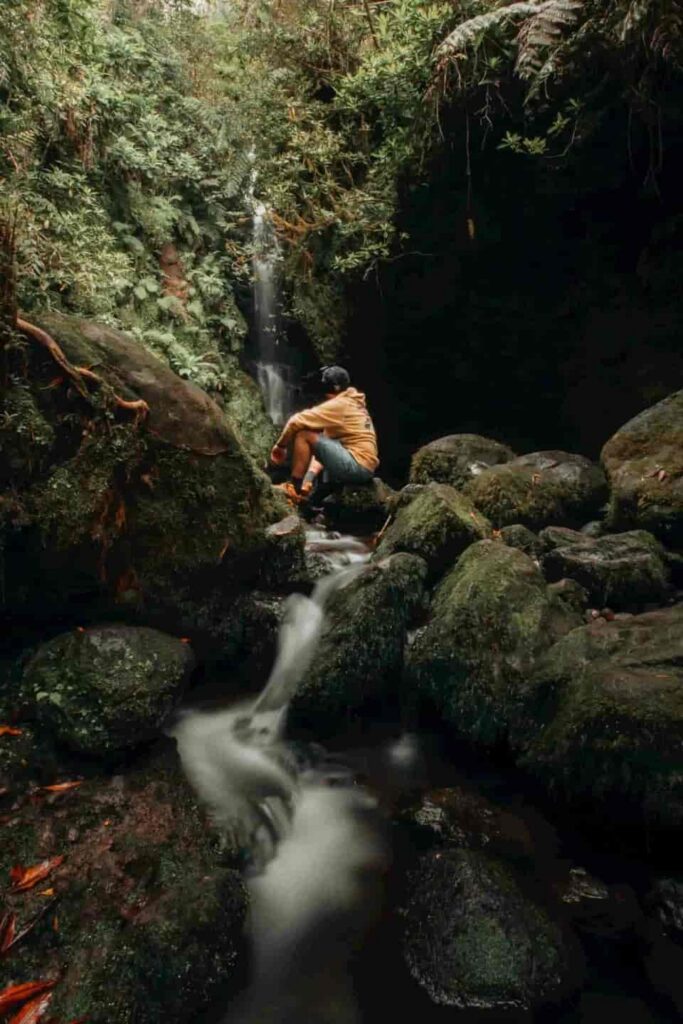
Auditory openness is not a practice you keep isolated in the first hour of a hike. It works in concert with every other element of the QuietRoam system: the shoes that read the ground, the hydration that keeps awareness clear, the base layer that manages the thermal exchange, the navigation that reads the landscape. A hiker whose ears are plugged is missing a channel of sensory input that the body is designed to use, and the body is poorer for the loss. A hiker who is listening fully is not doing one extra thing. They are simply not suppressing one of the five senses that nature is using to communicate with them.
The feet open their own channel, the shoes that read the ground registering the slope, the texture, the moisture. A hydrated body keeps awareness available: a nervous system with water in it processes sound with a clarity that dehydration quietly erodes. The practice of invisible gear asks the same question: how do you move through the landscape without the landscape being dominated by the tools you are carrying, including the tools in your ears?
The Daoist approach is the same at every level: open the channel, remove the interference, let the environment speak. The shoe, the water bottle, the base layer, the ears, and none of them is sovereign. All of them are participants in the single act of being present in the wilderness.
None of these elements should announce its presence louder than the forest itself. The practice is not complete in the ears alone. A hardshell jacket that rustles like dry leaves in a wind that is not there, a pack whose buckles click against each other with every step, trekking poles with worn ferrules grinding on stone — each of these is a note the listener has brought into the acoustic space, and each of them competes, gently and without intention, with the music of heaven that the ears are trying to receive. The second skin against the skin manages the thermal conversation without competing for attention. A quiet pack reduces the acoustic footprint of every step. And the shoes on the feet remain the physical foundation. The gear does not do the listening. But when the gear itself has learned to be quiet, the practice of listening becomes something the body can sustain all day long, and the forest is left to speak without an audience that did not intend to be there.