
This article contains affiliate links. We earn a commission if you purchase through them, at no extra cost to you.
There is a story about a pot, and it is a short one.
I was at a campsite three hours off the last road, near a stream that ran cold even in late summer. The wind had been blowing all afternoon, and the wind carries away heat faster than almost anything else. I pulled a pot out of my pack. It was small. I could have mistaken it for a cup. I set it on the stove, and the stove hissed, and the flame caught, and ten minutes later I was eating out of something I had not had to think about for ten minutes.
The pot did its job. The stove did its job. And then they went back in the pack, and I had not given a single thought to either of them.
The difference between a pot you notice and a pot you do not notice is not a matter of capacity. It is a matter of whether the pot uses you. A cookware set that asks you to adjust it, to arrange it, to think about it, is a cookware set that has become a second job. A cookware set that boils water, holds a meal, and goes quiet is a cookware set that has done its job.
That is the principle from the Dao De Jing that guides every choice in this article, and it is the principle that any backcountry cookware is measured against. We fashion a vessel from clay, and it is the empty space inside that makes it useful. The best cookware is the cookware you forget is in your pack. The pot gives the meal back to you. The pot disappears. The meal is all that is left, and the meal is what you came for.
The Six Cookware Sets at a Glance
| Cookware Set | Weight | Capacity | Material | Rating |
|---|---|---|---|---|
| TOAKS 1100ml Pot with Pan | 5.6 oz | 1100 ml + 280 ml pan | Grade 1 titanium, no coating | 4.7 / 5 |
| GSI Halulite Soloist | 10.9 oz | 1.1 L + bowl + cup + spork | Hard-anodized aluminum | 4.5 / 5 |
| Snow Peak Multi Compact (SCS-020T) | 11.68 oz | Two-person nested | Titanium, made in Japan | 4.5 / 5 |
| Keith Ti6014 3-Piece Set | 10.2 oz | 1200 ml + 800 ml + 400 ml pan | Grade 1 titanium, sandblasted | 4.5 / 5 |
| MSR Ceramic 2-Pot Set | 15.1 oz | 2.5 L + 1.5 L | Aluminum, ceramic non-stick coating | 4.5 / 5 |
| GRITR Titanium Mess Kit | 26.1 oz | Canteen + mess tin + cup + spork | 100% titanium | 4.8 / 5 |
All specifications are listed as they appear on Amazon. These are product details from the public listings; this is not an exhaustive or certified independent test report.
The Six Backpacking Cookware Sets
1. TOAKS 1100ml Pot with Pan — The Pot That Disappears
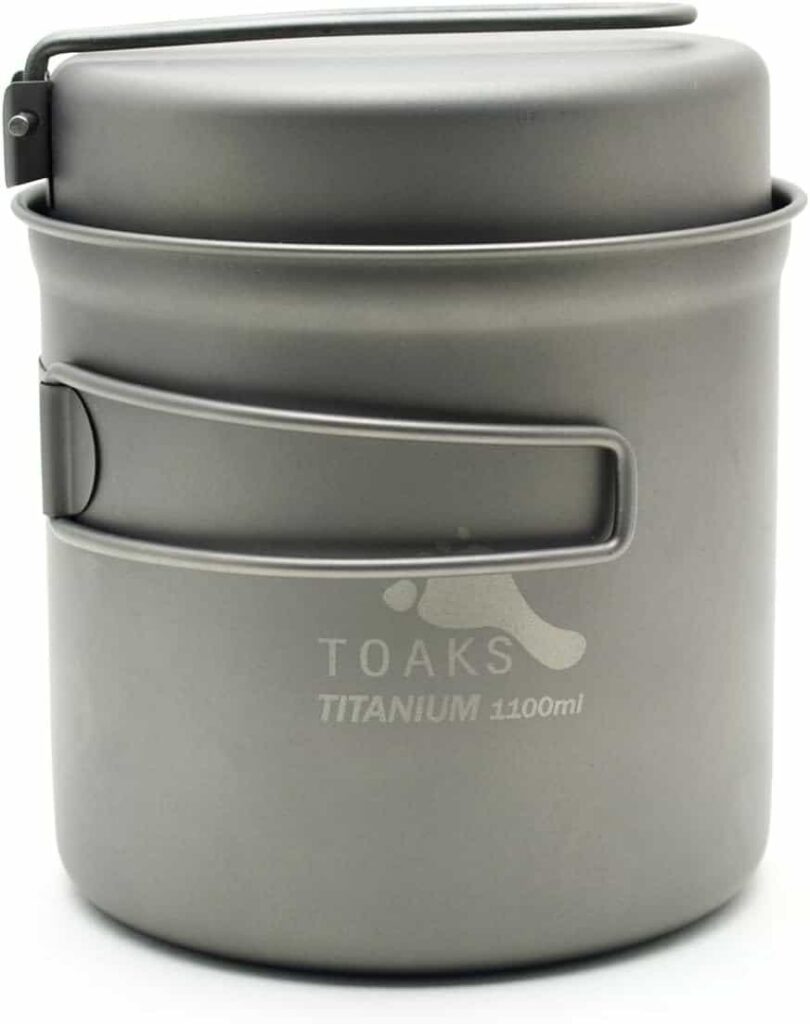
The TOAKS 1100ml Pot with Pan is the cookware set for the hiker who is trying to carry as little as possible and who is not willing to give up a pot that works. It weighs five and a sixth of an ounce, which is one hundred and fifty-nine grams, and it puts a one thousand one hundred milliliter pot into a unit that is small enough to forget is in your pack.
The TOAKS pot is made of Grade 1 titanium with no coating, and the pan folds inside it as a lid. The cookset nests — pan inside, handles folded — into a cylinder that is easy to stow and easy to reach. It is designed to nest with a wood stove, a fuel canister, or a medium cup, and with a mesh storage sack included, the whole thing disappears into the pack with almost no attention required.
The Daoist principle the TOAKS carries is the one the Laozi puts behind the line about the vessel that is useful because of its emptiness. A pot that holds a meal and nothing else is a pot that has given its space to the meal. The TOAKS is not the most versatile. It is not the most feature-rich. It is the pot that holds exactly what it holds and weighs almost nothing while doing it, and the pot that weighs almost nothing while doing its job is the pot that has done its job the way the vessel does its job. The gift of emptiness is the principle that governs not only shelter but cookware, and the cookware that disappears into the meal is the cookware that has done its work.
2. GSI Halulite Soloist — The Solo Traveler’s Complete Meal
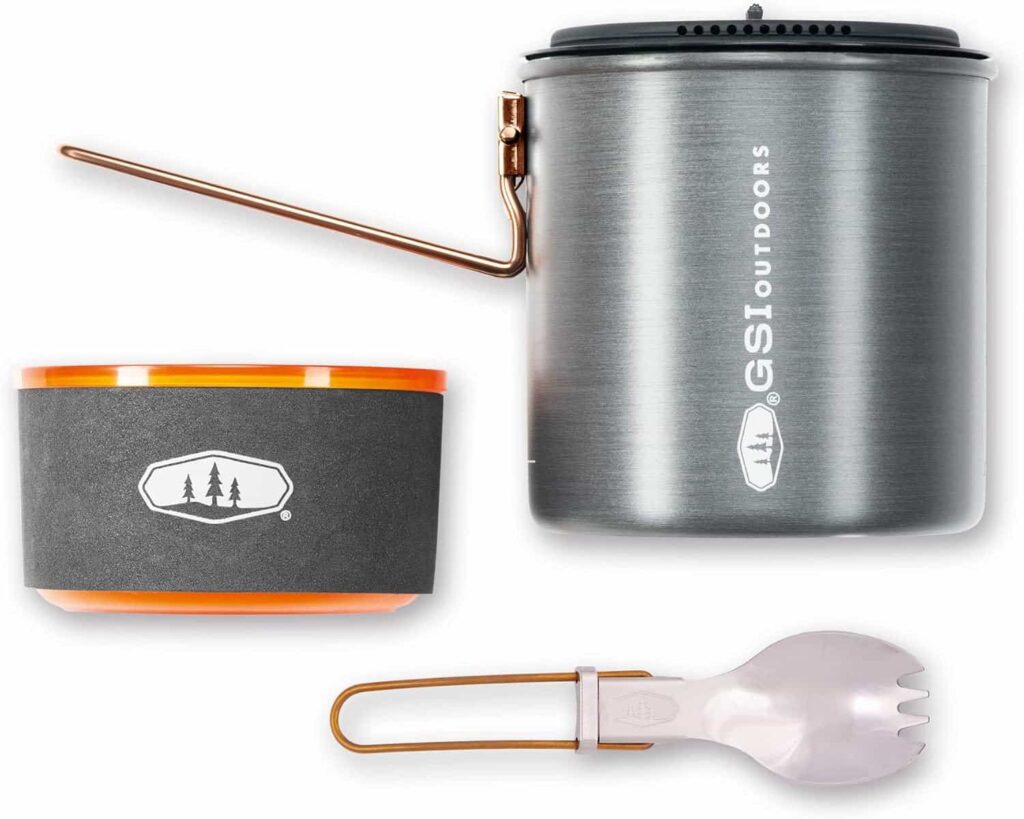
The GSI Halulite Soloist is the cookware set for the solo traveler who wants the whole meal, not just the cooking vessel. It weighs ten and a ninth of an ounce, which is three hundred and nine grams, and it includes a one point one liter pot with a heatsink ring, a bowl, an insulated cup with a sip lid, and a folding spork — four pieces that nest and color-code themselves for quick identification on a dark campsite.
The pot base carries a heatsink ring that spreads heat efficiently over the small burners most backpackers carry. The double-roll rim and locking handle keep things stable where the ground is uneven. The bowl and the mug have a low center of gravity, spill-proof sip lids, and room to nest small stoves and fuel canisters inside. It is not the lightest thing in this category — titanium will beat it — but it is, for a complete solo kit, almost the most practical.
The Daoist principle the Soloist carries is the one the Laozi puts in the line about the tool that gives the hand what the hand needs. Four pieces that nest into one is four tools that do not ask to be four tools. A cookset that is complete but does not demand attention is a cookset that serves the meal and steps back. Daoist simplicity on the trail is about letting go of weight, and the Soloist lets go of clutter by putting everything one person needs into a single nested unit.
3. Snow Peak Multi Compact (SCS-020T) — Heirloom Quality in Titanium
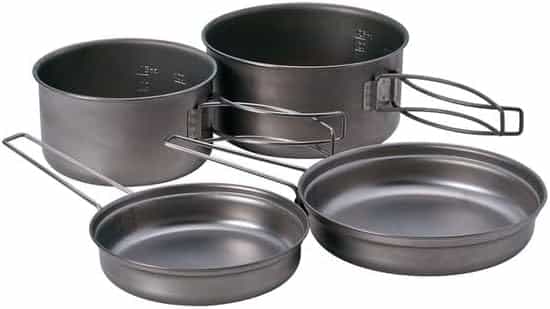
The Snow Peak Multi Compact Cookset is the cookware set for the hiker who wants gear meant to outlast the person who bought it. It weighs eleven and a sixty-eighth of an ounce, it is made of titanium, and it is made in Japan by a company that has been building outdoor gear for more than sixty years. The set includes two stacking pots and frypans with foldable handles, and the pot lids work as lids, as plates, and as small saucepans.
The cookset is built around a nested philosophy. Every component folds or nests, and nothing is left to rattle loose in the pack. The titanium is thin but not fragile, and the lifetime product guarantee carries the assumption that the set will be used long after most gear in the pack has been replaced. It is not the lightest two-person titanium option — the TOAKS is — but it is built for two: a partner’s meal, a shared stove, a camp that stays a little longer.
The Daoist principle the Snow Peak carries is the one the Zhuangzi puts in the story of the useful thing that lasts. A set built to outlast you is a set that does not ask to be replaced, and the cookware that does not ask to be replaced is the cookware that has done its work across years rather than across seasons. The principle that the best gear disappears is the one the Snow Peak follows — it does not vanish because it is light, but because it is simply not going anywhere.
4. Keith Ti6014 3-Piece Set — Three Pieces, One Job
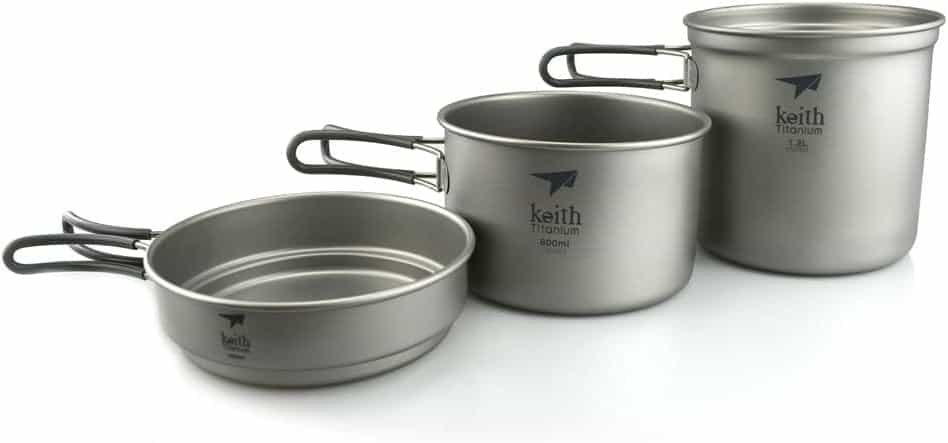
The Keith Ti6014 3-Piece Set is the cookware set for the hiker who wants a little more than one pot and a little less than a full two-person kitchen. It weighs ten and a fifth of an ounce, which is two hundred and ninety grams, and it includes three pieces: a one thousand two hundred milliliter pot, an eight hundred milliliter pot, and a four hundred milliliter pan that doubles as a lid.
The set is made of Grade 1 titanium with a sandblasted matte finish, which is non-reflective on a bright trail and pleasant under the hands. The three pieces nest into a single streamlined unit, and the pan folds into a lid for either pot. The company is ISO 9001 certified, and its titanium samples have passed both EU LFGB and US FDA food-grade testing — certifications that matter less than the result: a pot that does not taint the taste of what you put in it.
The Daoist principle the Keith carries is the one the Laozi puts behind the line about the work that completes itself and then steps back. Three pieces that do the work of four is three tools that have already given up one tool. A cookset that does more with less is a cookset that has done the work the Laozi meant to describe. On the trail, where flavor is often the only pleasure you have earned, a pot that does not change the taste of what you eat is a pot that has done its job in the way the vessel does its job.
5. MSR Ceramic 2-Pot Set — The Pot That Cooks Like a Kitchen
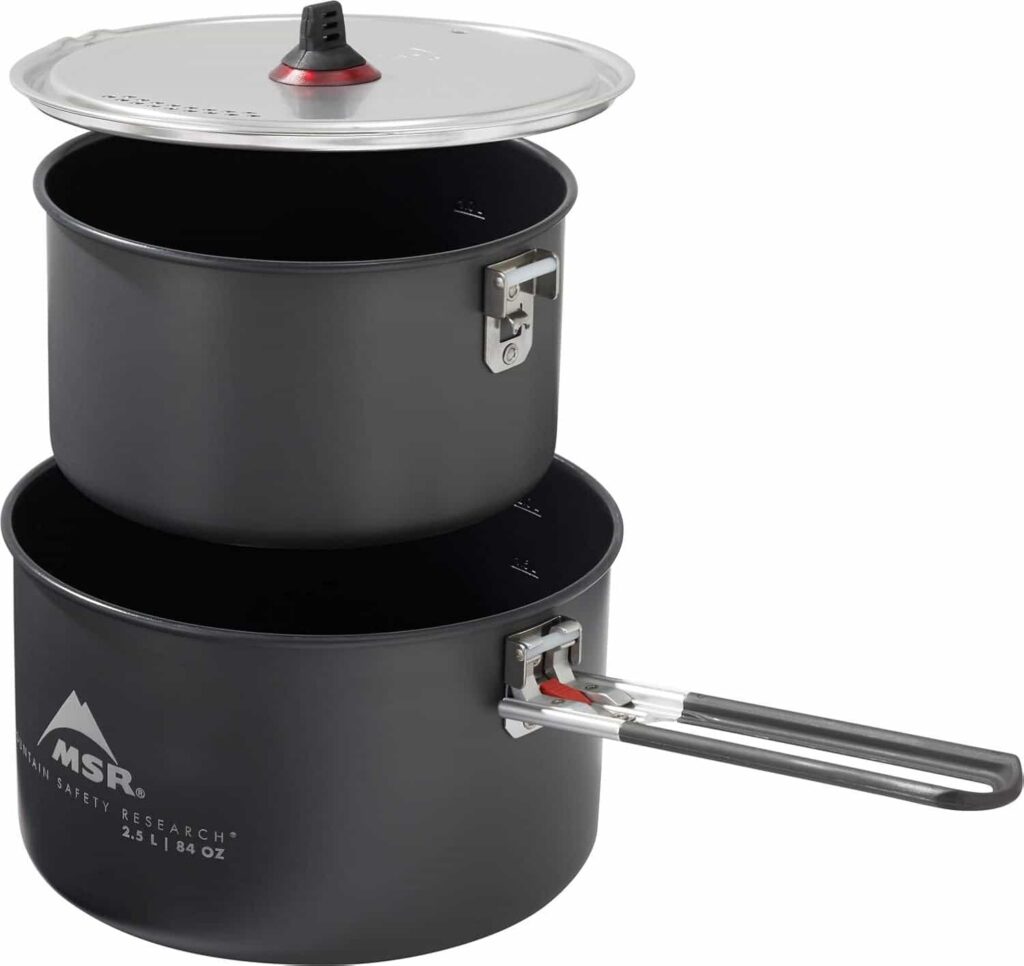
The MSR Ceramic Coated 2-Pot Set is the cookware set for the person who is willing to spend a little more weight because weight is what you are buying when you buy a pot that behaves like a pot from a real kitchen. It weighs fifteen and a tenth of an ounce, which is four hundred and twenty-eight grams, and it includes a two point five liter pot and a one point five liter pot, both with a ceramic non-stick coating.
The aluminum conducts heat evenly, and the Fusion ceramic non-stick coating makes that heat do real work. The coating is scratch-resistant with metal utensils, safe at high temperatures, and free of PTFE and PFOA. Pasta slides. Eggs release. The two pots nest together with room inside for a mug and utensils, and the included Talon pot handle clips on and off. The lid doubles as a strainer, and the manufacturer carries a three-year limited warranty.
The Daoist principle the MSR carries is the one the Laozi puts in the line about the tool that serves the hand, not the other way around. A pot that lets you cook a real meal rather than boiling water into a packet is a pot that has done its work in a kitchen the way a kitchen does its work. This set does not win on lightness. It wins on what you can actually make. For people who prefer the stove to do most of the work, the guide to backcountry stoves names the MSR set as the obvious partner for a kitchen that travels.
6. GRITR Titanium Canteen Mess Kit — When the Pot Is Also the Cup
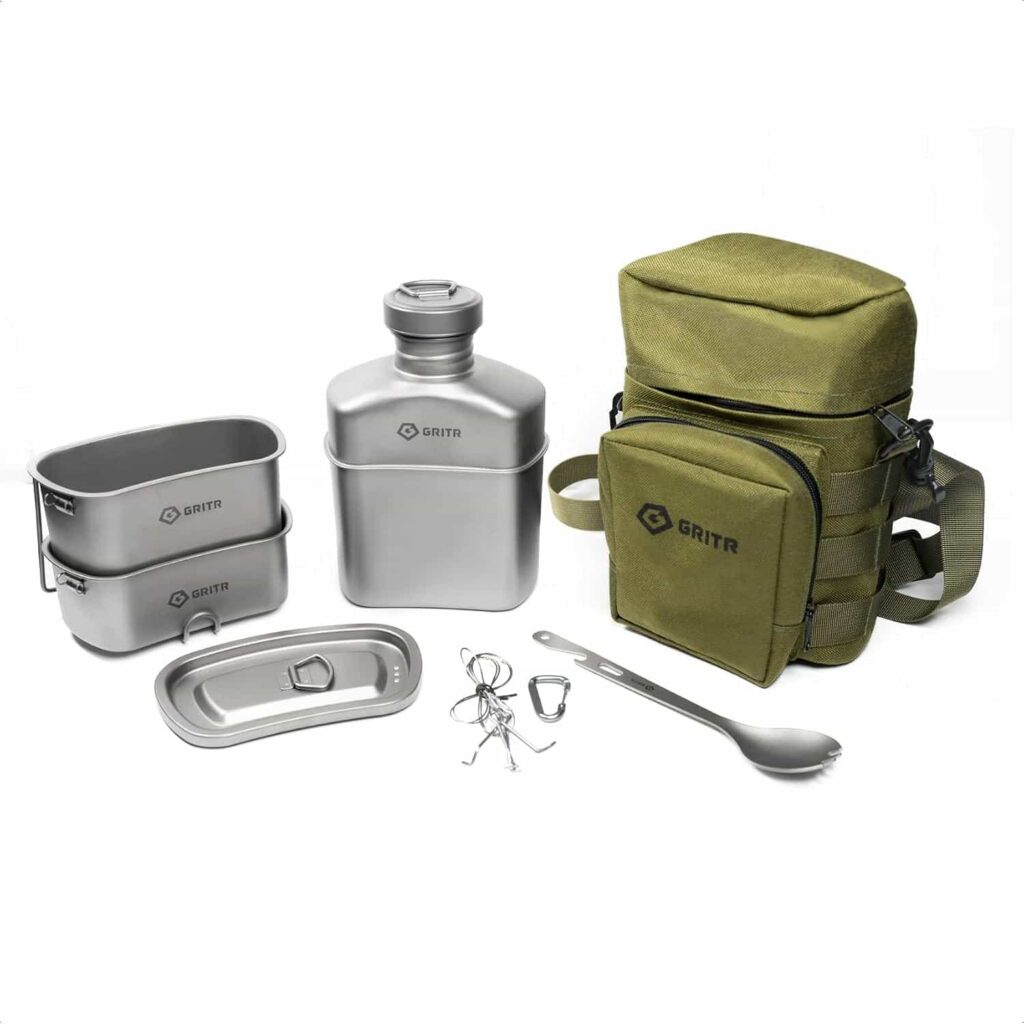
The GRITR Titanium Canteen Mess Kit is not a cookware set in the usual sense. It is a canteen, a mess tin, a cup, and a spork, all titanium, all nesting into a nylon bag with an adjustable strap and a carabiner clip. It weighs twenty-six and a tenth of an ounce, which is seven hundred and forty grams, and the pot is the canteen: pour from it, cook in it, drink from it.
The mess tin carries a volume scale marked in ounces and milliliters on the interior, and the handles fold. The spork doubles as a bottle opener. The cup has a lid and a folding handle. The bag fits over a belt or clips to a pack, and the lifetime warranty covers repair and replacement for essentially anything short of deliberate damage. It is not the lightest option. It is not the most compact. It is the most complete.
The Daoist principle the GRITR carries is the one the Zhuangzi puts behind the idea of the useful useless thing. A kit that is a canteen, a pot, a cup, and a utensil all at once is a kit that has done the work of four objects as one object. The hiker who wants the fewest possible things in their hand at the end of a long day wants this kit. The hiker who is moving over a multi-day alpine traverse wants something lighter. Know what you are buying, and the kit that matches your trail is the kit that has done its job.
The Standard, Applied
The standard this article has been built around is a single question: when you are cooking on the trail, are you aware of the pot, or are you aware of the meal?
If you are aware of the meal, the cookware has done its job. If you are aware of the pot, the cookware has not. The question is the same question that guides the choice of every piece of equipment a hiker carries. It is the question the Daoist philosophers asked about the way of the world, and it is the same question that the mindful roaming gear system asks of every piece of equipment the hiker carries. The pot that gives back the meal is the pot that has done its job. The pot that does not give back the meal is the pot that has become work, and the pot that has become work is the pot that the hiker has begun to carry the trail to serve.
A backcountry cookware set is judged not by how many pieces it holds, or how much it weighs, but by how much of your attention it takes. Great skill looks like clumsiness, and the cookware that does its work without drawing attention to itself is the cookware that has done its work the way the Daoist philosophers meant it to be done. The best one takes none. The six sets in this article do not take the same amount, but they all take less than the alternative, and the difference between the cookware set and the kitchen is the difference between the hiker who is eating a meal and the hiker who is working the pot.
Frequently Asked Questions
Should I carry titanium or aluminum cookware? Titanium is lighter and more durable, but it does not conduct heat as evenly as aluminum and does not have a non-stick surface. Aluminum is heavier, but it conducts heat well and, in its ceramic-coated form, can be non-stick. If you are trying to carry as little as possible, choose titanium. If you want a pot that behaves like a pot from a kitchen, choose aluminum.
Do I need a complete mess kit, or just a pot? For a solo day hiker who is rehydrating food, a single pot is enough. For a solo overnighter who wants a bowl, a cup, and a utensil without carrying them separately, a complete mess kit is the better choice. The kit that adds weight is worth carrying only if the weight it adds buys you a better meal than the meal you would eat otherwise.
Is a pot with a pan worth the extra weight? A pan that doubles as a lid is worth almost no weight at all. A pan that is a separate frying surface is worth the weight only if you are cooking more than you are rehydrating. The pan that does its job as a lid is a pan that does not ask to be two objects.
Do I need to worry about coatings? If you are cooking with titanium, you will not have a non-stick coating, and dry pasta will cling. Oil is your friend, and boiling water is the job most titanium pots do best. If you want a non-stick surface, a ceramic-coated aluminum pot is the answer. PTFE- and PFOA-free coatings are the current standard for health-conscious use.
What is the lightest cookware set I should carry? The TOAKS 1100ml Pot with Pan weighs five and a sixth of an ounce. That is the lightest serious pot in this guide, and it is the right choice for the hiker who wants the least possible weight for the most possible function.
How do I store my cookware in the pack? Nest the pieces together, pan inside pot, handles folded, and stow the set in the bottom of the pack or in a side pocket depending on how often you expect to cook. A mesh storage sack, when included, keeps the titanium quiet against the other gear in the pack and prevents the clatter that is the only reason cookware becomes noticeable.
Summary
The best backcountry cookware set is not the one with the most pieces, the largest capacity, or the lowest weight. It is the one that you stop noticing, because noticing it means it is doing something that the meal is not, and the meal is the thing you are carrying yourself for.
The pot that asks you to arrange it, to watch it, to think about it, is the pot that is doing the work of eating for you. The pot that boils water, holds a meal, and goes quiet is the pot that has disappeared into the meal it is making. The pot that gives a meal and disappears is the pot that the Laozi would call the useful thing: the thing that does its work because of the space it holds, not because of the material it is made from. And the hiker who is eating on the trail and is not aware of their pot is the hiker who is on the trail. That is the standard, and that is the cookware.