
This is a long essay. It is also one of the most important ideas on this site, because it is the idea that explains why the other ideas exist. Everything else — the gear that disappears, the water that gives itself away, the light that goes quiet, the path that is walked without a plan — is a practice of returning to the state the mountain restores. This essay is about the state itself.

There is a phrase I hear often, in English, from people who write about the outdoors and from people who come back from the outdoors with a strange look in their eyes. They say they went into the wild to find themselves. They say the mountain was where they found themselves. They say the trail was where they finally became the person they always wanted to be.
I do not want to dismiss what those people are feeling. I feel it too. When you are on a trail, something about you changes. It feels like finding. It feels like coming home. It feels like you have met someone you did not know you were, and that someone is more you than the you that sits in meetings and reads messages and stands in line at the grocery store.
But the word “find” does a quiet piece of violence to what is actually happening.
There is a way to name what actually happens in Daoist thought, and that way is called Daoist Pu. Pu is the uncarved state, the state of the wood before it has been shaped into anything, and it is the state the mountain returns you to when the layers the city has put on you fall away.
You do not find yourself in the mountain. You were never lost. What the mountain does is take something away. It takes away the layers you did not know you were carrying — the voice in your head that is not yours, the habits that are not yours, the ways of being that belong to the city and to the office and to the social life you have been performing and mistaking for living. It takes them away so slowly and so completely that by the second day on the trail you no longer notice them, and on the third day you no longer notice that they are gone.
You are not finding yourself. You are being returned to what you were before the city told you who you should be.
That is the idea of Pu. It is one of the oldest ideas in Daoist thought, and it is the idea that the rest of this site is built around, even when it is not named.
The Block of Un-carved Wood
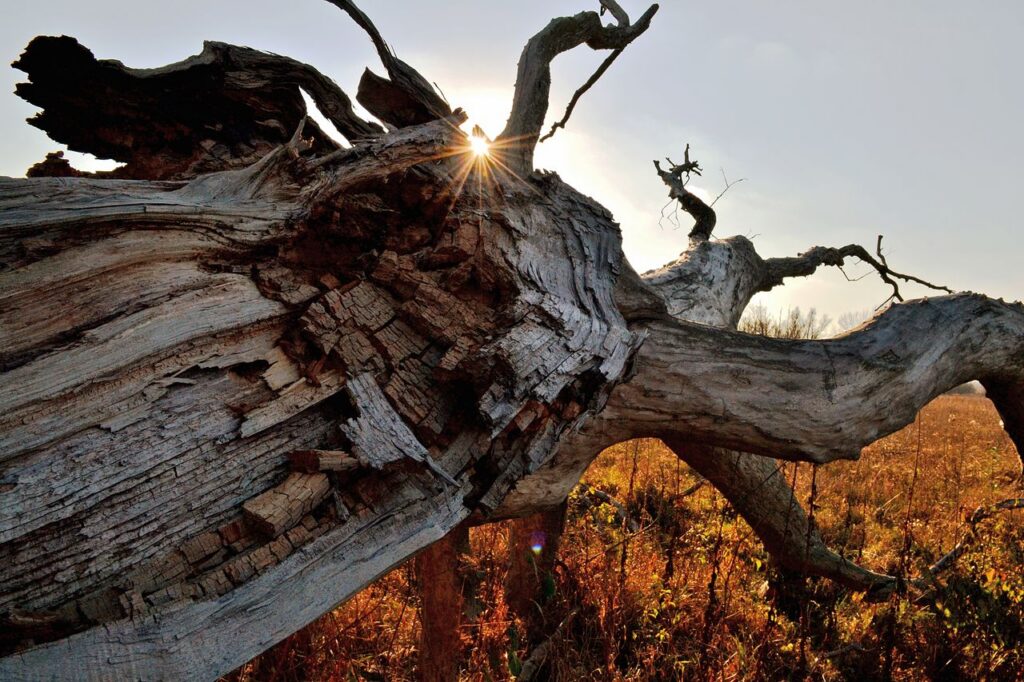
The word Pu does not have a single English translation that holds it whole. The closest English word is uncarved. The closest English noun is the uncarved block, or the uncarved log. It is the piece of wood before it has been shaped into anything. It is not a bowl. It is not a chair. It is not a spoon. It is wood, and it is everything wood can become, because it has not yet been committed to any one of those things.
Laozi uses the image of Pu in a number of places in the Tao Te Ching. In Chapter 28, he writes a line that is one of the most important in Daoist thought. In the original:
知其白,守其黑,為天下式。常德不離,復歸於嬰兒。
Know the white, keep to the black, and be the model for the world. Constant virtue does not depart, and one returns to the state of the infant.
The English translations of this line vary. The important thing is not the translation. The important thing is the image it builds. The white is the known, the labeled, the shaped thing — the thing that has been carved into a bowl or a chair or a spoon, the thing that has a name and a use and a place in the system. The black is the uncarved, the unknown, the unshaped thing — the thing that is still a block of wood, that has not yet been carved, that is still Pu.
Laozi is not asking the reader to refuse knowledge. He is asking the reader to know the carved thing and still keep the uncarved thing, to know the white and still hold onto the black. The person who can do this, the person who has been carved by the world and still holds the uncarved state inside, is the person who has not been changed into what the world wanted to change them into.
That is what this essay is about. That is what the mountain is about. That is what everything else on this site is about.
A Different Idea From the West
The phrase “find yourself” belongs to a Western tradition that reaches back further than most people realize, and it belongs to a Western tradition of the outdoors that is still alive today. The American wilderness writers — Muir, Thoreau, Abbey — are all writing in this tradition, and even though Thoreau is the closest of them to the Daoist sensibility, even Thoreau is not quite the same as Laozi.
In the Western tradition, the wilderness is a place of discovery. The self is a thing that is there, somewhere inside you or somewhere in front of you, and the wilderness is where you go to meet it. The mountain is a mirror. The river is a teacher. The trail is a path toward revelation. These are not bad ideas. They are not wrong ideas. But they are not the Daoist idea, and the difference between them matters.
The Daoist idea is not discovery. It is return.
The Daoist idea is that you are already what you need to be. You do not need to go into the mountain to find yourself, because yourself is already here, and the mountain is the place where everything that is not yourself stops getting in the way of it. The mountain does not reveal you. It removes the disguise.
This is not a subtle difference. It changes how you move through the wilderness and it changes how you move through the rest of your life. The person who goes into the mountain to find themselves is carrying a destination into the mountain with them, and the destination is called self. The person who goes into the mountain to return to Pu, to the Daoist Pu, is not carrying a destination at all. The destination is not something to reach. The destination is something to stop reaching toward.
In the essay on wu wei flow hiking, I wrote about the hiker who learns to walk without a plan and to trust the path instead of the map. That essay is about movement. This essay is about the self that is moving. They are the same practice seen from two different directions.
The Wood That Was Already There
Zhuangzi, the second of the two great Daoist philosophers and the one who brought humor and madness and the strangest stories to the Daoist tradition, tells a story about a tree that is useful because it is useless.
The tree is a tree of extraordinary size, hollow at the top, knotted at the roots, the kind of tree that a carpenter passes by and does not look at twice. A carpenter walks past it and calls it useless, because the wood is warped and the grain is broken and the tree cannot be made into a bowl or a chair or a spoon. The tree cannot be used by the system of use.
A man named Liezi, one of Zhuangzi’s characters, asks the tree why it is useless. The tree answers. It says that all the useful trees — the trees that the carpenter takes and cuts into things — are cut down when they are full-grown, in the middle of their lives, because they are useful, and they do not live to the end of their days. The useless tree lives. It grows old. It drops its leaves and puts them back. It stands. It is useless, and it is alive.
Zhuangzi’s story is not about trees. It is about the person who refuses the shape the world wants to give them.
The useful person is the person who fits the shape the world has carved for them. They are useful because they are shaped. They work the job, carry the title, perform the role, live the life that the system has defined as a good life. They are a bowl. They are a chair. They are a spoon. They fit perfectly into the hand that is holding them, and they do not last.
The useless person, in Zhuangzi’s sense, is the person who does not fit the shape. They do not fit the job. They do not fit the title. They do not fit the role. They are the tree that the carpenter walks past. And the tree that the carpenter walks past is the tree that is still standing at the end of the story.
This is not advice to stop working or to stop being useful in the way the world means. Zhuangzi does not want you to quit your job. He wants you to know that the version of you that the world calls useful is not the version of you that is you. The useful version is the carved version. The you that you are looking for is the uncarved version, and the uncarved version is not something to achieve. It is something that is already there, underneath all the carving.
A Story About the First Day On the Trail
I want to tell you a story about the first day someone spends on a trail after being off the trail for a long time.
The person is a professional. They have spent the last few years of their life in a job that requires them to speak in a certain way, to dress in a certain way, to answer questions in a certain way, to think about a certain set of things and not to think about a different set. The person is good at the job. The person is very good at the job. The person has built a self around the job, and the self is not the job. The self is the shape the person has learned to be inside the job.
The person gets on the trail, and within two hours the shape has begun to come off.
It happens without the person noticing it, which is why the story is worth telling. The voice that says, I need to be productive, goes quiet. The voice that says, I need to make a good impression, has no one to impress. The voice that says, I need to know what I am doing, runs out of things to evaluate. The voice that says, I need to answer this message, has no message to answer.
By the end of the first day, the person has not said any of those sentences out loud, and the person has not noticed that they have stopped saying them. The person has noticed, instead, that the trail is there. The person has noticed that the sky is there. The person has noticed that their own body is there, and that the body has been there for years, and that the body has never really been noticed until now.
On the second day, the person notices that they have forgotten their name for a few minutes. They reach for it and it is there, but it feels like a piece of information, the way a zip code or a bank account number feels, and not like a thing that belongs to them.
On the third day, the person stops noticing that they have forgotten their name.
By the fourth day, the person is no longer a professional. They are no longer a good worker. They are no longer a person who is good at being a person. They are a person walking, and that is the whole of what is happening, and the person is finally, for the first time in years, not being anything else.
The person did not find themselves. The person was returned to a state that was already there, underneath the professional, underneath the worker, underneath the person who is good at being a person. The mountain did not reveal them. It removed the layers.
What Is Removed
There are four things the mountain removes. They are not all physical. They are all learned.
The first thing the mountain removes is the voice. The voice is not a metaphor. It is a sound you hear inside your head when you are thinking, and it is a sound that belongs to a certain set of people and not to you. The voice that tells you what to do, when to do it, how to do it, and what other people will think about how you did it — this voice is a learned thing, and the mountain removes it the way the mountain removes everything else: by giving you something else to pay attention to. The voice stops because the trail is there, and the trail does not give you permission to talk to yourself over it.
The second thing the mountain removes is the self-image. The self-image is the story you tell yourself about who you are. The prepared hiker. The experienced hiker. The beginner who is trying to do it right. The professional who has taken a break from work. All of these stories are heavy, and all of these stories are things you built for other people, and all of these stories are things you do not need to be carrying on the trail. The mountain removes the self-image the way it removes the voice: by taking the self out of the story. You are walking. That is the story. The rest of it is noise.
The third thing the mountain removes is urgency. Urgency is the belief that there is something you need to be doing and that you need to be doing it now. The belief is not wrong. The belief is true, for a certain kind of life, in a certain kind of place. The belief is not true on the trail. On the trail, there is nowhere to be, and there is no time to be there, and there is nothing to be doing. You are walking, and you are here, and there is no other place to be, and there is no other time to be now. The mountain removes urgency the way it removes everything else: by giving you nothing else to be urgent about.
The fourth thing the mountain removes is the future. This is the hardest one to remove, because it is the one most people are most attached to. The future is the belief that the walk has a point, and that the point is somewhere ahead of where you are, and that when you get there, you will be the person the walk has been leading you to. The mountain removes the future by making the walk long enough and slow enough that the point is never reached in the time you have. You do not get to the summit. You do not get to the end of the trail. You get to the next step, and the next step, and the next step, and that is the whole walk, and that is the whole walk.
What is left, after the four things are removed, is the person who is walking, and nothing else. That is Pu. That is the uncarved state.
The Difference Between Removal and Discovery
The phrase “find yourself” implies that the self is a destination, and that the self is somewhere ahead of you, and that the wilderness is the place where you walk toward it. The Daoist phrase “return to Pu” implies something different. It implies that the self is already here, underneath everything, and that the wilderness is not a place of discovery but a place of removal.
The difference matters because it changes how you treat the wilderness, and it changes how you treat yourself.
If the wilderness is a place of discovery, then the wilderness is something you use to find yourself, and the self is something you obtain from the wilderness, and the wilderness is a means, and the self is the end. If the wilderness is a place of return, then the wilderness is not something you use. The wilderness is something you enter, and the entering is the whole of what happens, and there is no end to the entering, and there is no self to be found at the end of it.
This is not a subtle difference. It is the difference between a person who goes into the wilderness and comes back with a story about what they found, and a person who goes into the wilderness and comes back with no story at all, because there was nothing to find and nothing to return with, and because the returning was the whole point.
In the essay on Daoist simplicity, I wrote about letting go of the weight you carry in your mind. That essay is about the mind. This essay is about the self underneath the mind. They are the same direction, and they are the same practice, but they are different things, and they are not interchangeable.
The Un-carved Person
There is a person in Daoist thought who is often called the uncarved person. The uncarved person is not a sage. The uncarved person is not a hero. The uncarved person is not a person who has achieved anything or accomplished anything or become anything that the world recognizes as a person who has become something. The uncarved person is the Daoist Pu in human form, and the uncarved person is the person who has been left alone by the system of carving.
Laozi describes this person in Chapter 30:
善者果而已,不以取强。果而勿矜,果而勿伐,果而勿骄,果而毋强。
The good one is satisfied with the fruit and does not make use of force. After the fruit, do not boast. After the fruit, do not praise yourself. After the fruit, do not be proud. After the fruit, do not be strong.
The person who has the fruit and does not boast about it is the person who has been given something and has not made it into a story. The person who does not make the fruit into a story is the uncarved person. The uncarved person is the person who has the thing, and who has not made the thing into a thing.
This is a strange description of a good person. In Western thought, the good person is the person who does good things. In Daoist thought, the good person is the person who does things and does not make the doing into something. The uncarved person is not a person who has become a bowl or a chair or a spoon. The uncarved person is a person who is still wood.
The mountain does not make you into the uncarved person. The mountain takes away the things that have been carving you, and what is left is the uncarved person. The mountain is not a teacher. The mountain is a mirror that removes the mask, and what you see in the mirror is not what you have found. It is what you were.
What to Do When You Come Back
The mountain removes four things. The question is what to do with them when you come back.
You do not need to keep them removed. That would be a different kind of discipline than the Daoist one. The Daoist discipline is not about staying removed. The Daoist discipline is about knowing that the things can be removed, and knowing that they are not you, and knowing that you are not the things that have been carved into you.
When you come back to the city, the voice comes back. The self-image comes back. The urgency comes back. The future comes back. They come back because they belong to the city, and the city will put them back on you, and you will put them back on yourself, and that is the way of the city, and that is the way the city works, and you cannot stop it from working.
What you can do is know that the voice is not you. What you can do is know that the self-image is not you. What you can do is know that the urgency is not you, and that the future is not you, and that the thing that is underneath all of those things is you, and that the thing underneath is the thing that was there before the city, and the thing underneath is the thing that will be there after the city, and the thing underneath is the only thing that is yours.
This is the discipline of Pu. It is not a discipline of removal. It is a discipline of knowing what has been removed and what is left. It is a discipline that can be practiced on the trail, and it is a discipline that can be practiced in the city, and it is the same discipline in both places, because the thing underneath is in both places.
In the essay on mindful gear, I wrote about the gear that disappears so the hiker can disappear into the trail. The gear does not reveal the trail. The gear removes the barrier between the hiker and the trail. The same is true of the mountain, and the same is true of the city, and the same is true of the self. The self is not revealed. The self is uncovered.
A Practice That Has No Name
There is a practice that can be done in two minutes, and it is the practice of returning to Pu, and it has no name, because the practice does not need a name.
The practice is this. You sit down somewhere. You sit down where you are, and you do not sit down where you should be. You do not sit down in the chair, and you do not sit down on the couch, and you do not sit down in the park. You sit down on the floor, or on the ground, or on the step, or on the bench, or on the curb. You sit down where you are.
Then you listen to the voice that is in your head. You do not try to make it stop. You do not try to change it. You do not try to answer it. You do not try to argue with it. You do not try to dismiss it. You listen to it, and you listen to it, and you listen to it, and you listen to it, and the voice is doing what the voice has always been doing, and the voice is not you, and the voice is not telling you the truth, and the voice is not the only thing in your head.
Then you listen to something else. You listen to the breath that is happening in your chest, and you do not try to make the breath happen, and you do not try to make it stop, and you do not try to change it. The breath is happening, and you are listening to the breath, and the breath is not a thing you are doing. The breath is a thing that is doing you.
Then you notice the body that is breathing. The body is there, and the body has been there, and the body has never been asked to stop and notice itself, and the body has always been busy, and the body has always been carrying the voice and the self-image and the urgency and the future, and the body is still there, and the body is not the voice and is not the self-image and is not the urgency and is not the future.
Then you sit there for two more minutes, and then you stand up and go do whatever you were going to do.
Nothing has changed in the city. The voice is still in your head. The self-image is still in your head. The urgency is still in your head. The future is still in your head. But something has changed in the body. The body knows, and the body has always known, and the body was the uncarved person all along, and the body did not need to be found.
The River of Pu
There is a river that runs through the Daoist tradition, and the river is called Pu, and the river is the Daoist Pu in the fullest sense of the word, and the river is not a metaphor, and the river is not a symbol, and the river is the state of the wood before it has been carved, and the river is the state of the person before they have been carved, and the river is the state of the self before it has been shaped into the thing that other people can use. For those who want to read more on Zhuangzi and the Daoist tradition of Pu, the Stanford entry on Zhuangzi is a good starting point.
The mountain does not make you into the river. The mountain removes the things that have been stopping you from being the river. The city does not make you into the river. The city removes the things, and then puts them back, and then removes them, and then puts them back, and then removes them, and then puts them back, and that is the city, and that is the way the city works, and you cannot change the city, and you cannot change the way the city works, and you do not need to change the city or the way the city works, because the river is still there, underneath the city and underneath the way the city works, and the river was always there, and the river is you.
The river is not a destination. The river is not a thing to be found. The river is a thing to be returned to, and the returning is the whole of what the river is for, and the river does not ask to be found, and the river does not ask to be used, and the river is the river, and the river is the uncarved thing, and the river is the only thing that was always yours.
Laozi writes, in Chapter 15, a line that has been translated in almost every way possible and understood in almost no way possible, and the line is about the person who walks in the river of Pu. In the original:
致虛極,守靜篤。萬物並作,吾以觀復。
Reach the utmost emptiness, hold steadfast in stillness. All things arise together; I watch their return.
All things arise together. They rise from the river, and they rise from the wood, and they rise from the uncarved block, and they rise from the person who is still a person before they have been carved, and they rise and they rise and they rise, and the person who watches their rising does not get in the way, and the person who watches their rising does not try to make the rising into something, and the person who watches their rising is the uncarved person, and the uncarved person is the person who has been returned to the river, and the river was always there.