This article contains affiliate links. We earn a commission if you purchase through them, at no extra cost to you.
There is a story about a headlamp, and it is a short one.
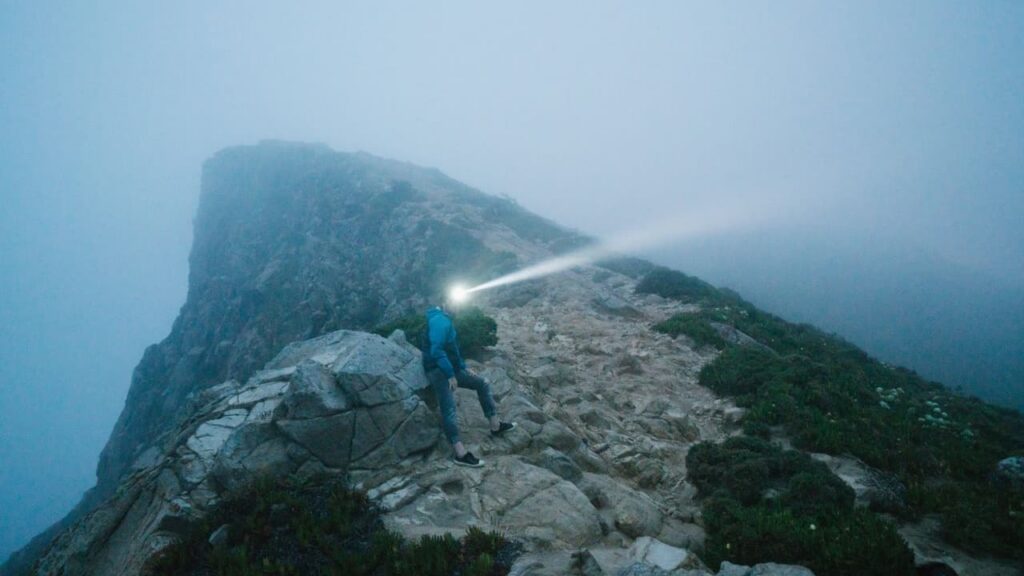
I was on a trail in the dark, on a section of ridge that drops on either side into nothing, and I knew that the next two miles would be in the dark. The woman in front of me pulled a headlamp out of her pack, turned it on, and the beam hit the trail. She walked.
Fifteen minutes later, the trail narrowed and the beam had to follow. I watched her hand go up to her forehead. I watched her shift the lamp. I watched her put her hand down. I watched her walk.
She had been aware of her light. The light had been doing something to her.
My own light did nothing to me. It pointed where I was walking, and I did not have to do anything to make it point where I was walking. I did not shift it. I did not notice it. I noticed the trail.
The difference is not a matter of brightness. It is a matter of whether the light uses you. A headlamp that asks you to adjust it, to think about it, to notice it, is a headlamp that has become a second job. A headlamp that points where you are walking, and does not become work, is a headlamp that has done its job.
That is the principle from the Dao De Jing that guides every choice in this article, and it is the principle that any backcountry headlamp is measured against. Great skill looks like clumsiness, and the best headlamp is the headlamp you forget is on your head. The light gives the trail back to you. The light disappears. The trail is all that is left, and the trail is what you came for.
The Six Headlamps at a Glance
| Headlamp | Brightness | Weight | Material | Rating |
|---|---|---|---|---|
| AXRUNZE KH85 (8 Pack) | 1000 lumens, 230 deg beam | 3.5 oz | ABS | 4.4 / 5 (165) |
| PETZL ACTIK CORE | 625 lumens | 3.1 oz | Plastic | 4.5 / 5 (2,390) |
| DanForce Bold-S | 1080 lumens, zoomable | 8.8 oz | Aluminum | 4.5 / 5 (9,512) |
| AKNEAR FR-GTK9800-K1 | Manufacturer claims 99,000 lumens, 125 deg | 0.32 kg | Aluminum | 4.4 / 5 (513) |
| OLIGHT Perun 3 | 3000 lumens, 160 m | 5.28 oz | 6061-T6 Aluminum | 4.7 / 5 (849) |
| Klein Tools 56048 | 400 lumens, 64 deg beam | 4.8 oz | ABS | 4.6 / 5 (1,347) |
All specifications are listed as they appear on Amazon. The AKNEAR brightness figure is the manufacturer’s claim as stated on the product listing.
The Six Backcountry Headlamps
1. AXRUNZE KH85 — The Wide-Beam Headlamp That Gives You Eight
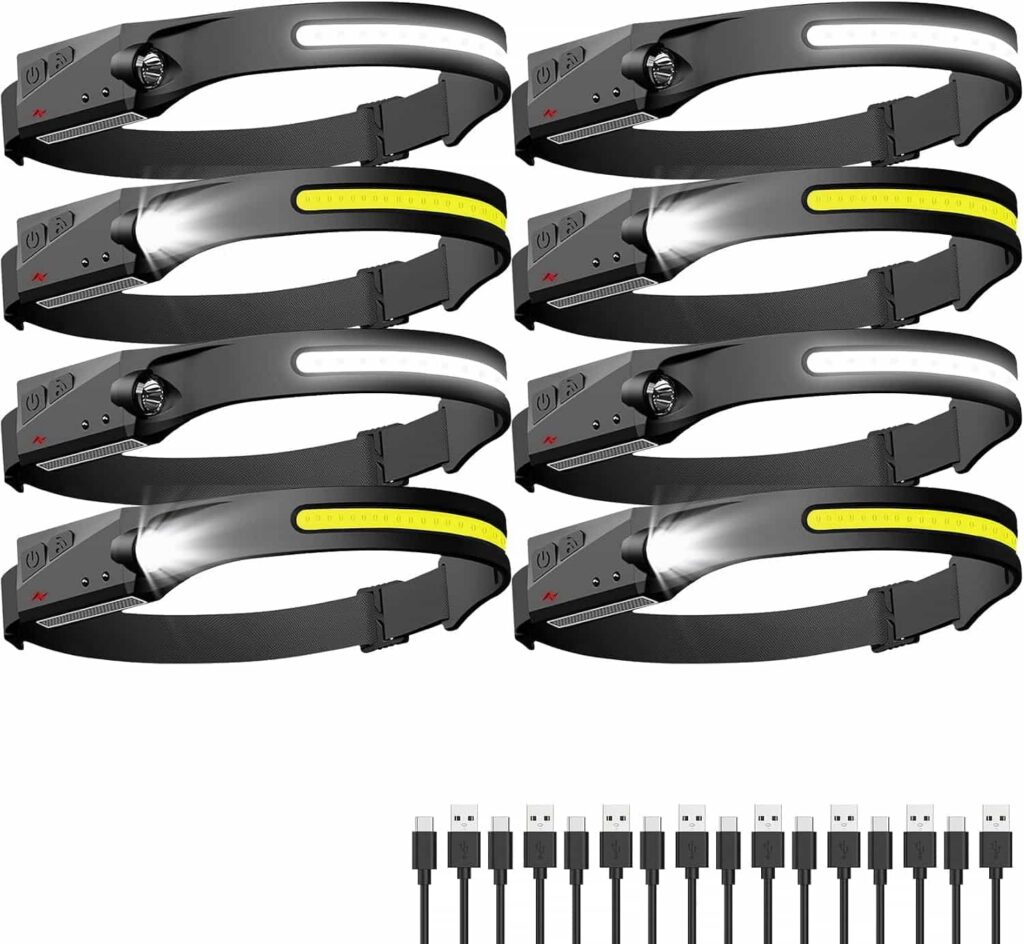
The AXRUNZE KH85 is the headlamp for the person who wants a wide pool of light instead of a narrow beam, and who does not want to buy one. It comes in a pack of eight, each weighing three and a half ounces, and it is the kind of purchase that happens when you need lights for a group, or for a house, or for a trail that has three exits and you want one on each of them.
The AXRUNZE has a dual light design. There is a COB floodlight that spreads light across a two hundred and thirty degree beam, and there is a separate XPE LED for when you need a focused beam instead of a wide one. Five modes cover most of what a hiker or a worker needs. There is a COB high and a COB low, an XPE high and an XPE low, and a strobe mode for signaling. The battery is a built-in one thousand five hundred milliamp-hour unit that charges over USB, and the listing runs to ten hours on a single charge. It is IPX4 water-resistant, which means it handles rain, and it is made of ABS plastic that is designed to take the kind of knocks a light sees on a trail.
The Daoist principle the AXRUNZE carries is the one that the Laozi calls the highest excellence, and the highest excellence is like water. A single headlamp is a piece of equipment. Eight headlamps, at the price of one, is a piece of equipment that multiplies itself and gives the light to the people walking behind you. It is not the light that disappears. It is the light that makes sure no one in the group is left in the dark, and the light that gives light and does not ask to be the light is the light that has done its work the way water does its work. The highest excellence is like water, and the headlamp that gives light to the people who need it most without asking to be noticed is the headlamp that has done its job.
2. PETZL ACTIK CORE — The Lightest Headlamp for a Clear View
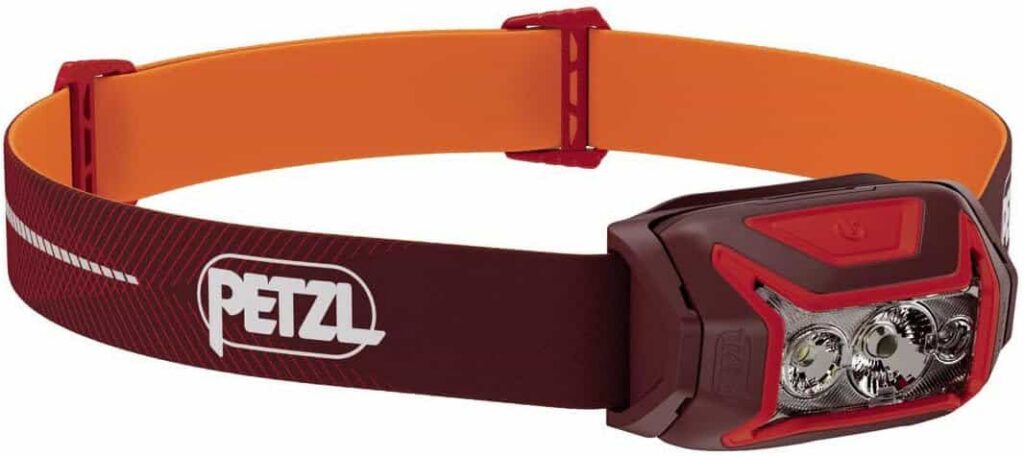
The PETZL ACTIK CORE is the headlamp for the hiker who is trying to carry as little as possible and who is not willing to give up a light that works. It weighs three and a tenth of an ounce, which is eighty-eight grams, and it puts out six hundred and twenty-five lumens in a unit that is small enough to forget is on your head.
The ACTIK CORE uses what PETZL calls a hybrid concept. The headlamp detects what kind of power source is inside it and adjusts itself to match, so it runs on the rechargeable battery that comes with it and on three AAA batteries without the user doing anything to switch between them. The beam is a mixed beam, which means it is wide when you are close to what you are looking at and focused when you are looking into the distance, and the beam changes without you changing a setting. There are three white lighting levels, a continuous red light that preserves night vision and does not blind the people around you, and a strobe for signaling. A battery indicator shows the charge each time the lamp is turned on or off.
The most Daoist thing about the ACTIK CORE is the glow ring. The PETZL listing notes a phosphorescent reflector around the LED that glows in the dark, and the glow ring lets you find the headlamp when it is turned off and you are reaching for it in a tent at three in the morning. For a backcountry headlamp, being findable in the dark is being useful in the dark. A headlamp that you can find without a light is a headlamp that has made itself useful in the very moment when light is absent. That is the principle the Laozi puts in the line about the vessel that is useful because it is empty, and the ACTIK CORE is useful in the dark for the same reason the vessel is useful in the empty: the thing that holds the light is made to be found without it.
3. DanForce Bold-S — The Heavy-Duty Headlamp with a Long Reach
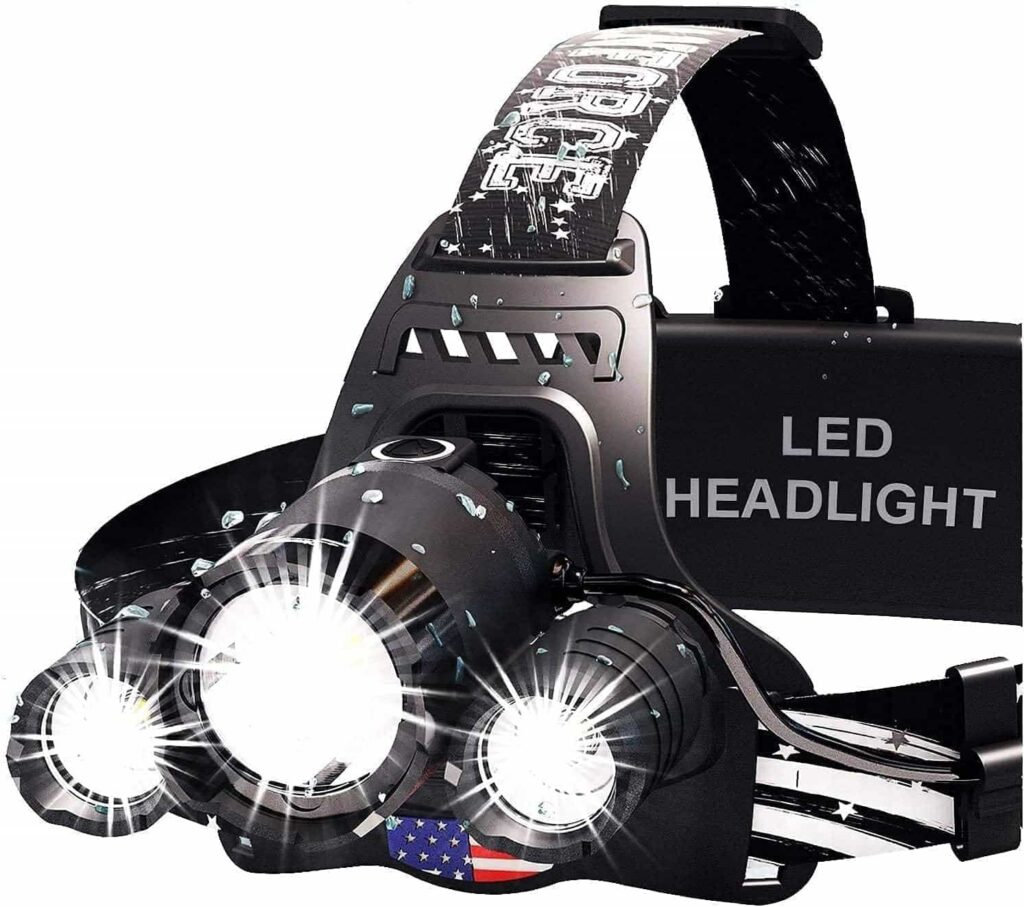
The DanForce Bold-S is the headlamp for the person who does not mind weight, because weight is what you are buying when you buy a piece of equipment that feels like it belongs on a job site or a backcountry ridge and is not going to give out. It weighs eight and eight-tenths of an ounce, it puts out one thousand and eighty lumens, and it is made of aluminum, which is the material that gives a headlamp the balance of toughness and lightness that a lighter plastic cannot.
The Bold-S is a zoomable headlamp. The beam can be shifted from a wide flood to a narrow spot, and the zoom is a mechanical one that the hiker or the worker adjusts with their hand when the situation calls for a long reach. There are multiple light modes, a red light function for night-vision work, and a USB rechargeable battery. The body is water-resistant at the IPX54 level, and the aluminum construction is what makes the headlamp feel like it is meant to last rather than to be replaced.
The Daoist principle the DanForce carries is the one that the Zhuangzi puts in the story of the butcher who works the ox without forcing the cut. A light made of aluminum is a light that does not pretend to be lighter than it is, and a light that knows its weight is a light that does not fight it. It is a light that tells you, the first time you put it on your head, that it is a light that will still be on your head when the hike is over and the plastic lights will have broken or been left behind. A headlamp that knows its weight and works with its weight is a backcountry headlamp that works the way the butcher works, and the work does not become a fight.
4. AKNEAR FR-GTK9800-K1 — The Longest-Running Headlamp for Endurance
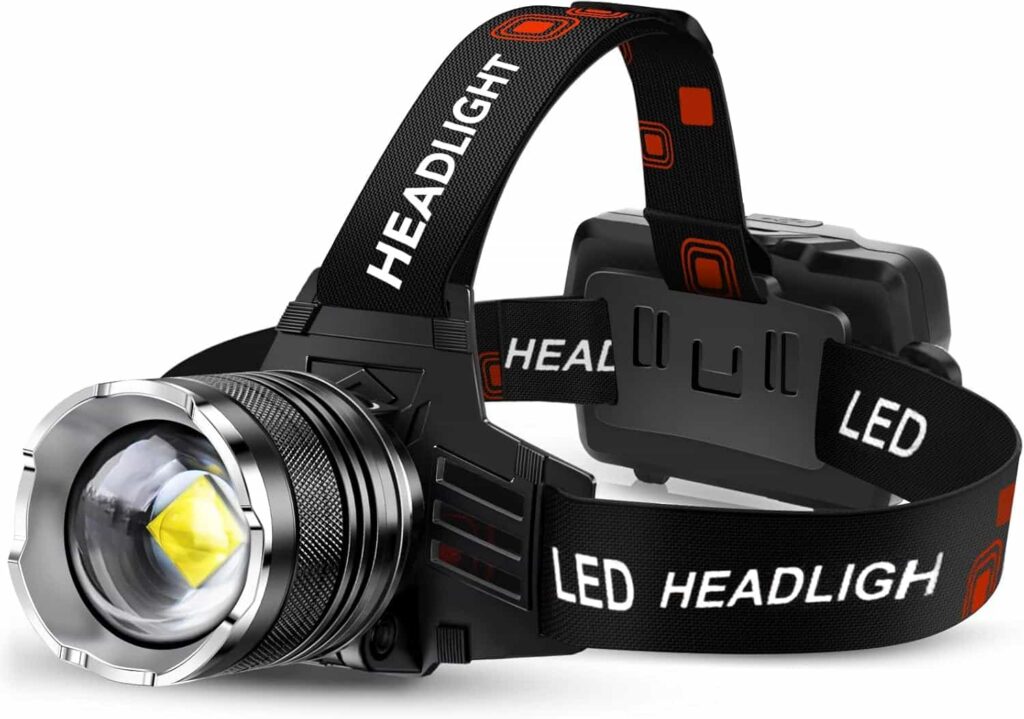
The AKNEAR FR-GTK9800-K1 is the headlamp for the person who wants the longest possible run time out of a single unit, and who wants a headlamp that can do something when the power is out. The listing carries a brightness figure of ninety-nine thousand lumens, and that figure is the manufacturer’s claim as stated on the product page, which is why it is noted here the way it appears on Amazon. The headlamp also carries a battery capacity of ten thousand five hundred milliamp-hours and a run time that the listing describes as ninety-five hours.
What the AKNEAR does most reliably is give you a long stretch of light from one battery. Twelve modes cover a wide range of tasks. There are five modes in the floodlight setting, five in the spotlight setting, and a red backlight that runs both constant and blinking. The beam can be zoomed between flood and spot, and the headlamp charges over USB-C. The body is made of aluminum, it is IPX7 waterproof, and the listing describes it as impact resistant.
The Daoist principle the AKNEAR carries is the one that the Laozi puts behind the idea that the useful thing is born from the empty thing. The large battery is a large empty space, and the large empty space is what holds the light for the long trail. A headlamp with a battery that can be left alone for a long time and still do its job is the headlamp that the hiker wants on a trail where the next charge is a day or two away. The AKNEAR is not the lightest. It is not the most precise. It is the headlamp that stays on while everything else has gone quiet, and the headlamp that stays on is the headlamp whose emptiness has become the thing that carries the light.
5. OLIGHT Perun 3 — The Highest-Performance Headlamp on Amazon
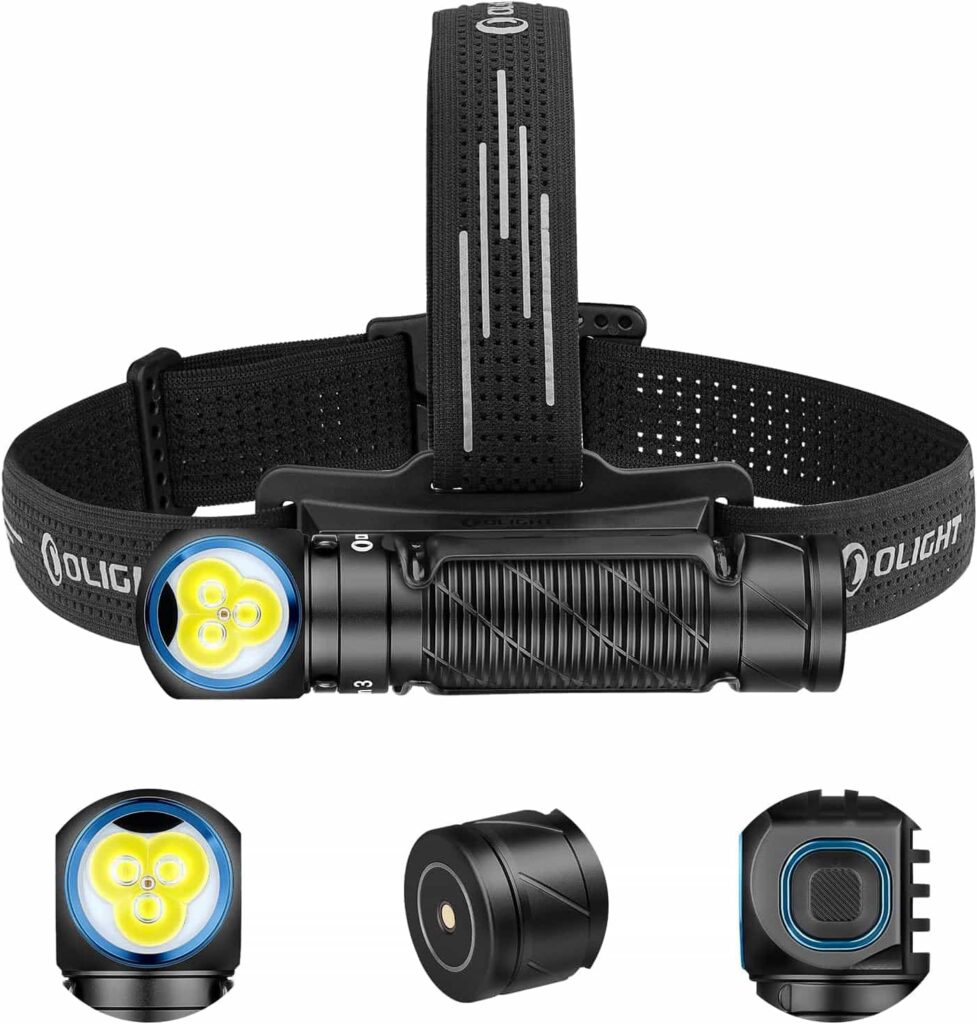
The OLIGHT Perun 3 is the headlamp for the hiker who wants the most light out of the smallest possible unit and is willing to pay for it. It puts out three thousand lumens in a body that weighs five and a quarter ounces, and it is made of 6061-T6 aluminum, which is the alloy that gives the light its balance of weight, toughness, and heat dissipation when the unit is running at its maximum output.
The features that make the Perun 3 distinct are the ones that let it work without the user doing anything to it. The light head can be detached from the headband and used as a right-angle flashlight, so the light is a light and a flashlight and the two do not have to be carried separately. It is equipped with a red light at two brightness levels and a flashing mode for signaling. A proximity sensor reduces the output automatically when the unit is brought near another object in turbo mode, which is the feature that prevents the light from blasting out in a tent or in the face of the person standing next to you. It is IP68 waterproof, and the headband has a breathable design and an anti-sweat rubber strip.
The Daoist principle the Perun 3 carries is the one that the Laozi puts in a line about the work that completes itself and then steps back. A light that automatically dims when it is near something is a light that knows when to be quiet. A light that can be taken off your head and put in your hand is a light that changes its use without changing its nature. The Perun 3 is the headlamp that illuminates the path and then disappears, and the headlamp that illuminates the path and then disappears is the headlamp that has done its work the way the Laozi meant it to be done.
6. Klein Tools 56048 — The Work-Ready Headlamp That Lasts All Day
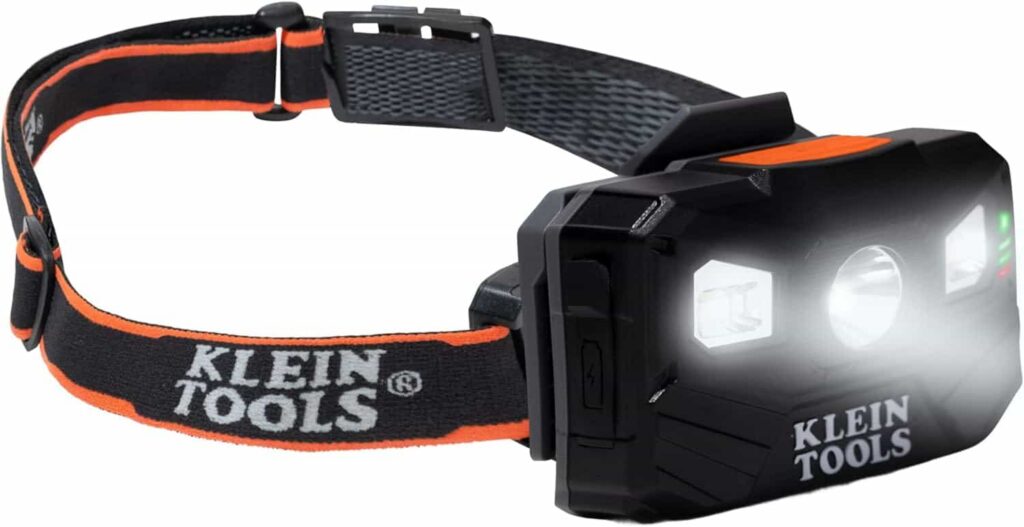
The Klein Tools 56048 is the headlamp for the person who is not buying a light for a single night, but for the kind of day where the light is on for hours and the light is doing work and the light is not allowed to be a distraction. It puts out four hundred lumens in three FL1-rated modes, and it is made of ABS that has been tested to survive a six-foot drop.
The Klein gives the user three modes. There is a boost mode at four hundred lumens that runs for four hours, a spotlight at two hundred lumens that runs for twelve, and a floodlight at one hundred lumens that runs for twenty-two hours. The headlamp pivots on a mount that gives it sixty-four degrees of mobility, so it can be angled without the user touching it, and the fabric strap has a silicone grip that holds it in place whether it is on a head or on a hard hat. A battery gauge shows the charge through multi-color LEDs, and the unit charges over USB-C.
The Daoist principle the Klein carries is the one that the Zhuangzi puts behind the idea of the useful useless thing. The worker puts the Klein on and does not think about the Klein, because the Klein has a battery gauge, a pivot, and a strap that fits a hard hat, and the Klein is the headlamp that has been made to disappear into the work. It is not the brightest. It is not the most versatile. It is the headlamp that becomes part of the hand, and the part of the hand is the part the hand does not notice.
The Standard, Applied
The standard this article has been built around is a single question: when you are walking in the dark, are you aware of the light, or are you aware of the trail?
If you are aware of the trail, the headlamp has done its job. If you are aware of the light, the headlamp has not. The question is the same question that guides the choice of every piece of equipment a hiker carries. It is the question the Daoist philosophers asked about the way of the world, and it is the same question that the mindful roaming gear system asks of every piece of equipment the hiker carries. The light that gives back the trail is the light that has done its job. The light that does not give back the trail is the light that has become work, and the light that has become work is the light that the hiker has begun to use the trail to serve. That is the wu wei of the trail: the light that moves with the hiker and does not become a task the hiker has to carry alongside the trail.
A backcountry headlamp is judged not by how many lumens it produces, but by how much of your attention it takes. Great skill looks like clumsiness, and the headlamp that does its work without drawing attention to itself is the headlamp that has done its work the way the Daoist philosophers meant it to be done. The best one takes none. The six headlamps in this article do not take the same amount, but they all take less than the alternative, and the difference between the headlamp and the torch is the difference between the hiker who is watching the trail and the hiker who is watching the light.
Frequently Asked Questions
What lumen output do I need for a backcountry headlamp? For most single-day hikes, four hundred to six hundred lumens is enough. A thousand lumens is the right amount for a ridge walk in the dark or a long evening on the trail. Above one thousand lumens is the territory of the hiker who is moving over rough ground at speed and who wants the light to keep up with them. More lumens is not always better, because a headlamp that is too bright can blind you in a tent and can drain the battery in a few hours, and the headlamp that keeps you safe on the trail is the one that is bright enough to see and long enough to last.
How long should a headlamp battery last? For a day hike, ten hours on the main mode is a good baseline. For a multi-day trip, you want a headlamp that can run for a day on a single charge without you worrying about it. The run time is always a function of which mode the light is in. A headlamp that gives twenty-two hours at one hundred lumens and four hours at four hundred lumens is giving you two different lights, and the hiker who is hiking at night and is not in a tent is the hiker who wants the longer run time.
Is rechargeable better than disposable? For a headlamp that will be used regularly, a rechargeable unit is the better choice, because the cost of batteries adds up and the weight of disposable batteries adds up, and the headlamp that is charged over USB-C and runs for ten hours on a single charge is the headlamp that the hiker stops thinking about. For a headlamp that will be used once a season and stored for the rest of the year, disposable batteries have an advantage, because a lithium battery that has not been used in six months is still a battery, and the rechargeable battery that has been left on a shelf for six months is sometimes not.
Do I need a red light? A red light is the light that the hiker needs when the other people in the tent need to sleep, and it is the light that the hiker needs when they are trying to keep their night vision for the section of trail ahead. A headlamp with a red light is a headlamp that can be used without being disruptive, and the red light that preserves night vision is the light that gives the trail back to you without taking it from you.
Is a zoomable headlamp better than a fixed beam? A zoomable headlamp gives the user a wider beam when they need to see the ground and a narrower beam when they need to see into the distance, and it is the kind of feature that the hiker who is moving between different kinds of trail needs more than the hiker who is walking on one kind of trail for the whole day. A fixed beam that is mixed, which is wide when you are close and focused when you are far, does the same thing without the user doing anything to it, and the headlamp that changes its beam automatically is the headlamp that has done the zooming for you.
Summary
The best backcountry headlamp is not the one with the most lumens, the longest run time, or the widest beam. It is the one that you stop noticing, because noticing it means it is doing something that the trail is not, and the trail is the thing you are carrying yourself for.
The headlamp that asks you to adjust it, to watch it, to think about it, is the headlamp that is doing the work of walking for you. The headlamp that points where you are walking and does not become a second job is the headlamp that has disappeared into the light it is giving. The headlamp that gives light and disappears is the headlamp that the Zhuangzi would call the useful thing: the thing that does its work and does not ask to be a second job. And the hiker who is walking in the dark and is not aware of their light is the hiker who is on the trail. That is the standard, and that is the light.