This article contains affiliate links. We earn a commission if you purchase through them, at no extra cost to you.
There is a story about a pair of shoes, and it is a short one.
I was walking a ridge in the early morning, on a section of trail that drops on either side into pine and rock. The boots I had worn for the first three miles were stiff. They were protective. They were also present. They were doing something to my feet, and my feet were doing something to me, and the conversation between them was a kind of noise I had not noticed until it stopped.
Two miles later I put on a different pair — a low shoe, light, already broken in on my feet. The noise stopped. The ground became the only thing my foot knew. I did not think about the shoe. I thought about the trail.
The difference is not a matter of protection. It is a matter of whether the shoe uses you. A hiking shoe that asks you to adjust to it, to break it in, to think about it, is a hiking shoe that has become a second job. A hiking shoe that disappears into the ground under your foot is a hiking shoe that has done its job.
That is the principle from the Dao De Jing that guides every choice in this article, and it is the principle that any pair of lightweight hiking shoes is measured against. Great skill looks like clumsiness, and the best hiking shoe is the one you forget is on your foot. The shoe gives the ground back to you. The shoe disappears. The trail is all that is left, and the trail is what you came for.
The Six Shoes at a Glance
| Shoe | Weight (per shoe) | Material | Water Rating | Rating |
|---|---|---|---|---|
| KEEN Voyageur Low Height | 13.6 oz | Water-resistant leather + mesh | Water-resistant | 4.3 / 5 |
| Merrell Moab 3 Hiking Shoe | 13.9 oz | Pigskin leather + mesh, rubber sole | Not waterproof | 4.6 / 5 |
| KEEN Targhee 3 Low | 16.0 oz | Leather + breathable mesh | Waterproof | 4.4 / 5 |
| Oboz Bridger Mid B-DRY | 19.0 oz | Nubuck leather + B-DRY membrane | Waterproof | 4.5 / 5 |
| Salomon Speedcross GTX | 12.0 oz | Anti-debris mesh, Gore-Tex | Waterproof | 4.5 / 5 |
Weight per shoe calculated from the listed item weight per pair. All other specifications are listed as they appear on Amazon. This is not a certified independent test report.
The Best Lightweight Hiking Shoes
1. KEEN Voyageur Low Height — The Shoe That Breathes
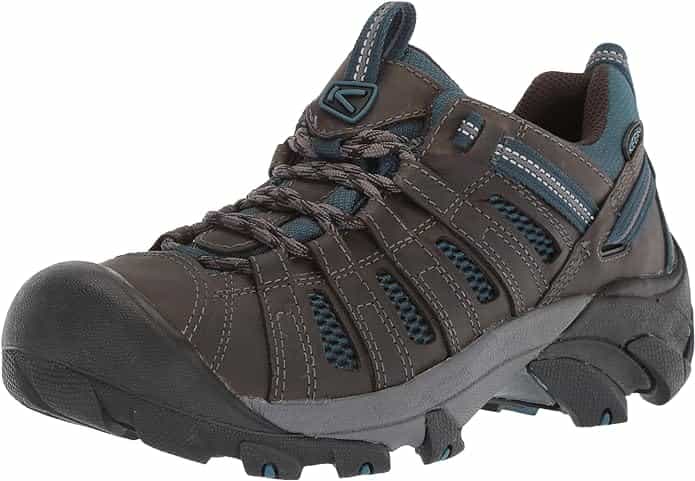
The KEEN Voyageur Low Height is the hiking shoe for the person who wants a shoe that stays cool in the sun and lets their foot remember what air feels like. It weighs thirteen and a sixth of an ounce per shoe, which is one hundred and ninety-one grams, and it is the lightest shoe in this guide. That is not a small number. A hiking shoe that weighs less than a pound per foot is a hiking shoe that you will not miss when you take it off your pack.
The upper is made of water-resistant leather and performance mesh, and the mesh is where the shoe earns its name. The breathability is not a feature listed for effect — it is the job the shoe does when the trail runs through sun and the temperature is rising. The sole is KEEN.ALL-TERRAIN rubber with four-millimeter lugs, which gives grip on dirt, root, and loose rock without the weight of a heavier compound. A stability support shank keeps things controlled on uneven ground, and the injected heel capture system holds the heel in place without needing a tight lacing job.
The Daoist principle the Voyageur carries is the one the Laozi puts behind the line about the thing that is useful because of the empty space inside it. The mesh is empty space, and the empty space is what lets the foot breathe. A shoe that gives its material to air is a shoe that has given its weight to lightness. Heel breathing on the trail is about restoring the conversation between feet and earth, and the shoe that breathes is the shoe that lets that conversation happen.
2. Merrell Moab 3 Hiking Shoe — The Shoe That Lasts
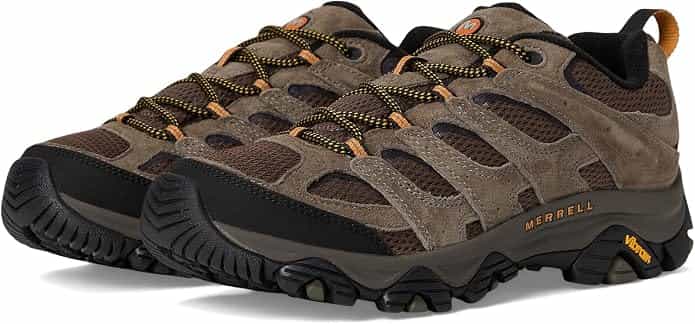
The Merrell Moab 3 Hiking Shoe is the hiking shoe for the person who does not mind a shoe that knows its weight, because weight is what you are buying when you buy a shoe that will still be on your foot after a thousand miles. The listed item weight per pair is zero point eight four kilograms, which works out to about thirteen point nine ounces per shoe, and the shoe is made of pigskin leather and mesh with a rubber sole, the same combination that has made the Moab the best-selling hiking shoe in its class for more than a decade.
The Moab 3 carries a Kinetic Fit ADVANCED removable contoured insole with reinforced heel cushioning, a bellows tongue that keeps debris out, a protective toe cap, and a molded nylon arch. The laces, the webbing, and the mesh lining are all made from one hundred percent recycled materials, and the shoe earned the number one position in Men’s Hiking Shoes on Amazon with nearly fifteen thousand reviews. The cushioning level is moderate, which is to say the shoe is comfortable without being soft, and comfortable without being heavy.
The Daoist principle the Moab carries is the one the Zhuangzi puts in the story of the ax that cuts for nineteen years and never dulls its edge. A shoe that lasts is a shoe that does not ask to be replaced, and the shoe that does not ask to be replaced is the shoe that has done its work across years rather than across seasons. This shoe is not the lightest in this guide. It is the one with the longest track record, and on the trail the shoe with the longest track record is often the shoe you stop thinking about first. For the hiker who is still deciding what a hiking boot should cost and what it should do, the beginner hiking boot guide is the right place to start.
3. KEEN Targhee 3 Low — The Shoe That Stays Dry
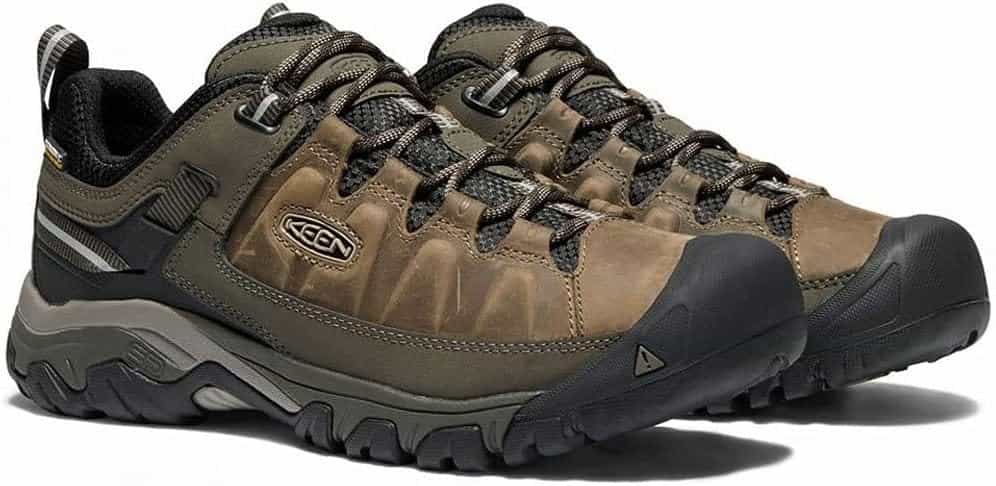
The KEEN Targhee 3 Low is the hiking shoe for the person who wants a shoe that will not fail when the trail goes through water, and who is willing to spend a little weight for that certainty. It weighs sixteen ounces per shoe, it is made of durable premium leather and breathable performance mesh, and it carries a KEEN.DRY waterproof breathable membrane that keeps external water out while letting sweat vapors escape.
The outsole is KEEN.ALL-TERRAIN rubber with strategically placed four-millimeter lugs that deliver grip on dirt, mud, rock, and everything in between. A bruise plate protects the foot on uneven surfaces, the high-abrasion rubber toe guard adds durability, and the external support shank adds balance where the ground is not flat. The removable footbed has arch support, the heel cradle adds stability, and the KEEN Original Fit gives generous space for toes to spread out. The shoe is true to size, which is a statement that matters more than it should in a category where the fit of a hiking shoe can make or break the trip.
The Daoist principle the Targhee carries is the one the Laozi puts behind the line about the highest excellence being like water. A shoe that lets water pass through and does not let it stay is a shoe that works with water the way water works — without resistance, without fighting. The shoe that stays dry without becoming heavy is the shoe that has done its job the way water does its job. The Targhee is not the lightest. It is the lightest waterproof shoe in this guide, and the waterproof shoe that weighs the least is the waterproof shoe that has done the most with the least.
4. Oboz Bridger Mid B-DRY — The Shoe That Holds
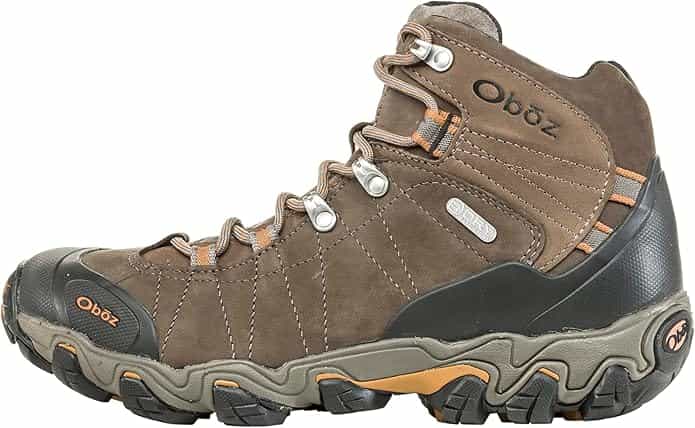
The Oboz Bridger Mid B-DRY is the hiking shoe for the person who wants ankle support without the weight of a full boot, and who is willing to trade a few ounces for the security of a mid-cut silhouette. It weighs nineteen ounces per shoe, it is made of waterproof nubuck leather with an Oboz B-DRY waterproof breathable membrane, and it has a break-in period so short it is almost nonexistent.
The shoe is built around an O-FIT insole molded to each shoe for fit and feel, and a Granite Peak midsole that carries a TPU chassis for stability and stone protection, with EVA cushioning for all-day comfort. The Trail Tread outsole blends purpose-built design with custom rubber compounds to handle diverse terrain, and the molded rubber toe cap and heel counter keep the foot protected without adding the bulk of a traditional boot. The shaft height is four and a half inches, which is mid-cut territory: enough support for uneven ground, low enough to feel like a shoe rather than a boot.
The Daoist principle the Bridger carries is the one the Laozi puts behind the line about the thing that is not soft and still prevails. A shoe that holds the ankle without binding the leg is a shoe that supports without constraining, and the shoe that supports without constraining is the shoe that has done its work the way the Laozi meant it to be done. This shoe is the heaviest in this guide, and the heaviest shoe in this guide is also the one that carries the most protection. Know what you are buying.
5. Salomon Speedcross GTX — The Shoe That Holds On
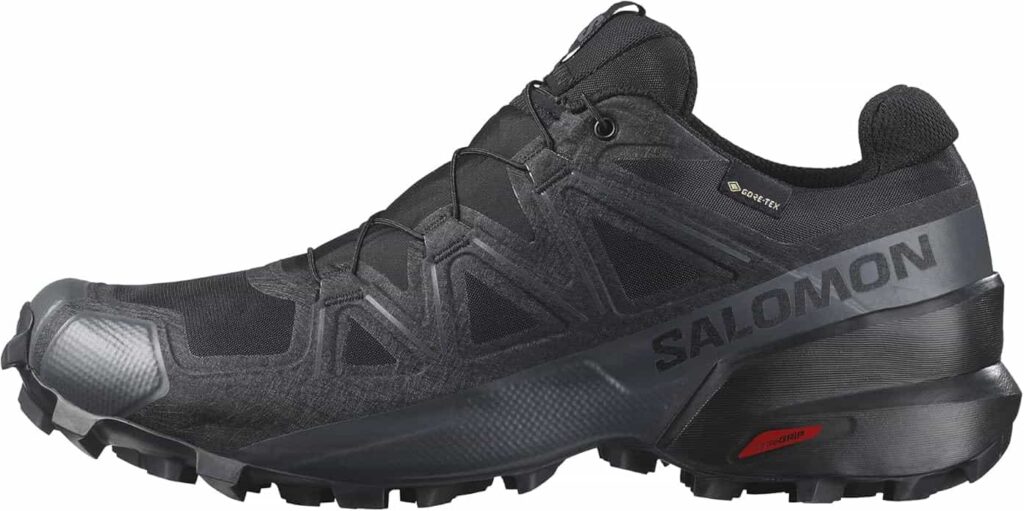
The Salomon Speedcross GTX is the hiking shoe for the person who wants a shoe that does the work of two shoes at once: a trail runner that will stay dry on a hiking trail, and a hiking shoe that will not cost an ounce to do it. It weighs about twelve ounces per shoe, which is the lightest shoe in this guide by two ounces, and it is a waterproof shoe that weighs less than half a pound per foot. It began life as a trail running shoe. The fact that it works on a hiking trail is not an accident, but it is a consequence: the shoe was built to hold the foot on fast ground, and the foot on a slow trail is still a foot.
The upper is an anti-debris mesh with a ripstop fabric that does not tear on rock or root, and the Gore-Tex membrane inside it keeps water out and lets moisture escape. The outsole is the Contagrip TA rubber, with an aggressive lug pattern that bites into mud, wet root, and soft snow, which is where most hiking shoes in this guide go soft. The Sensifit construction wraps the foot in a single cage so the shoe fits like it was poured around the foot rather than tied on it, the Quicklace system closes in one pull and tucks away so nothing flaps, and the OrthoLite foam footbed carries the cushioning. The fit is true to size, and the shoe is made for the hiker who moves fast and does not want the shoe to slow them down.
The Daoist principle the Speedcross carries is the one the Laozi puts behind the line about the thing that is not fixed and therefore does not break. A trail runner that crosses into the role of a hiking shoe is a shoe that has not declared itself one thing and is therefore available to be another. The shoe that does the work of two without demanding to be called either is the shoe that has done its work without asking for a label. For the hiker who is walking that line between running and hiking and still figuring out what wu wei looks like on the trail, the Dao of the intuitive path is the right place to start.
The Standard, Applied
The standard this article has been built around is a single question: when you are walking on the trail, are you aware of the shoe, or are you aware of the ground?
If you are aware of the ground, the shoe has done its job. If you are aware of the shoe, the shoe has not. The question is the same question that guides the choice of every piece of equipment a hiker carries, and it is the same question the Daoist philosophers asked about the way of the world. The shoe that gives back the ground is the shoe that has done its job. The shoe that does not give back the ground is the shoe that has become work, and the shoe that has become work is the shoe that the hiker has begun to walk the trail to serve.
A pair of lightweight hiking shoes is judged not by how much it weighs, but by how much of your attention it takes. Great skill looks like clumsiness, and the shoe that does its work without drawing attention to itself is the shoe that has done its work the way the Daoist philosophers meant it to be done. The best one takes none. The five shoes in this article do not take the same amount, but they all take less than the alternative, and the difference between the lightweight shoe and the boot is the difference between the hiker who is feeling the trail and the hiker who is feeling their feet — the same difference that decides which trekking poles a hiker carries and which ones they leave behind.
Frequently Asked Questions
How much should a lightweight hiking shoe weigh? For a true lightweight hiking shoe, thirteen to sixteen ounces per shoe is the right territory. Above sixteen ounces the shoe is still light for the category, but it is not the shoe you buy for the weight alone. Below thirteen ounces the shoe is entering minimalist territory, where protection and support give way to lightness, and the trade is worth making only if you know the ground you will be walking.
Should I carry a waterproof shoe or a breathable one? A waterproof shoe keeps your foot dry when the trail goes through water, but it does not breathe as well as a breathable one, and on a hot day a wet foot from sweat is almost as uncomfortable as a wet foot from rain. If you hike mostly in dry conditions, a breathable shoe is the better choice. If you hike often in wet conditions or carry a waterproof jacket and expect the trail to match it, a waterproof shoe is worth the weight.
Is a mid-cut shoe better than a low shoe? A mid-cut shoe holds the ankle and adds stability on uneven ground. A low shoe is lighter and moves more freely, and the hiker who is walking flat ground and light packs does not need ankle support. The mid-cut shoe is the shoe for the person who wants support without the weight of a full boot. The low shoe is the shoe for the person who wants weight they can forget.
Should I size up in a hiking shoe? For most shoes in this guide, the answer is no: the KEEN Voyageur is positive for fit, the KEEN Targhee is true to size, and the Merrell Moab 3 is the same famous fit it has always been. Size up only if your foot is wide or if you plan to hike in thick socks. A hiking shoe that is too loose is a hiking shoe that blisters, and a hiking shoe that blisters is a hiking shoe that has stopped doing its job.
What matters more, weight or traction? They are not opposites. A light shoe with bad traction is not light — it is just dangerous. A heavy shoe with good traction is not heavy — it is just a boot. The right answer is to buy a shoe that is light enough that you will actually walk in it, and grippy enough that you will not fall off the trail when you do.
How long should a hiking shoe last? For a shoe like the Merrell Moab 3, the answer is measured in years rather than seasons. For a lighter shoe like the KEEN Voyageur, the answer is still years, but the sole may wear faster under heavy use. A shoe that lasts is a shoe that does not ask to be replaced, and the shoe that does not ask to be replaced is the shoe that has earned the most of your pack.
Summary
The best lightweight hiking shoes are not the ones with the most features, the stiffest support, or the lowest price. They are the ones that you stop noticing, because noticing them means they are doing something that the trail is not, and the trail is the thing you are carrying yourself for.
The shoe that asks you to adjust to it, to break it in, to think about it, is the shoe that is doing the work of walking for you. The shoe that points your foot where the ground is and does not become a second job is the shoe that has disappeared into the step it is making. The shoe that gives the ground back to you is the shoe that the Laozi would call the useful thing: the thing that does its work because of what it holds, not because of what it is. And the hiker who is walking on the trail and is not aware of their shoe is the hiker who is on the trail. That is the standard, and that is the shoe.